
In a quiet basement in southern England, a cardboard box containing the skeleton of a young woman remained undisturbed for decades. She lived in Roman times.
There was no name or record of her burial – only a scribbled note saying that she was discovered somewhere near the chalk cliffs of Beachy Head sometime in the 1950s. For several years, that was all that was known.

The skeleton came back into focus in 2012, raising more questions than answers. Preliminary tests suggested that this woman may not have been from around there at all.
Some scientists believed she may have had some recent ancestry from sub-Saharan Africa. Others have more recently proposed the Mediterranean.
Both theories have massive implications for who lived in Britain during the Roman period. But none of it seemed quite right. New DNA research has now shifted that story in a surprising way.
The mystery of Beachy Head Woman
Roman Britain was not a closed-off place. Soldiers, traders, craftspeople, and families moved across the empire. Written records and archaeology show people traveling between Britain, Europe, and north Africa.
So when early studies suggested that the Beachy Head Woman may have had African ancestry, it caught public attention. She became a symbol of long-distance movement and diversity in ancient Britain.
But the science behind those early claims was shaky. The DNA was badly preserved. The samples were thin. The conclusions rested on limited data. As technology improved, researchers knew it was worth another look.
More than a decade after the skeleton was rediscovered, scientists returned to it with new methods. This time, the DNA told a clearer story.
“By using state-of-the-art DNA techniques and newly published genomes, we were able to determine the ancestry of the Beachy Head Woman with much greater precision than before,” said Dr. William Marsh, one of the scientists who analyzed the DNA.
“We show she carries genetic ancestry that is most similar to other individuals from the local population of Roman-era Britain.”
According to Dr. Selina Brace, the study’s senior author, it is up to scientists to keep pushing for answers as technology advances.
“Thanks to the advancement of technology that has occurred in the past decade since Beachy Head Woman first came to light, we are excited to report these new comprehensive data and share more about this individual and her life,” said Dr. Brace.
The new analysis shows no sign of recent African or Mediterranean ancestry. Instead, her DNA most closely matches rural communities from Roman-era Britain.
The simplest answer now seems to be the right one. The Beachy Head Woman was likely local.
Life and death near the Roman coast
The cliffs at Beachy Head tower above a coastline that was active during Roman times. There were villas, forts, and farming settlements. A fort stood at Pevensey. A villa lay near Eastbourne.
Smaller communities spread across the downs. The landscape was shaped by trade, military movement, and daily life tied to the empire.
The woman herself lived sometime between 129 and 311 AD. She was young, likely between 18 and 25 years old. She stood just over 5 feet tall.
Her bones show a healed leg injury, evidence of a serious wound she survived earlier in life. Chemical traces in her skeleton suggest she ate seafood often, which fits life near the coast.
Her exact burial site is still unknown. That missing detail keeps her story incomplete. But the physical clues give a sense of an ordinary life lived in a connected, working landscape.
From fragments to a face
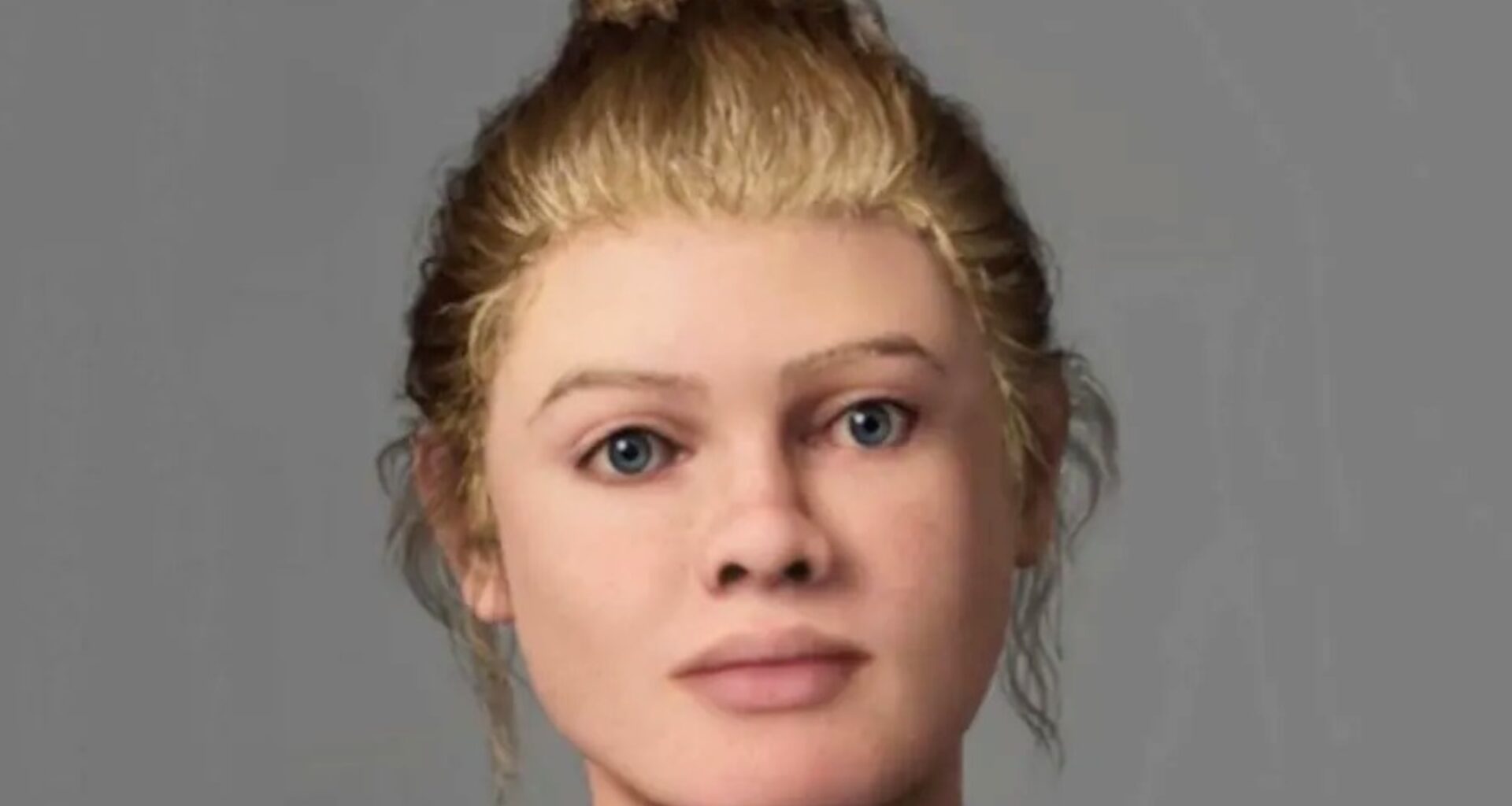
The improved DNA did more than settle the question of ancestry. It also allowed scientists to update her facial reconstruction.
Based on genetic markers, researchers predicted she likely had light skin, blue eyes, and fair hair. These details replaced earlier assumptions and reshaped how the public sees her.
This kind of work shows how fragile historical conclusions can be. A few bits of damaged DNA once sent her story in one direction. Better data later pulled it back. The bones never changed, but the tools did.
Why this woman still matters
The Beachy Head Woman is no longer evidence of a far-off birthplace. Instead, she represents something quieter but just as important.
She shows how easy it is to project modern expectations onto the past. She also shows how careful science can correct itself.
Roman Britain was diverse. People did move across long distances. That remains true. But not every surprising story turns out to be extraordinary. Sometimes, a young woman found near where she lived really was from there all along.
Thanks to advances in DNA research, her story is now clearer, even if parts remain unknown.
The Beachy Head Woman is no longer a mystery shaped by guesswork. She is a local woman from Roman Britain, brought back into focus by better evidence and a willingness to reexamine the past.
The full study was published in the journal Journal of Archaeological Science.
Image Credit: Credit: Face Lab at Liverpool John Moores University
—–
Like what you read? Subscribe to our newsletter for engaging articles, exclusive content, and the latest updates.
Check us out on EarthSnap, a free app brought to you by Eric Ralls and Earth.com.
—–