
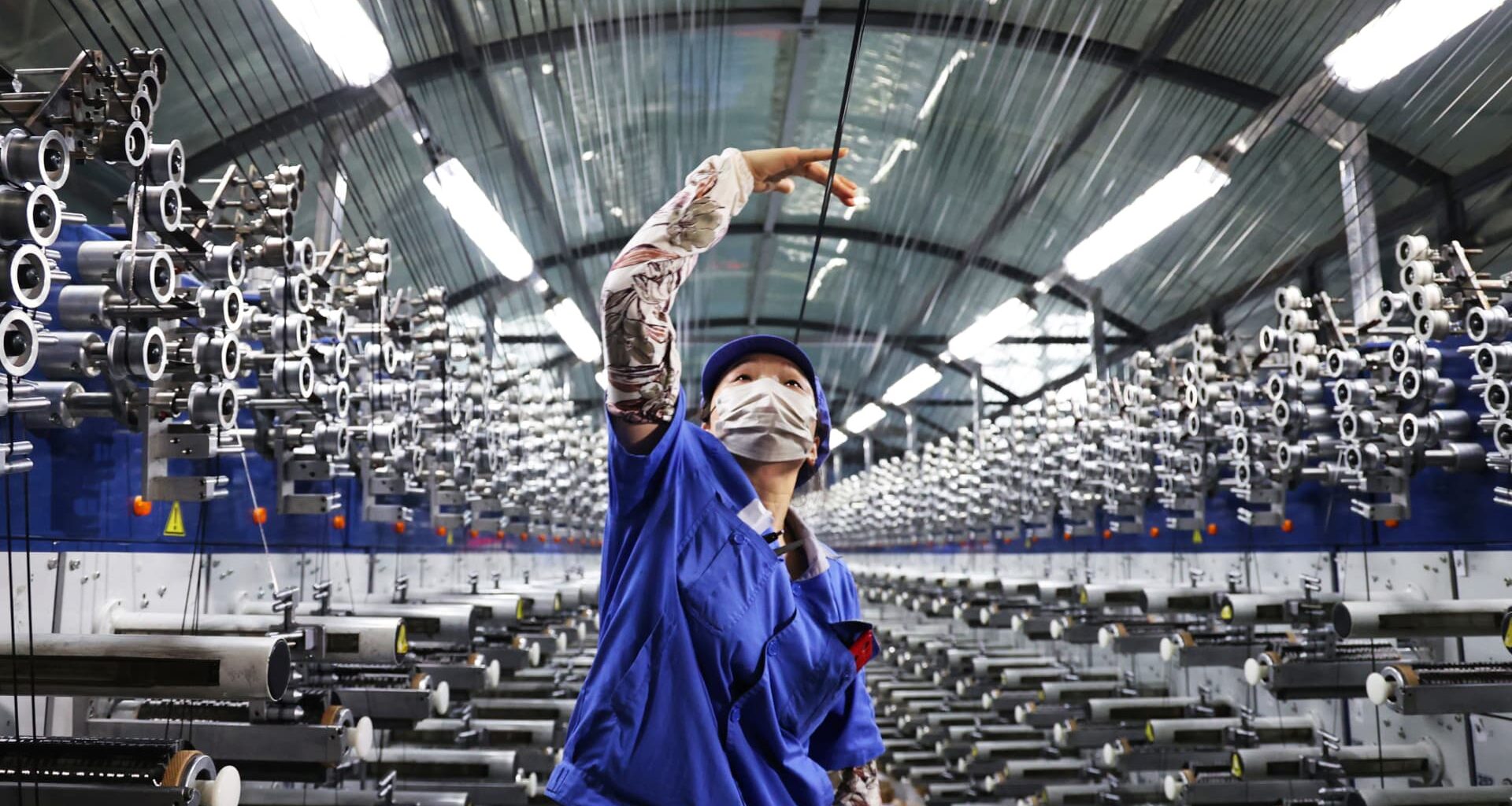
An employee works on a carbon fiber production line at Zhongfu Shenying in Lianyungang, China’s eastern Jiangsu province on July 31, 2025.
Str | Afp | Getty Images
China’s factory activity gathered speed in January, according to a private survey released Monday, as manufacturers accelerated production and front-loaded shipments ahead of the extended Lunar New Year holiday.
The seasonally-adjusted RatingDog China General Manufacturing PMI, compiled by S&P Global, rose to 50.3 in January from 50.1 the previous month, in line with analysts’ expectations of 50.3 in a Reuters poll. A reading above the 50 benchmark indicates an expansion, while one below that suggests contraction.
That marked the strongest level since October, when the private survey came in at 50.6.
Production accelerated last month as new orders picked up both at home and abroad, prompting firms to hire additional staff to cope with rising workloads and clear outstanding orders.
Total new orders expanded for the eighth straight month while new export orders rebounded, primarily buoyed by increased demand from overseas buyers, particularly Southeast Asia.
Business confidence, however, slipped to a nine-month low, as firms worried about rising costs, the private survey showed. Corporate expenses expanded at the fastest rate in four months, pushing factory-gate prices up for the first time since November 2024.
Metal prices, in particular, surged during the latest survey period, sending input cost inflation to its highest level since last September, the survey showed.
“Looking ahead, if cost pressures persist while demand recovery is limited, profit margins will remain under pressure,” said Yao Yu, founder of credit research firm RatingDog.
Subdued confidence among Chinese manufacturers could further hurt demand in the upcoming months, said Jingyi Pan, an associate director at S&P Global Market Intelligence, noting that the rise in geopolitical instability at the start of this year may have prompted firms to front-load their production.
The reading was better than an official survey released on Saturday, which showed manufacturing activity unexpectedly contracted in January, coming in at 49.3, compared with 50.1 in the previous month, according to the National Bureau of Statistics.
The RatingDog private survey, which samples a smaller group of export-oriented manufacturers, has typically painted a brighter picture than the official polls that cover a broader range of firms.
National Bureau of Statistics officials attributed the slump to a seasonal slowdown and softer global demand. Local media reported that some factories halted production last month to allow their workers to return home ahead of the upcoming Lunar New Year.
This year’s Lunar New Year holiday has been extended to nine days for the first time, stretching from Feb. 15 to Feb. 23, as Beijing aims to boost domestic spending on travel, tourism, dine-out services and leisure activities during the holiday.
The two PMI readings also provided an early glimpse of how the world’s second-largest economy fared at the start of this year. China’s economy hit the government’s 5% growth target last year, underpinned by strong exports as manufacturers ramped up shipments to non-U.S. markets amid higher U.S. tariffs.
Economists, however, have warned of persistent deflationary pressures, with retail sales weakening to the slowest pace in three years. Fixed-asset investment also recorded its first annual decline in decades, contracting 3.8% last year, as a deepening property slump and local governments’ fiscal constraints curbed investment.
Growth momentum in the economy is expected to remain weak in January, Jing Wang, China economist at Nomura, said in a note, citing payback effects from Beijing’s consumer goods trade-in program last year and the persistent property distress.
Chinese officials launched a package of measures last month aimed at lowering financing costs for households and corporates and boosting credit borrowing demand.
But “these measures are far from enough to stabilize growth,” said Wang, adding that Beijing will have to “do much more in coming months to deliver an annual GDP growth rate above 4.5% in 2026.”
The Chinese government is expected to announce its official growth target for 2026 at the annual parliamentary session in March.

Weekly analysis and insights from Asia’s largest economy in your inbox
Subscribe now