
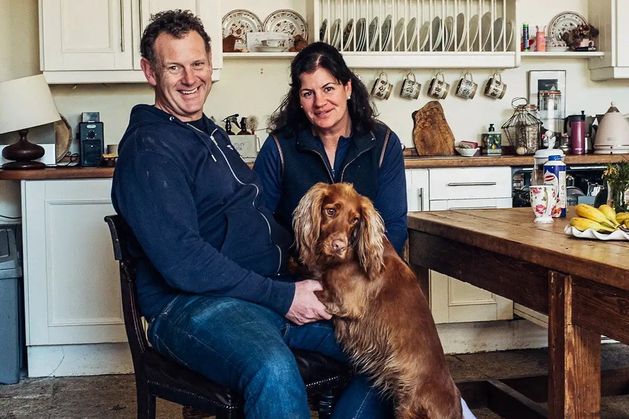
Across more than two centuries, Munny House in Coolkenno has evolved from a Georgian demesne and a cutting-edge model farm to a post-war refuge, and now, to an enterprise known as Munny Farm – an organic sheep farm and glamping business that remains faithful to the property’s past.
Built in the 1780s, Munny House was originally owned by Abraham Nickson and formed part of the Coollattin Estate. It later operated as a model farm with two water wheels, which was visited by English Prime Minister William Gladstone.
That rich agricultural heritage was reshaped in the 1940s by German lawyer Peter Bielenberg and his English wife Christabel, who had been active opponents of Nazism from the early years of Hitler’s rise to power.
Peter was arrested, interrogated and imprisoned in Ravensbrück prison camp after the July 1944 coup against Hitler, while Christabel later chronicled her wartime experiences in the best-selling books The Past is Myself and The Road Ahead, memoirs adapted into a BBC television drama series starring Elizabeth Hurley as Christabel.
Peter ultimately survived the war, and the couple left Germany with their children, purchasing Munny Farm in 1948 for £4,000.
Using a book as his guide, Peter restarted the farm, later passing it to his eldest son, Nicholas. The sheep side of the farm is now run by Peter’s granddaughter, Belinda, and her husband, Lorcan Carpenter.
“My grandfather had been a lawyer in Germany, and when he and my grandmother came to Ireland, he bought a book called Teach Yourself Farming, following it to the letter,” Belinda recalled.
“We’d always come down for the summer holidays when I was a child. I followed my grandfather around, filling buckets and helping him, as he was constantly in the sheep sheds.
“I have great memories of both of them. My grandmother was an amazing storyteller, and I’m so proud of what she achieved.
“Those memories create the essence of the love of the place, and it’s our drive to keep it going to the next generation because of the amount of work they and my parents put into it.
“All three generations have worked hard at making it a happy place to live, and we just want to see that continue for our three kids. That’s the dream.”
After relocating from Dublin, where they worked in recruitment, to the family farm, Belinda and Lorcan launched a quaint glamping venture, The Old Forge Glamping, along with a horse-riding trail, the Munny Trail, with Belinda handing in her resignation while Lorcan maintained his job.
“It wasn’t long before we took the plunge with the glamping and set up three bell tents on a small site,” Belinda said.
“There was a great demand from people with horses for our riding trail, the Munny Trail, and people were coming from as far as Galway.
“The interest in glamping just progressed from there, and we realised that yurts had more longevity for the Irish climate, so we invested in some, and it evolved into five units, sleeping 20 people on-site.”
Driven by a desire to preserve the farm’s original features and a need for space after the birth of their three children, Belinda and Lorcan undertook an extensive series of conservation works, transforming long-disused outbuildings into cosy self-catering lodgings, one of which later featured on RTÉ’s Great House Revival.
After Belinda’s mother passed away, the family moved into the main house to care for Nicholas and opened the two self-catering houses in the yard for holiday lets, increasing the farm’s capacity to 40 guests.
“The barns in the yard weren’t in use because my grandfather had built commercial sheep sheds across the road, which were more practical for lambing,” Belinda explained.
“With my father’s approval, we converted one of the Georgian farm sheds into the camping kitchen, where campers can cook and store their food.
“We then mucked out a few sheds that were full of sheep buckets and farm waste. We thought it could be really nice for accommodation for ourselves, as we were expecting my first daughter.
“Soon after we finished that, we got pregnant with the twins, and that’s when we built the second barn, because we needed more space, and that was featured on the Great House Revival,” she continued.
“Hugh Wallace, the presenter, was a great character with a wicked sense of humour. He was a complete pleasure to work with, as was Ross Whitaker, who did the Katie Taylor Netflix documentary.”
Belinda said that the ongoing preservation of the farm’s rich heritage has undoubtedly added to the appeal for guests.
“It’s such a unique thing to have all these buildings, the old dungstead, the haggard, the stables, the buttery, the binder house, and it was always mine and Lorcan’s dream to preserve them,” she said.
“All that heritage adds to the uniqueness here, and to the experience for our guests, who can see how these places would have operated 100 years ago.”
Also at the heart of the glamping venture’s appeal, Belinda said, is the atmosphere and authenticity of the working farm, which is currently in conversion to organic status, with certification due next January.
“When my dad hung up his wellies, 15 ewes were looking through the gate about to go to the factory, and I said, because my grandfather had bred them, we couldn’t let them go,” Belinda reflected.
“We added those to some more bought at Tullow Mart, where Eric Driver was really great and advised us on what to get. Now, we’re up to a flock size of 64 organic ewes.
“Organic opens up gateways for us to sell the meat. My mother sold the meat direct and we would love to continue in the same vein, except with the organic certification.
“The feedback from guests is that they really enjoy that it’s a working farm and the family feel,” she continued.
“We have twins, who just turned eight, and our eldest daughter, who just turned 10. As a result, there’s a dynamic where our kids are running around with guests’ kids, playing with the train sets in the playroom or in the sand area, etc.
“The place definitely lends itself to family reunions of all generations, as there is glamping and self-catering.”
Noting how rural businesses depend on one another, Belinda said she loves nothing more than seeing guests explore the stunning surroundings and unearth hidden gems in neighbouring towns and villages.
“Everybody feeds off each other down here, as it’s a quiet rural area,” she said.
“It really works well because our guests enjoy visiting the Crab Lane and Dying Cow pubs, Olde Shillelagh Stick Makers, walking the Wicklow Way, hiking in the area, and exploring Huntington Castle, Rathwood, the Chocolate Garden of Ireland, and the butcher shops in Tullow.
“This part of the county is very unspoiled and undiscovered in many ways, but we have so many hidden gems.
“We really appreciate where we live and the people of Coolkenno, who are so lucky to have the likes of Coolkenno GAA and Crab Lane in such proximity,” she added.
“We’re lucky to have had a multi-generational background here, so we know our neighbours. We feel so at home, and that’s lovely for our children to grow up with.”
Looking ahead to a busy 2026, Belinda outlined plans to establish new woodland trails, a sauna and camps for equine enthusiasts, with ambitions to woo corporate guests by offering an authentic slice of rural life.
“We have a mature native wood here with beech, oak and sweet chestnut trees, so we want to open up more walkways for our guests. There’s going to be a good bit of work involved – but we’re not afraid of that,” Belinda joked.
“We also want to introduce adult bring your own horse-riding camps, incorporating our new arena, and integrate a hydrotherapy sauna experience into the glamping.
“Another big thing is the corporate offerings, as we see huge potential there with Dublin companies that have international employees.
“This part of Wicklow can offer them the real essence of a rural community. If you go down to the local pub, you’ll meet all the characters, you’ll feel the vibe and the music and get a sense of community that is so unique and special.”