
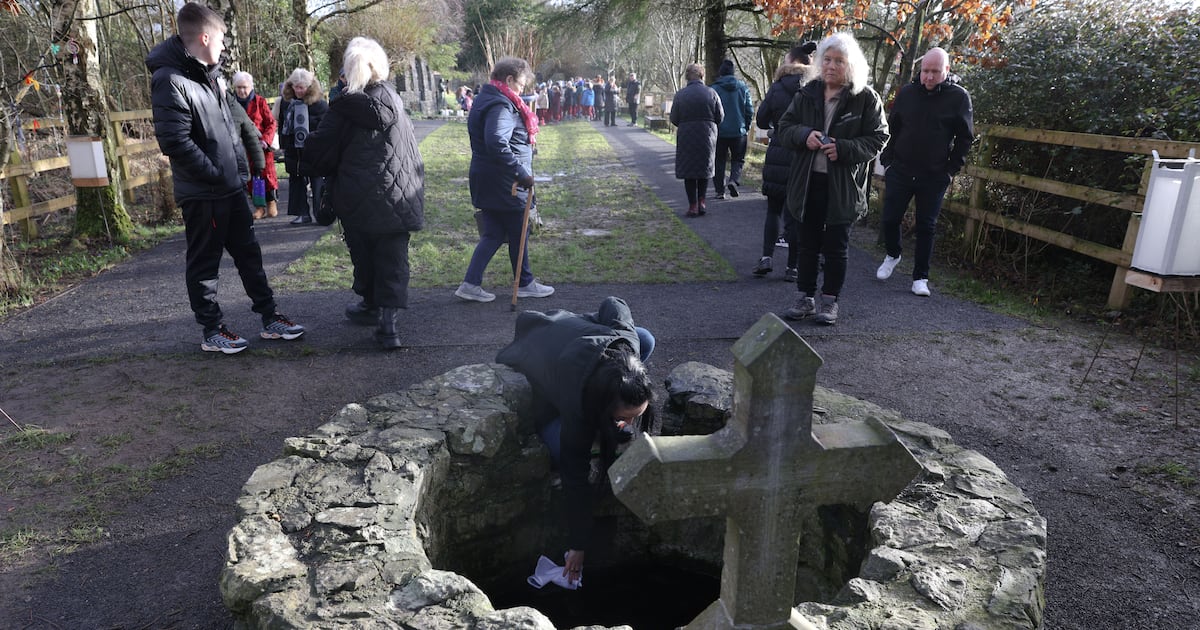
Today, across the island, we mark a very significant feast day, St Brigid’s Day, co-patron of Ireland. Our saint’s day, February 1st, also heralds the start of our culture’s traditional springtime, when “creation was begun”, and we get to enjoy longer days, while our skies, rivers and lakes teem with new life and new flora and fauna inhabit every garden, park, street, road and field.
Legend records that Brigid was born in a doorway, on a threshold. Maybe she stands at the meeting of two worlds. Author and religious sister Rita Minehan wonders if “the boundaries of Christianity nor the older beliefs can contain her exclusively”.
The image of a doorway speaks to us in the Ireland of today, a home place we once self-styled with the slogan one hundred thousand welcomes – ceád míle failte.
Sadly, in recent times, this is not true for some fleeing persecution, war or trauma. The disturbing scenes that we have witnessed in the media are the opposite to the hospitality espoused by Brigid. As the monk and scholar Cogitosus reminds us, with Brigid, “every guest is Christ”.
Every guest also takes their rightful place as part of God’s universal creation, the theme of a full-to-capacity conference organised by Ireland’s Christian denominations on January 17th, themed, Let Justice Flow Like Rivers. Hosted by the Irish Council of Churches, the Irish Inter-Church Meeting and the Church Leader’s Group, our gathering sought a faith response to the growing pollution in our island’s waterways, especially Lough Neagh, and the wider climate crisis.
It was a productive example of the Churches intentionally working in solidarity, to care for creation and act responsibly on behalf of this and future generations.
At times, Christians here have been pulled towards a quicksand theology that narrows its vision towards individual eternal security and settles for quick, neat solutions. The paradox of globalisation is that in a hyper-connected world, increased individualisation drives choice.
Yet, over the past decade, it is possible to chart a steady, modestly growing group of Christians from across a wide spectrum of Churches, choosing a faith that determines to gaze at brokenness, hold the complexity of competing global forces whilst patiently labouring towards transformation.
Creativity, and the act of creating, is gratuitous. Christians believe God did not need to create the world and yet did so out of nothing. Yet, rather than place creation as a superfluous, unnecessary sidebar, God welcomes and delights in what has been made. The Christian focal point for this is in the post resurrection appearance of Jesus coming back as a wounded human being, when he could have returned in another form.
In the West, even within Churches, there is a tendency to disown our grief and discard what is broken. This makes faith gnostic and disembodied, rather than somatic and healing. Frederick Beuchner, instead, brings the challenge to be good stewards of our pain: to own our pain in redemptive ways. Over the past decade, Churches in Ireland have taken steps to be better stewards of what is painful and broken.
Jane Mellett, Church Outreach Manager of Trócaire, describes how in 2018, the Catholic Bishops’ Conference divested its shared assets from the fossil fuel industry. In addition, 12 individual dioceses and many religious congregations made a similar commitment. With a parallel but separate move, the Church of Ireland also participated in the divestment from fossil fuels.
The global Laudato Si’ Movement was initiated to encourage the Catholic community to “care for our common home and achieve climate and ecological justice”.
Now that the 2015 bestselling encyclical letter by Pope Francis, Laudato Si’ On Care for Our Common Home has celebrated its 10 years, we can note some significant milestones in Ireland, such as the training of more than 900 people at grassroots level as active agents of change in their parishes, and the 2023 commitment by the Bishops’ Conference to return 30 per cent of church grounds back to nature by 2030.
This Return to Nature initiative is exemplified by the encouraging co-operation between the Bishops’ Conference and the Heritage Council Biodiversity Officers, specifically between Killaloe and Kilmore Dioceses, and the counties Clare and Leitrim Biodiversity Officers, respectively.
The stronger integration of worship and action is also witnessed by the growing number of parish communities embracing the Season of Creation, which runs annually from September 1st until October 4th, the feast of St Francis of Assisi, the patron of the environment and ecology. In an audit in 2024, 56 per cent of Dublin diocesan parishes marked this period in support of creation.
Jim Farrell, chairperson of Eco-Congregations Ireland, notes that in the 118 faith communities registered as eco-congregations and eco-parishes, there is a cross-pollination of activities including installing solar panels, running climate chats on how to make their gardens more pollinator friendly, planting pocket forests on church grounds.
In September 2025, more than 200 Presbyterians gathered from 72 different congregations for the conference God’s world, our responsibility? Neil Harrison, Mission Development Officer for PCI, noticed the “growing number of congregations that are proactive in engaging with creation in a variety of ways including Bible teaching, encouraging sustainable decision making, reducing carbon outputs and improving local biodiversity and advocacy”.
Fittingly, in 2024, during its Season of Creation, Pope Francis, the Orthodox Ecumenical Patriarch Bartholomew and the Anglican Archbishop of Canterbury issued this joint statement: “future generations will never forgive us if we miss the opportunity to protect our common home. We have inherited a garden; we must not leave a desert for our children.”
Our prayer is that we may see glimpses of the flourishing garden in our time.
Rev Dr Karen Campbell is General Secretary of the Irish Council of Churches