
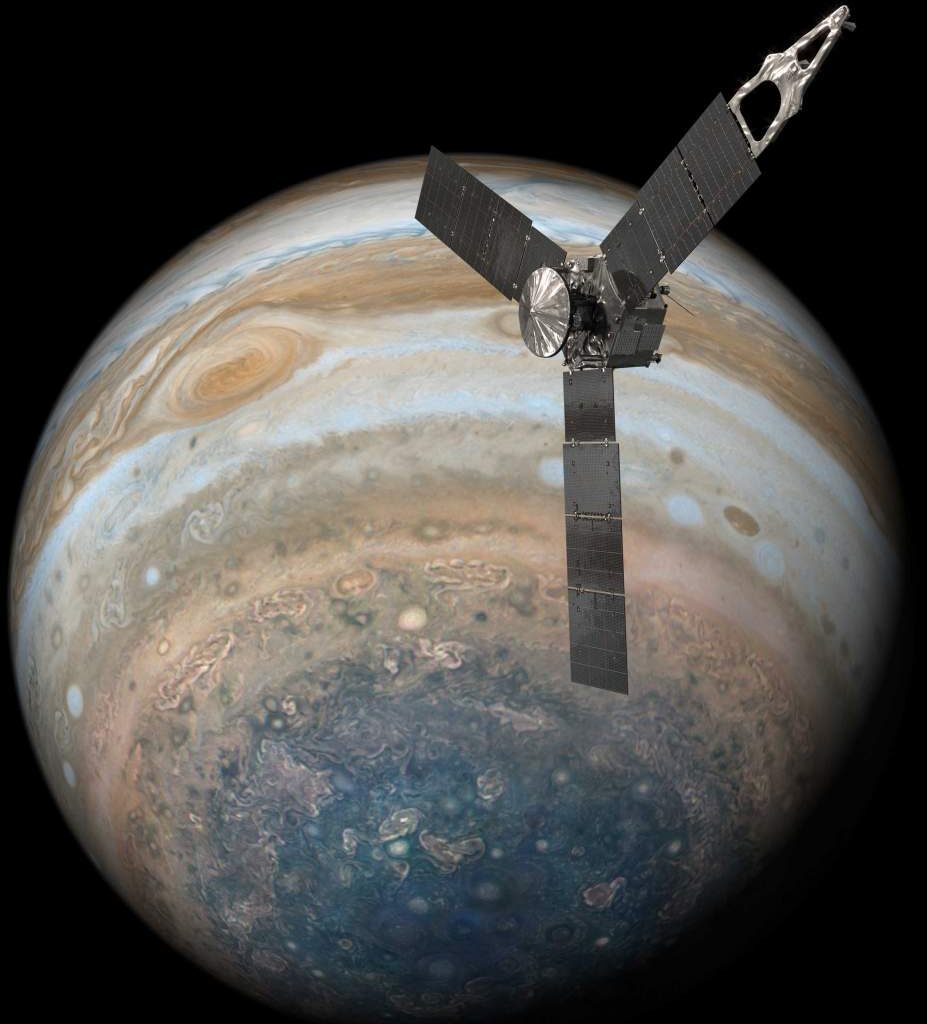
Jupiter, the largest planet in the solar system, is slightly smaller and flatter than scientists had believed for the past 50 years, according to a breakthrough discovery by Israeli researchers.
Leading an international team from Italy, the United States, France and Switzerland, Weizmann Institute of Science researchers have produced more precise measurements of Jupiter’s size and shape than ever before, using new data from NASA’s Juno spacecraft.
The peer-reviewed research, published today in Nature Astronomy, shows that the radius of Jupiter is about four kilometers (2.5 miles) thinner at its equator and 12 kilometers (7.5 miles) flatter at the poles than believed in earlier assessments.
The scientists determined the planet has a radius of 71,484 kilometers (44,418 miles). Earlier data measured it at 71,492 kilometers (44,423 miles). The fifth planet from the sun, Jupiter is large enough to hold more than 1,300 Earths.
“We have now, for the first time, an accurate measurement of the size of Jupiter,” said Prof. Yohai Kaspi of Weizmann’s Earth and Planetary Sciences Department, speaking to The Times of Israel. “It’s a big deal in the sense that we never really knew the radius of this planet. We always had estimates. And now we have something more accurate, which has helped us solve a lot of things that were mysterious to us.”
Get The Times of Israel’s Daily Edition
by email and never miss our top stories
By signing up, you agree to the terms
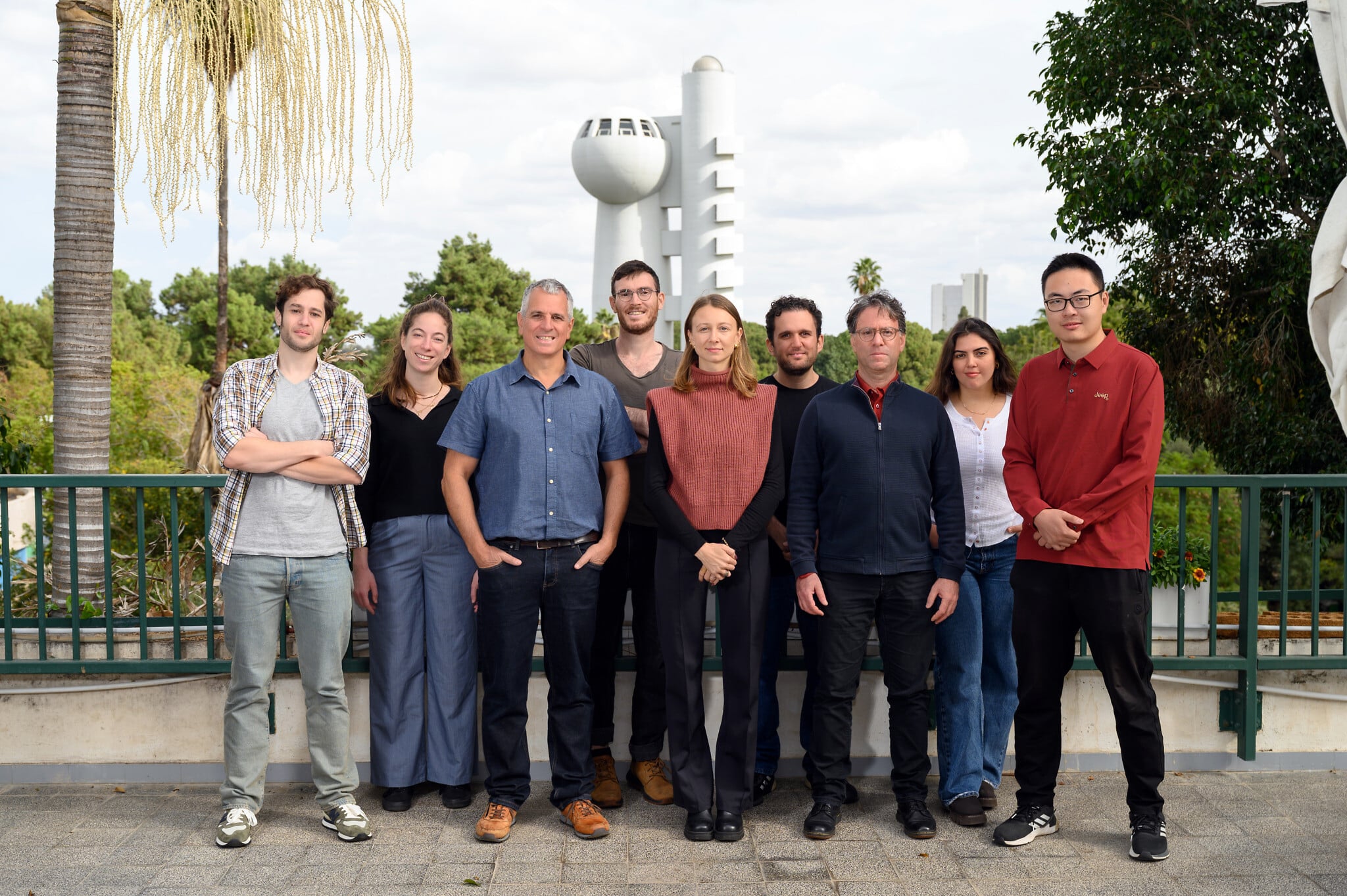
From left to right, Dr. Gidi Yoffe, Zohar Tal, Prof. Yohai Kaspi, Dr. Or Hadas, Dr. Maria Smirnova, Maayan Ziv, Dr. Eli Galanti, Rachel Navon, and Wuqiushi Yao of Weizmann Institute of Science’s Earth and Planetary Sciences Department. (Courtesy/Weizmann Institute of Science)
Jupiter: mostly gases with 95 moons
Jupiter contains mostly hydrogen and helium. The massive giant was “likely the first planet to form in the solar system,” Kaspi said.
“We know that because it’s the biggest,” he said. “There’s no way that a small planet would form before such a big planet.”
Kaspi said that the study of Jupiter’s interior structure and its density provides scientists with evidence for how that formation took place.
“We had the sun, we had an explosion, then we had Jupiter, then Saturn, and then the rest of the planets,” Kaspi said.
Scientists are still unclear if the planet has a central core of solid material. Circling it are 95 moons, rings, and asteroids.
The giant planet also has the shortest day in the Solar System. It takes Earth 24 hours to spin around. Jupiter’s rotation lasts less than 10 hours.
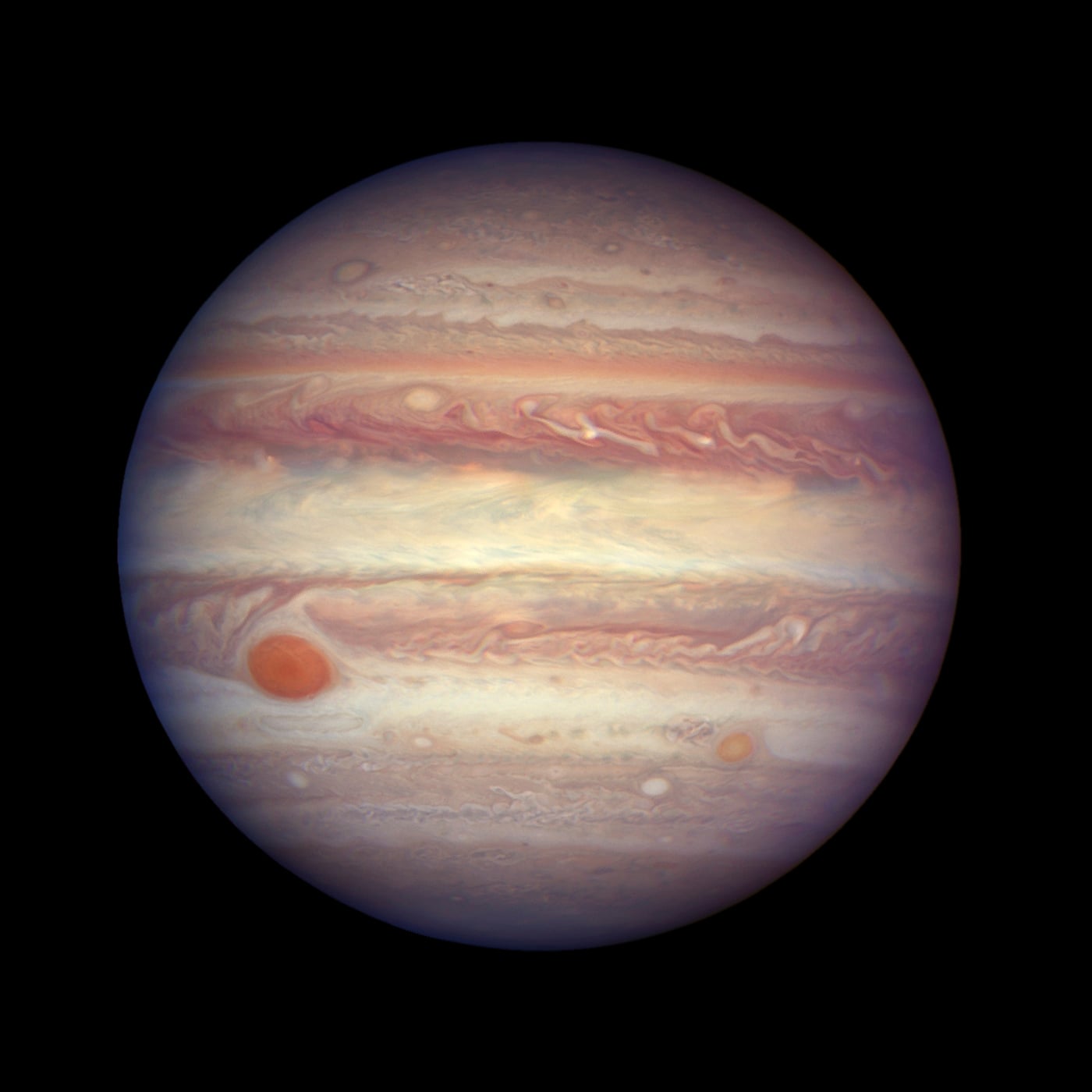
This April 3, 2017, image made available by NASA shows the planet Jupiter. (NASA, ESA, and A. Simon (GSFC) via AP, File)
Until now, estimates of Jupiter’s shape were derived from six measurements that researchers made using NASA’s Voyager and Pioneer missions 50 years ago. These missions sent radio beams from the spacecraft to Earth, providing a foundation of knowledge about Jupiter.
Then, NASA launched Juno in 2011. After more than 2.8 billion kilometers (1.74 billion miles) and almost five years, it reached Jupiter and began orbiting the giant and sending back streams of raw data.
The spacecraft is the first to probe beneath Jupiter’s dense, forbidding clouds. According to NASA, Juno is “looking to answer questions about the origin and evolution of Jupiter, our solar system, and giant planets across the cosmos.”
In 2021, NASA extended Juno’s mission so the spacecraft could keep studying Jupiter and its moons more closely. Its new, expanded path placed the spacecraft in an orbit that allowed it to pass behind Jupiter from Earth’s point of view, something its earlier orbit never did.
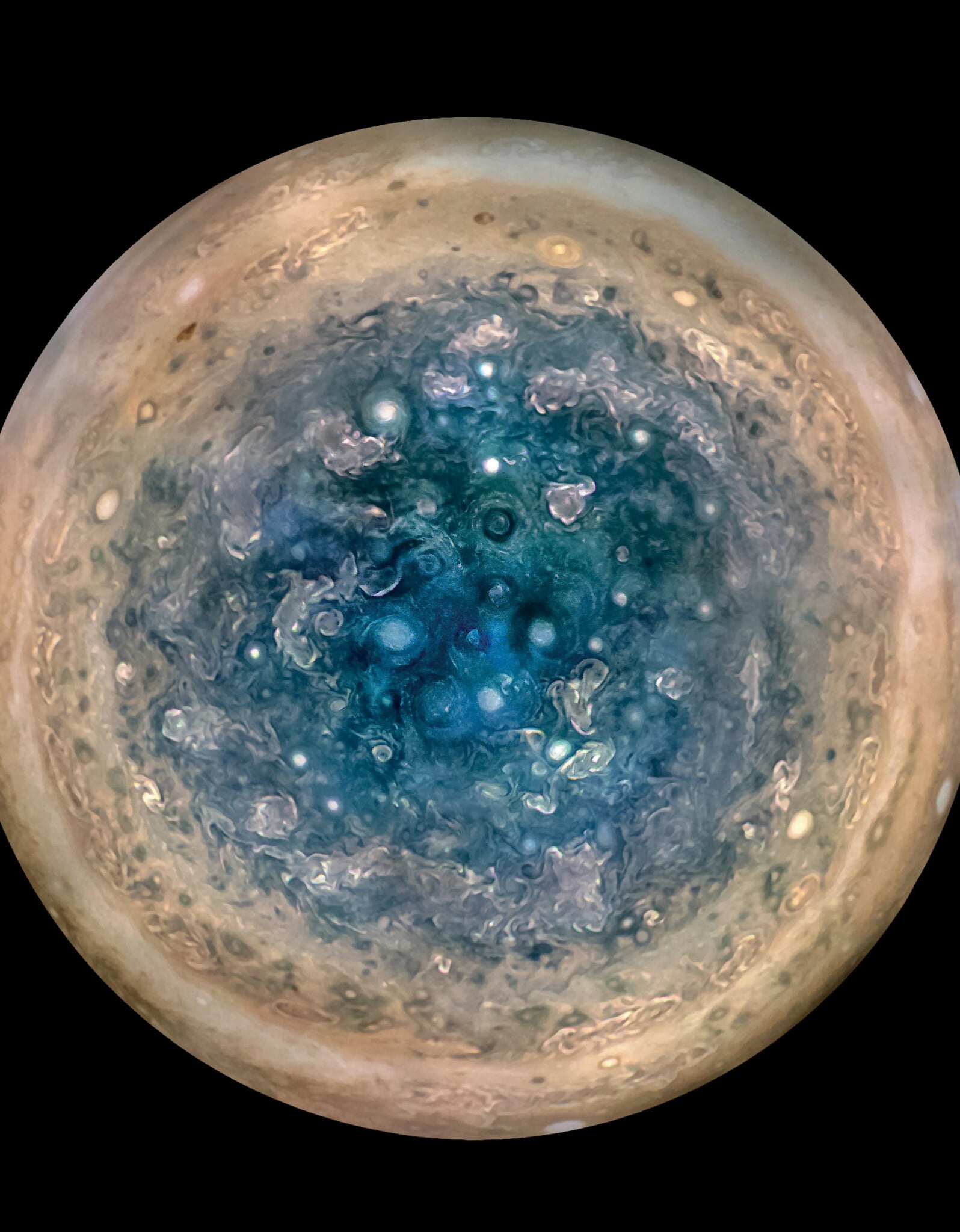
Jupiter’s south pole as seen by NASA’s Juno spacecraft at a close pass. (Courtesy/ NASA)
When the spacecraft passed behind the planet, its radio communication signal was blocked and bent by Jupiter’s atmosphere.
Maria Smirnova, a PhD student in Kaspi’s group at Weizmann, developed a special technique to process Juno’s new data via the radio beam sent to Earth.
“When the radio beam goes through the atmosphere of the planet, it bends a little bit,” Kaspi described. “We measure this bending. The more it bends, the denser the atmosphere is.”
Since the scientists “know exactly where Jupiter is, and we know where Earth is, and we know where the spacecraft is, then we can say what the density is at a certain distance from the center of the planet, and by that, we can set up the radius and the shape of the planet,” Kaspi said.
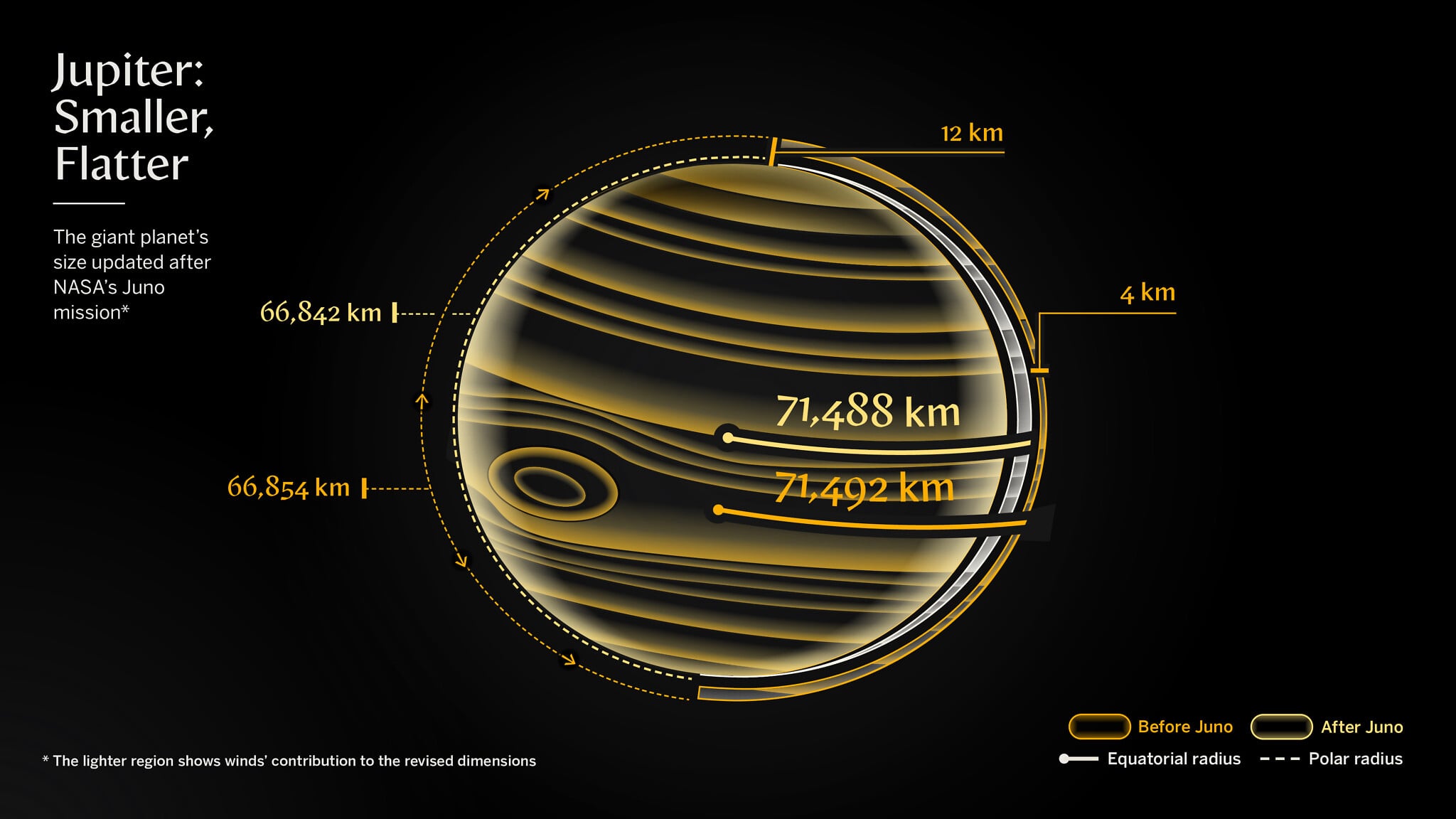
Jupiter’s profile updates after Weizmann Institute of Science researchers found a ‘slimmer, flatter’ planet. (Courtesy/Weizmann Institute of Science)
Jovian winds and storms
Kaspi noted that NASA’s earlier measurements also didn’t account for Jupiter’s powerful winds, some reaching 539 kilometers per hour (335 miles per hour).
Moreover, it is difficult to see what’s happening beneath the planet’s clouds.
“The radio data give us a window into the depth of Jupiter’s zonal winds and powerful hurricanes,” he said.
Kaspi’s previous work on Jupiter’s polar cyclones, with Dr. Nimrod Gavriel, a graduate of his group, provided critical insights to NASA for Juno’s extended mission. The research was published in the peer-reviewed journal PNAS.
Further understanding of Jupiter’s winds will enable scientists to explain the relation between the planet’s atmosphere and its deep interior.
“We’re studying the winds, the storms, the magnetic field, and various aspects of the planet,” he said. “By studying what’s happening inside Jupiter, we get closer to understanding how the solar system, and planets like ours, came to be.”
“When you look at the sky at night, you see Jupiter, which is the biggest planet, and the brightest star,” Kaspi said. “Until now, we knew roughly the size of that planet, and now we know exactly.”
You appreciate our journalism

You clearly find our careful reporting valuable, in a time when facts are often distorted and news coverage often lacks context.
Your support is essential to continue our work. We want to continue delivering the professional journalism you value, even as the demands on our newsroom have grown dramatically since October 7.
So today, please consider joining our reader support group, The Times of Israel Community. For as little as $6 a month you’ll become our partners while enjoying The Times of Israel AD-FREE, as well as accessing exclusive content available only to Times of Israel Community members.
Thank you,
David Horovitz, Founding Editor of The Times of Israel