
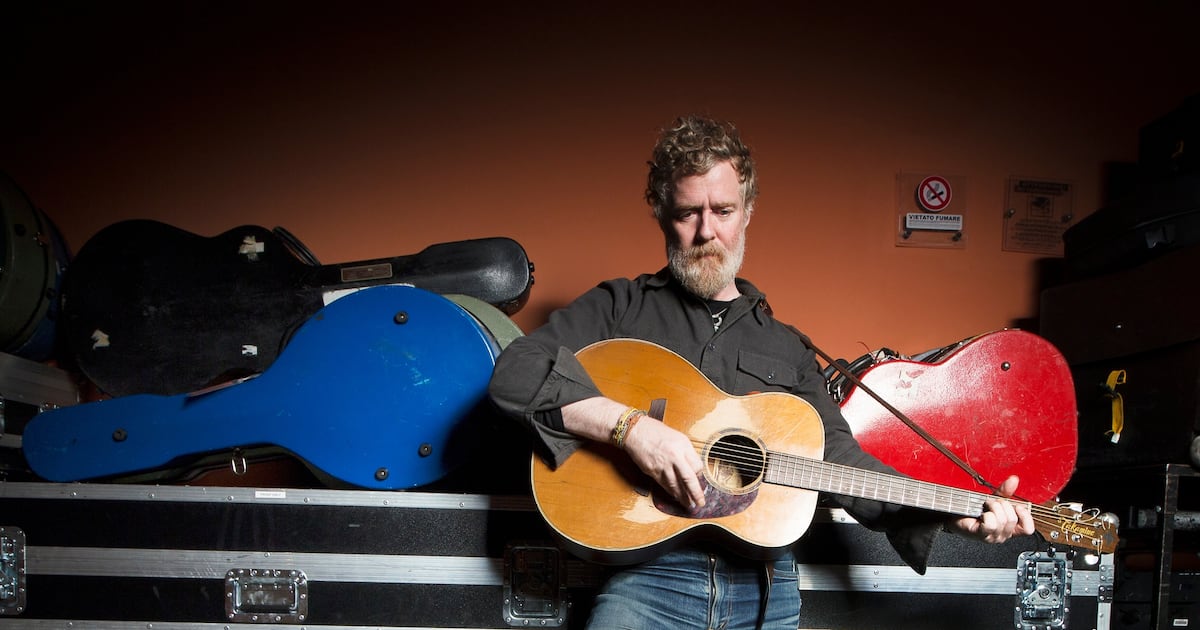
“You have to enter Dublin like a Spitfire. Full armour.”
In a hotel room in New York, Glen Hansard is pacing the thick carpet as he describes a typical day in his hometown, directing his thoughts over a WhatsApp video call. “Often Irish people will just come up and start a conversation in the middle: they don’t bother with the hello.”
In Helsinki, where Hansard winters with his wife, the Finnish poet Maire Saaritsa, and their son, Christy, it’s different. “It’s great for me, because – not to sound like an eejit – no one gives a f**k. In Dublin you might be a bit self-conscious. You have to have the energy.”
It’s unsurprising that many Dubliners feel they can dispense with the formalities. Ever since he played Outspan Foster in The Commitments, the Alan Parker film, from 1991, of Roddy Doyle’s first novel, Hansard has been a mainstay of Ireland’s cultural scene.
With an Oscar for the song Falling Slowly, which he wrote with Markéta Irglová, his Swell Season partner, for Once, the other iconic film he was involved in, and any number of fantastic records to his name, whether with The Frames or Swell Season or as a solo artist, Hansard is a household name even in households that aren’t interested in music.
These days there’s more salt and pepper than flame in the beard, and with his neat black jumper, earring and good haircut, he’s half indie rock musician, half coolly minimalist Silicon Valley tech employee as he flashes a tentative grin.
But Hansard still has a will-o’-the-wisp way about him: we talk not the first time we’re meant to but in an impromptu way, after he texts two days later, apologising. Turns out he bumped into a pal who inveigled him into an encounter with the black stuff, leading to an epic hangover and a tech hiccup. Very rock’n’roll?
“It was one of those rare moments,” Hansard says. “He ended up getting me in a headlock, and we ended up drinking together – and a lot more than we should have.”
The hangovers are few and far between now he has turned 55. “There’s a lot of ginger tea and long walks on tour. As you get older the existential dread of waking up hungover is appalling.”
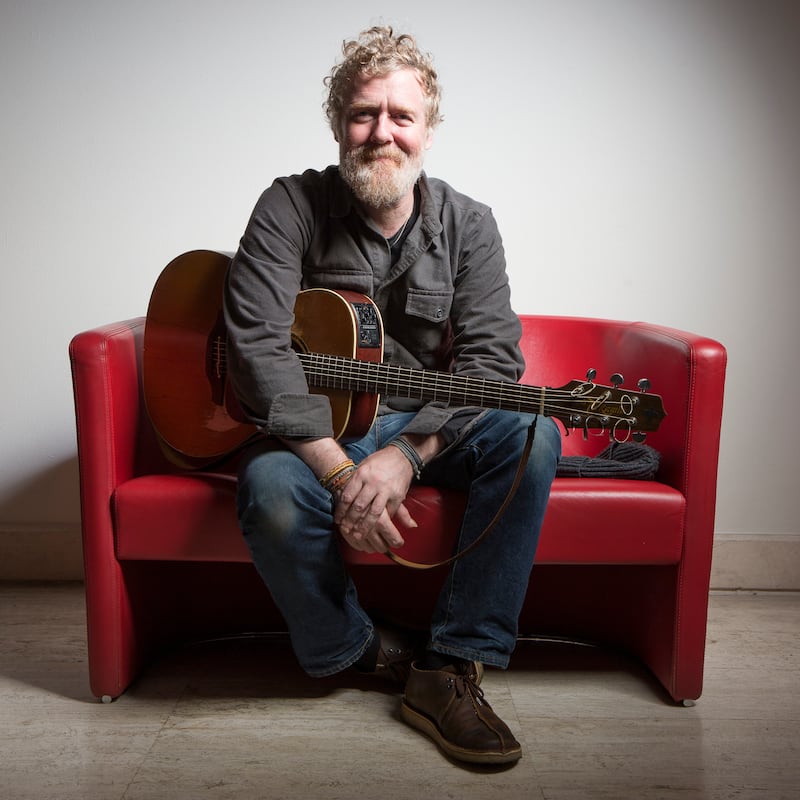 Glen Hansard: ‘Am I looking to slow down or speed up?’ Photograph: Luciano Viti/Getty
Rather than find Hansard in a pub, you’re more likely to encounter him in a soft-play centre in Kildare, near where he lives with Saaritsa and three-year-old Christy. “I’m in the soft-play centre a lot, and my will to live is low,” he says. Home time is about the simple stuff: bedtimes, storytimes, bathing. “That’s where you meet your kid: in the banal.”
Hansard has made it on to this video chat because he and The Frames, his band of origin, are about to headline a tour of intimate venues around Ireland. The aim is to highlight the importance of grassroots venues and their role in nurturing artists and getting music to fans outside cities.
They don’t need to explain that to me. The first time I saw The Frames was in one of those small venues. It was the 1990s. I was 16 and at a gig at Connolly’s of Leap, a dark womb of a venue with a low horseshoe-shaped balcony around the stage, band posters on every wall, bodies pressed so closely together you could taste sweat.
That night, to the grungy, overdriven guitar of their song Revelate, and Colm Mac Con Iomaire’s keening violin, Hansard climbed on to the balcony and jumped off. I’d never seen anything like The Frames. I spent plenty of school hours daydreaming about when they might come back.
Hansard remembers that era fondly, but with an acid touch. “The Frames didn’t fit into a particular colour or trend. Engine Alley had all the cool, and they were cool – they were brilliant as well. And Therapy? You had the [Hothouse] Flowers, [who] were a little bit older than us.
“Because we came out of busking, I don’t think we were ever a cool band in the sense of rock’n’roll cred. I would have been listening to The Jesus and Mary Chain, but I wasn’t advertising it and I wasn’t wearing their clothes.”
Those in the Church of the Frames were evangelical, those outside it sceptical. “We were signed to Island Records, and they just wanted us to tour England the whole time. They didn’t put any value on how well you were doing in Ireland.”
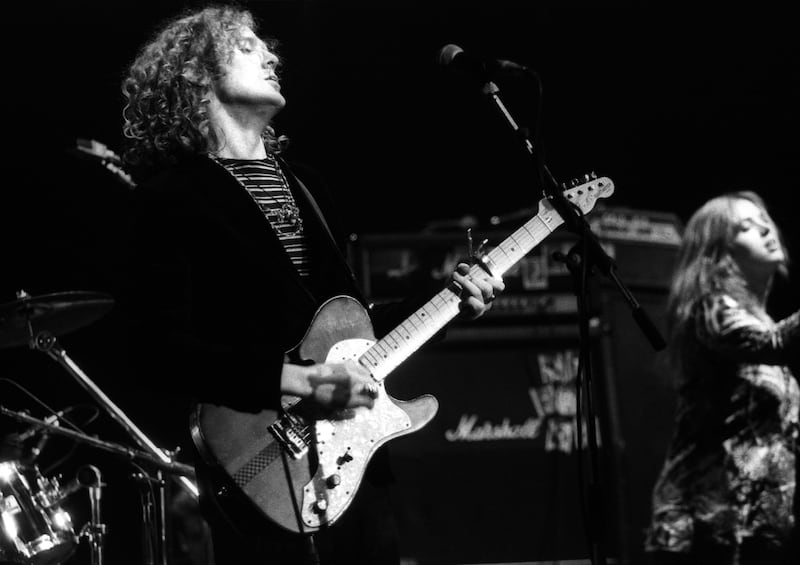 Glen Hansard and Noreen O’Donnell of The Frames at the Town & Country Club, London, in 1992. Photograph: Ian Dickson/Redferns
There were highs. “I remember being on the bill with Radiohead at the Krazyhouse in Liverpool at one point.” There were surreal phases. “Richard Ashcroft came to one of our shows in Wales. Noreen” – O’Donnell, of the band – “ended up going out with him for a while.” And then dizzying, band-buckling lows. “Island Records dropped The Frames because The Cranberries had done so well.”
Elevation, rejection: the rollercoaster ride had many loops. Hansard recalls being so broke at one low ebb that he and O’Donnell asked for chips “on tick” walking home to Killester and Artane one night. “We were looking under bushes, hoping someone had dropped money.”
When it came to making their second album, Fitzcarraldo, the band approached Whelan’s, the music venue on Wexford Street in Dublin, and asked its bookings manager, Dave Allen, if the venue would advance them £10,000 towards the making of the record.
“We said, ‘We’ll give you five gigs over the next four years. We’ll play for free.’ Whelan’s thought about it. They said, ‘We’ve never done that before,’ but they gave us the money.”
It’s a story that resonates now because small and medium-sized Irish venues are struggling. During Covid, music fans were told to stay away from gigs for the good of their health. Many never came back.
It’s all just about drinking the coffee and showing up for work
— Glen Hansard
The Live Venue Collective was established during Covid to petition the government for help. A €500,000 scheme to support small venues was announced in March 2025. The collective, which was initially formed by 23 venues, is seeking cultural-status protection for established grassroots venues, the removal of VAT on tickets, and a €1 levy on tickets for arena and stadium shows, to be donated to a grassroots-venue fund – a practice that is being increasingly adopted in Britain, with the suggestion of legislation should the nascent scheme falter.
“People don’t realise that we are under pressure,” says Edel Curtin of Coughlan’s Live, in Cork, a venue that holds 60-80 people. “If you don’t support these spaces they’re not going to be here any more.
“There is never a gig that we make a profit on. We don’t take anything from the ticket money. So, even if it is full, you’re depending on your bar sales to subsidise it.
“We’re seen as commercial because we’re not a not-for-profit, so that makes it very difficult for us to apply for any grants or funding.”
If gig-going is a habit, it’s one music fans need to reacquire, according to Hansard. He says he has walked into gigs where talented artists are playing to just five or six people. “It’s feast or famine. Peers of mine, they’re filling a room or they’re struggling to get anyone into it. There seems to be less of a good, honest number of people showing up for your show.
“It’s like that thing in New York where someone puts a good review of a doughnut shop up, and next thing there’s a queue down the street, but they’re not different to the doughnut place across the street, which is empty.”
At each venue on their tour, from Clonakilty to Kilkenny, The Frames will showcase a different local support act. It’s a way of giving back – which Hansard feels strongly about, whether it’s a grassroots tour or an initiative such as the Christmas charity busk on Grafton Street with Bono and Imelda May.
Is Hansard becoming an elder statesman of Irish music? He laughs. “Well, I grew up in Ballymun. I don’t make a big song and dance about it, but I grew up witnessing hardship among friends, family. Ballymun gets a bad rap, but it was an incredible community. There was a great sense of meitheal. My mother didn’t have any money, but she had a great sense of community.”
Hansard thinks it’s much harder now for people. “In the old days there were supports in place. You had a little distance between the bottom and where you were. It’s a tougher place now. For people who are a bit more sensitive, and who tend to fall off the path a bit, it’s not a world for them.”
As a teenager Hansard volunteered for Simon, the homelessness charity. It’s close to a decade since he got involved with the Apollo House movement, when he and other citizens tried to run an empty office building in Dublin city centre as a shelter, both to highlight and to help fix the homelessness crisis.
He stands by the purity of the move, but he has some regrets. “I remember Sinéad O’Connor rang me and she said, ‘Just be careful. I raised my head above the parapet a few years ago, and it really isn’t good for your mental health. If they come at you, they’re going to come after you big time.’
“She was so right. For such a simple thing that only lasted a month, I’m still dealing with the consequences of it in my life and in my head.”
His head has spun many times in the past few years. His mother, Catherine, died “of loneliness” in a care home during the first wave of Covid. “It’s a massive loss,” Hansard says. “She was the centre.”
He has also dealt with the transformation of self that comes with parenthood. Named after his late friend Mic Christopher, with a side nod to Christy Moore and Christy Dignam, little Christy has acted as a spur.
“It was, ‘Am I looking to slow down or speed up?’ I was looking to speed up, because I had a kid and I needed to make money. Funny as it sounds with all the success, the money is something that you have to go out and earn constantly. It’s not something that you just have all put away and it’s all sorted.”
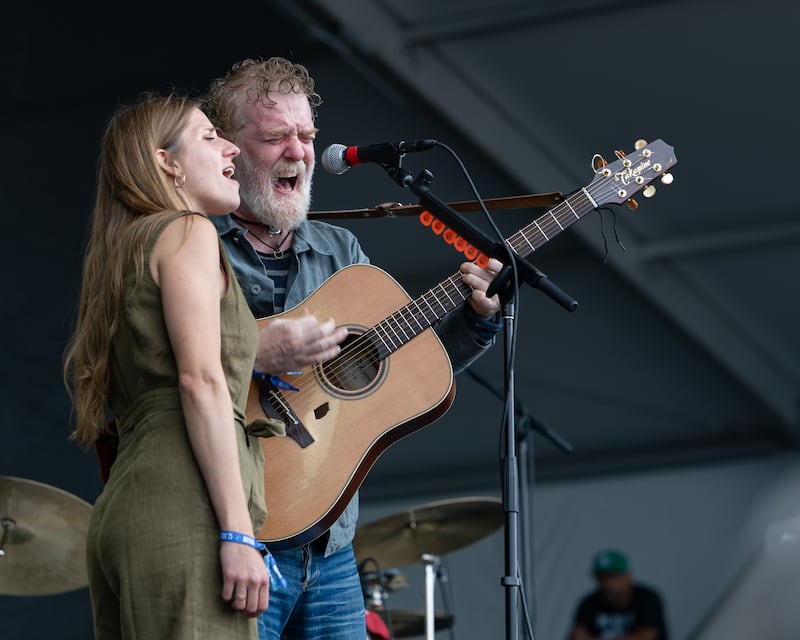 Markéta Irglová and Glen Hansard of The Swell Season during the 2025 Newport Folk Festival at Fort Adams State Park. Photograph: Douglas Mason/Getty Images
 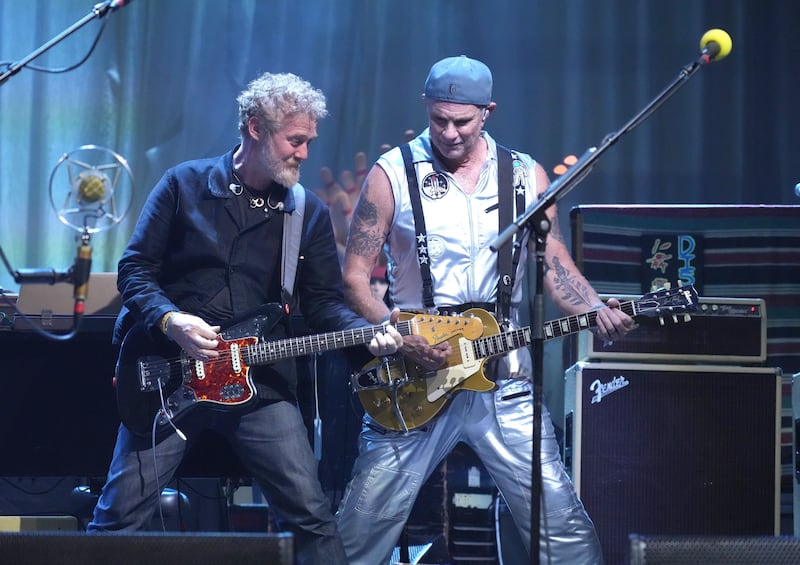 Glen Hansard and Chad Smith onstage at YouTube Theater in 2022. Photograph: Kevin Mazur/Getty Images for EV
Hansard recently switched management, signing with Brian Message and Ric Salmon of ATC, who represent Nick Cave, Thom Yorke and PJ Harvey. With a Swell Season tour just wrapped up, he plans to release a live record from Berlin in April that he stops just short of calling an introduction to the works of Glen Hansard. “It’s songs from the whole period: Frames, Swell Season and the solo career,” he says.
He’s also in a band with Chad Smith of the Red Hot Chili Peppers – “It’s frightening how loud he plays” – and thinking of making an album with Thomas Bartlett, aka Doveman, of The Gloaming.
Hansard is in New York to work on a record with unnamed friends – “We’re noodling, digging.” He was in the studio with Irglová in December, working on new material. And a Frames record, he says, could happen quickly if the stars align. He has “a bunch of songs” that could work for the band.
“There is a joy at the centre of my self that comes alive when I play with those lads. Something lifts in my heart. We’d probably rent a house in Kerry, bring some recording gear and spend maybe 10 days there, cooking, hanging out, and that’s where the record would be recorded. Because we know each other so well, we have a kind of universal mind about things.
“It’s all just about drinking the coffee and showing up for work.”
The Frames play Spirit Store, Dundalk, on Wednesday, February 4th; Dolan’s Warehouse, Limerick, on Sunday, February 8th; De Barra’s, Clonakilty, on Monday, February 9th; and Cleeres, Kilkenny, on Wednesday, February 11th. They also play Hot Press: History in the Making at 3Arena, Dublin, on Friday, February 6th. Glen Hansard plays the Trinity Summer Series in Dublin on Thursday, July 2nd