
As of 11:00 pm ET, NASA is still conducting the Artemis II Wet Dress Rehearsal test of the Space Launch System rocket that will send four astronauts around the Moon. The launch could be as early as Sunday, but the actual date depends on NASA’s assessment of the test results. The astronauts are in quarantine in Texas and ready to fly to Kennedy Space Center tomorrow if the answer is “go.”
NASA astronauts Reid Wiseman, Victor Glover and Christina Koch and Canadian Space Agency astronaut Jeremy Hansen will be the first humans to fly to the Moon since Apollo 17 in 1972. This is a test flight and they will not go into orbit, much less land, but instead will use a free-return trajectory that brings them back to Earth even if the Orion propulsion system doesn’t perform as planned. First, though, the SLS rocket and Orion capsule must pass this Wet Dress Rehearsal (WDR).
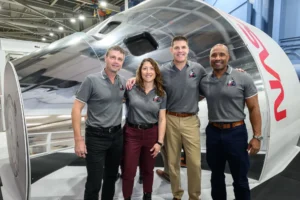
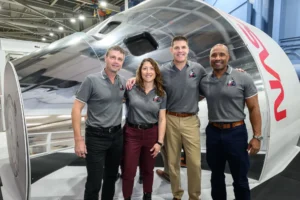 Crew of Artemis II in front of an Orion simulator, January 23, 2026, L-R: Reid Wiseman (NASA), Christina Koch (NASA), Jeremy Hansen (Canadian Space Agency), Victor Glover (NASA). Photo credit: NASA/Robert Markowitz
The approximately 49-hour test began Saturday evening, but the crucial phase of filling the enormous SLS rocket with liquid hydrogen and liquid oxygen — called “tanking” — started only late this morning. The test was delayed two days because of frigid weather in Florida and temperatures remained unusually low overnight, but Artemis II Launch Director Charlie Blackwell-Thompson approved proceeding with tanking at 11:25 am ET, about 40 minutes later than planned.
 Artemis II Launch Director Charlie Blackwell-Thompson. Screenshot, January 16, 2026.
Blackwell-Thompson was also the Launch Director for the first SLS launch, Artemis I, in 2022. An uncrewed test flight of SLS/Orion, many problems were encountered including a number of liquid hydrogen leaks. Artemis I had to roll back to the Vehicle Assembly Building twice for technical reasons and a third time because of a hurricane. In all it was eight months between when the Artemis I SLS/Orion rolled out to the launch pad the first time and when it actually launched. During a January 16, 2026 news conference, she said they’ve incorporated many lessons learned into planning for Artemis II.
Indeed, today’s test went comparatively smoothly. Once again there were hydrogen leaks, but NASA and its contractor teams were able to manage them. After two pauses, they resumed filling the core stage at 3:48 pm ET and by 4:41 pm ET it was in topping mode.
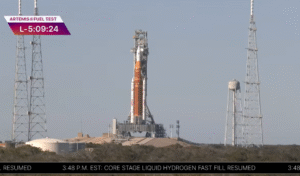 NASA’s Space Launch System (SLS) rocket and Orion crew capsule at Launch Complex 39B, Kennedy Space Center, during the Wet Dress Rehearsal for Artemis II, February 2, 2026. Screenshot from NASA’s webcast.
The core stage and the Interim Cryogenic Propulsion Stage (ICPS), or upper stage, were both filled with liquid oxygen (LOX) and liquid hydrogen (LH2) and in replenish mode by 6:03 pm ET. The super cold LOX (-295ºF) and LH2 (-423ºF) must be constantly replenished because they boil off even in Florida’s current cold temperatures.
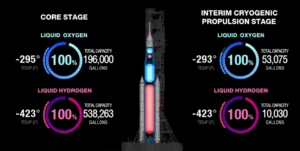 Screenshot from NASA’s livestream of the Artemis II Wet Dress Rehearsal, February 2, 2026, illustrating that all four tanks on the SLS core stage and ICPS upper stage are full.
Once the tanks were full, Blackwell-Thompson gave the go-ahead for the next phase of the test with the “closeout crew” heading to the launch pad to practice closing the hatch to the Orion capsule and ensuring the Launch Abort System was ready to pull the capsule away to safety if anything goes awry during launch. The Artemis II crew is not participating in this test, but otherwise the procedures are the same as they’ll be on launch day.
The plan was for a series of simulated launch countdowns starting at 9:00 pm ET, but at 10:40 pm ET NASA posted that the closeout crew was just getting ready to leave the pad and only one simulated countdown would be conducted.
As of this writing (11:00 pm ET), they continue to post updates on the Artemis blog and the livestream (with basic updates scrolling across the bottom, but no audio) remains active.
NASA will have a news conference at 12:00 pm ET tomorrow (Tuesday) that will air on the agency’s YouTube channel.
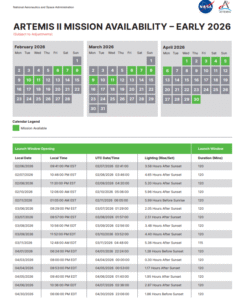
The Earth and Moon must be properly aligned for the launch to take place. February 8 is now the first date it can go, but there are two others this month (10th and 11th) and available dates every month thereafter. NASA posted the list for February, March, and April.
Last Updated: Feb 02, 2026 11:48 pm ET