
Orsted Onshore Ireland Midco Ltd has applied to Cork County Council for planning permission to build a 323-hectare solar farm with around 210 ha of solar panels on farmland around 7 km from the village of Killeagh.
The Greenhills proposal also includes a substation, a battery energy storage system (BESS) and security fencing. Orsted says the facility would provide enough electricity to power up to 52,000 homes.
However, the proposal has raised strong opposition with locals concerned about issues such as the loss of prime farmland, the visual and environmental impact, the impact on the existing road infrastructure and watercourses, and fears about what would happen if there was a fire at the BESS site.
“This application proposes to industrialise over 800 acres of agricultural land in a manner that is grossly disproportionate to the rural character of our parish. The impacts on water quality, biodiversity, road safety, residential amenity, and most critically, the health and safety of nearby residents, have not been adequately assessed or mitigated,” an objection submitted by a local family said.
Another objection said “our privacy is massively impacted as the panels will be right behind our home. Visually I cannot see us being able to enjoy our back garden anymore. Nobody will want to buy our house if we want to get away from this.”
In her submission, Cllr Mary Linehan Foley, who is the current Mayor of County Cork, said she would not support granting permission to the proposal, “pending the introduction of clear national planning guidelines for large-scale solar energy projects.”
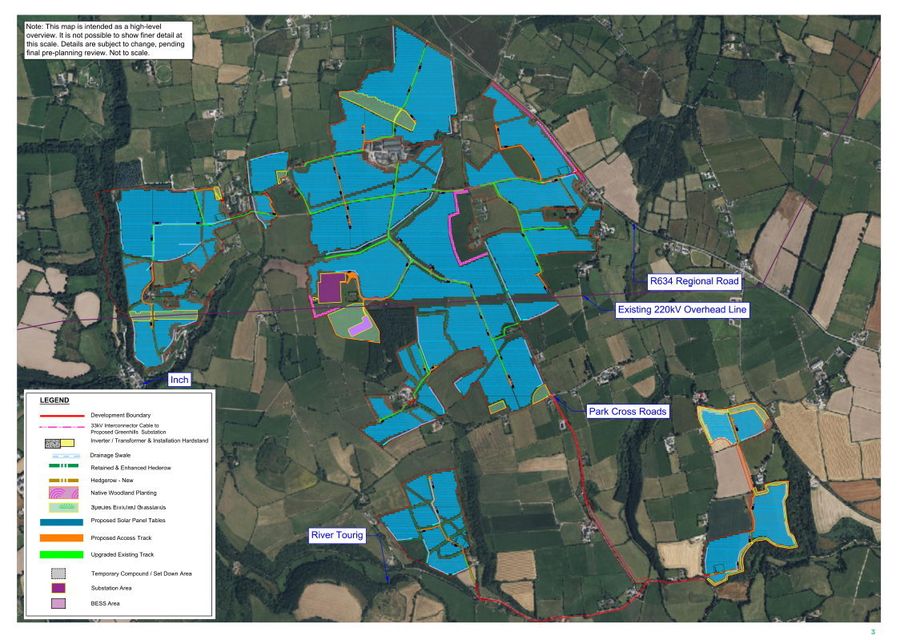
The Greenhills solar farm plan.
The East Cork councillor said that in the absence of such standards, planning applications for large-scale solar farms are “effectively being assessed on a case-by-case and ad-hoc basis, which places an unreasonable burden on local planning authorities and creates uncertainty for communities.”
Seventy-seven objections are currently listed on the council’s planning portal but a member of the Inch Killeagh Rural Preservation Group, which is opposed to the development, told the Irish Independent that the number in reality is much higher. “We have submitted a large volume of objections to the council offices over the last few weeks and unfortunately they are not showing up online very quickly and that includes paper and online objections.”
“Our submission clinics have been extremely busy, people have many and varied concerns. One that keeps cropping up is the permanence of the development and lack of legislation regarding massive utility scale solar developments and in particular this one, which will be the largest solar farm in Ireland.”
“Unfortunately we’re meeting people who are living in extremely close proximity to this development (such as panels behind their property or right across the road), who are only viewing maps now. Many people found it almost impossible to read the maps online and are now very upset,” the local resident said.
Orsted says it has consulted widely with locals and has kept them informed of developments through newsletters, a project webpage, a dedicated community engagement lead and a number of community engagement events held in the area.
The Danish renewable energy giant has a number of wind and solar projects operating or planned in Ireland and argues that projects like Greenhills will help Ireland reach its renewable energy targets.
The last day to submit observations on the planning application is February 3 with Cork County Council due to make a decision on the application by February 23.
Funded by the Local Democracy Reporting Scheme.