
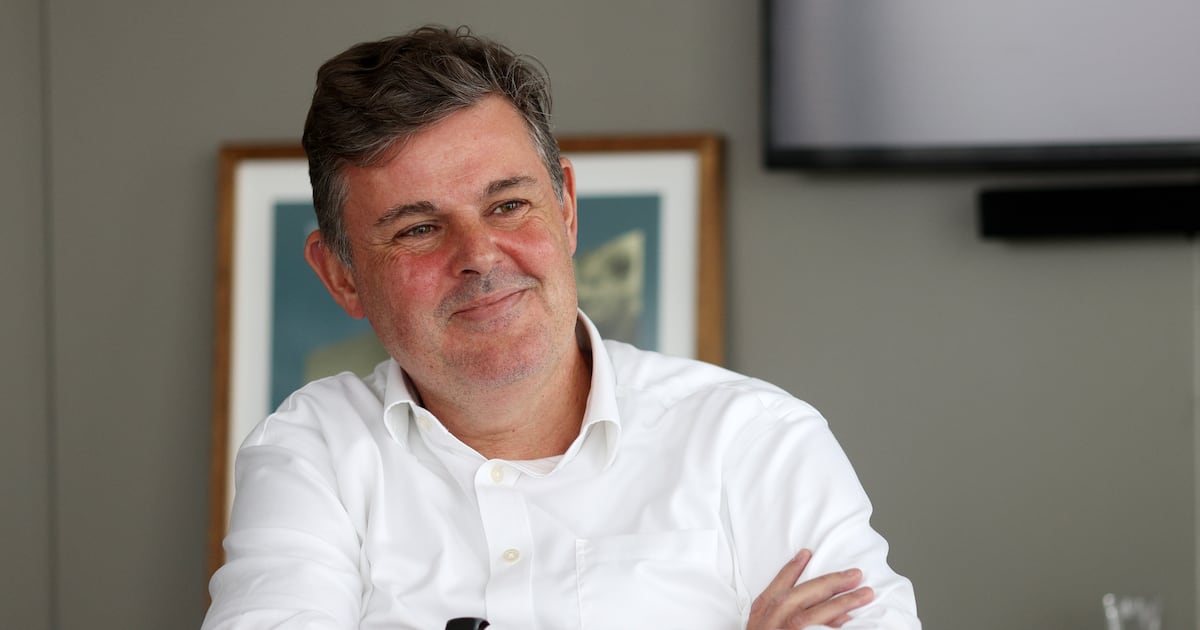
RTÉ has not had any difficulty filling top presenter roles despite the salary cap, Kevin Bakhurst has said.
The director general of the broadcaster also said Claire Byrne, who left RTÉ for Newstalk, had not been “admonished” by the introduction of the pay ceiling.
“She was not being admonished. Yes, she would have had to take a pay cut from what she was earning if she had stayed. She and I discussed it,” he said.
“Have we had a problem filling her [role] or other roles with the pay cap? Not at all. We pay enough to get absolute top-class presenters.”
Byrne, who began her new morning show on rival broadcaster Newstalk on Tuesday, had told the Sunday Independent that the pay cap “felt like the organisation was wagging its finger at me” and that she was “in trouble”.
Byrne was paid €280,000 by RTÉ in 2024. However, Bakhurst announced in 2023 that, once contracts were renegotiated, no presenter at the national broadcaster would earn more than his own basic salary, which stands at €250,000.
The measure came as he sought to restore trust after the failure of RTÉ’s previous management to disclose properly the pay of former presenter Ryan Tubridy.
“For many years the level of presenter pay at RTÉ got a little bit out of control and caused a lot of anger and upset, and a lack of trust with the audience and with politicians, and we had to deal with that,” Bakhurst said.
“We know from our audience research that it is not mentioned as an issue now.”
He also disagreed with Byrne’s claim there had been an “editorial nervousness” within RTÉ since the pay scandal.
“I know our editorial teams, and our programme teams, and I know the challenging topics we deal with. I know the courage that the investigations teams show and our news teams show day after day,” Bakhurst said.
One topic he has looked into is coverage of transgender issues.
“I asked a few programme teams about why they hadn’t done a particular story, which was actually in the UK. Individually, two or three programme teams I spoke to said there were other stories they thought were more important on the day,” he said.
“I wanted to be sure that we were not just leaving it because it is too difficult, too delicate. It is an important current topic and there are others.
“Every time you do any coverage of things like Gaza and the Middle East, it’s delicate and tricky. Do we shy away from doing it? Not at all.”
Bakhurst this week gave a round of media interviews that were postponed from late 2025 but were arranged before Byrne’s comments were published.
His total remuneration in 2024, including a car allowance and pension contributions, stood at €340,000. Under new Government pay structures, his basic salary could be in line to increase €50,000 to €300,000.
RTÉ employees have noted a disparity between this 20 per cent rise and the 6 per cent pay increase its unions fought to secure for the period between last May and the end of 2027.
“In fairness, pay across the organisation is really important, and we’ve already looked at a couple of areas since I’ve been here where I felt people were not being paid fairly, including Raidió na Gaeltachta. We have corrected that,” he said.
Bakhurst said executive pay and presenter pay could be “challenging”, and this was reflected in Mari Hurley’s decision to step down as chief financial officer to take up a higher paid role. But there was a “judgment call” to be made, he said.
Amid a plan to slash personnel costs and commission more content from the independent production sector, RTÉ is hoping to receive approval from the Department of Culture for a fresh voluntary exit programme.
About 100 people left the broadcaster in 2025, through redundancies and retirements. There is no specific target for 2026, but the plan to reduce staff numbers by 400 over a five-year period remains.
RTÉ is also in talks with the Government about shrinking back its presence at its Donnybrook campus in Dublin, which will eventually mean production of the Late Late Show and soap opera Fair City moves off-site.
Its three-year agreement for guaranteed public funding expires at the end of 2027, meaning it will need a new funding deal to continue operating.
“We will have to start those discussions. We’ve had very early discussions. This is a five-year strategy, and the multiyear funding we’ve had for the first three years has been unbelievably helpful in terms of allowing us a certainty on commissioning programmes and big digital investments. To see the strategy through we are going to need a certain level of funding, but that’s as far as we’ve got,” Bakhurst said.
RTÉ will receive €260 million of funding next year. It will not seek more than €260 million, “maybe with inflation”, in 2028 and 2029.
Responding to remarks made by Tubridy to The Irish Times last month, Bakhurst denied the RTÉ board had pushed him to part ways with the presenter, nor was he disappointed to see news reports highlighting his meeting with Tubridy last autumn.
“Funnily enough I said to him in the meeting if people ask if I met Ryan Tubridy, which I get asked every time I do an interview, I’m very happy to say I met you for a coffee,” he said.
He has not met the former Late Late host since. RTÉ has also “not yet” agreed a fresh contract with Tubridy’s Late Late successor, Patrick Kielty, whose initial three-year deal expires this summer.
“I’ve made it really clear to Patrick that we all think he’s doing a great job, and we would like to continue that,” Bakhurst said.