
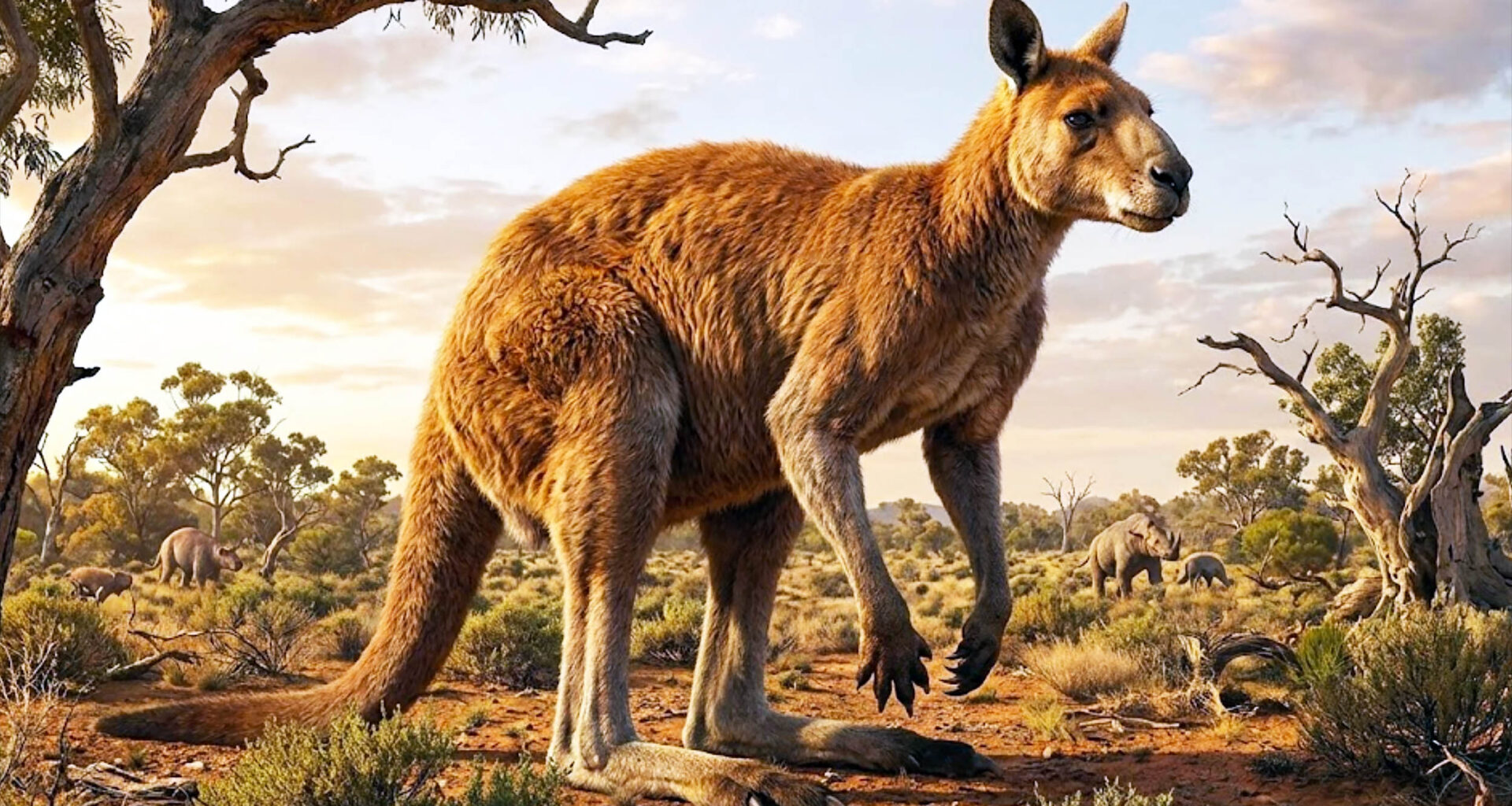
Australia once had kangaroos far larger than any living species. Fossils reveal animals weighing more than 440 pounds, with some reaching almost 550 pounds.
Such size raises an obvious question. Could an animal that heavy move by hopping, or did size force a different way of moving?

For many years, scientists believed hopping had a strict weight limit. New research now challenges that idea using bone mechanics, muscle forces, and fossil evidence.
Animal size shapes movement
Animal movement depends strongly on body mass. As body weight increases, bones, muscles, and tendons face greater stress.
Many large mammals reduce stress by standing more upright, which shortens force distances around joints.
Bipedal hopping mammals cannot fully use that solution because hopping requires a bent leg posture.
Modern kangaroos remain the largest living hoppers, with red kangaroos reaching nearly 200 pounds. Ice Age kangaroos exceeded double that mass.
Earlier studies suggested hopping would fail beyond about 310 to 350 pounds. Those studies relied mainly on scaling modern kangaroo bodies upward, without checking fossil bone structure.
Giant kangaroos were built differently
Simple scaling assumes giant kangaroos looked and moved like oversized modern ones. Fossil bones tell a different story.
“Previous estimates were based on simply scaling up modern kangaroos, which may mean we miss crucial anatomical differences,” said Megan Jones, a postgraduate researcher at the University of Manchester.
“Our findings show that these animals weren’t just larger versions of today’s kangaroos, they were built differently, in ways that helped them manage their enormous size.”
What makes hopping possible
The study tested two major limits on hopping. One limit involved bone strength in the foot. The other involved tendon strength at the ankle.
The fourth metatarsal bone plays a major role during landing. Bone failure often happens under bending stress, not compression.
Fossil measurements showed that giant kangaroos had shorter and thicker metatarsals. Shorter bones bend less under force, which raises resistance to fracture.
Calculations showed safety levels stayed above breakage limits, even under hopping loads.
The second limit involved ankle tendons, especially the gastrocnemius tendon that powers take off. Tendons must resist strong muscle forces without tearing.
Fossil heel bones showed wide attachment areas, allowing thick tendons. Calculations of muscle force revealed that enough space existed to support tendons strong enough for hopping.
How muscles powered giant hops
Muscle force scales with muscle size, which is typically measured by cross-sectional area. Larger muscles are capable of producing greater force.
The calculations showed that the muscle force required for hopping remained within feasible limits for giant kangaroos.
Elastic energy storage is what allows modern kangaroos to hop efficiently over long distances, so having less of it likely constrained the speed and endurance of giant kangaroos.
Dr. Katrina Jones, a research fellow in the School of Earth Sciences at the University of Bristol, noted that thicker tendons are safer, but they store less elastic energy.
“This likely made giant kangaroos slower and less efficient hoppers, better suited to short bursts of movement rather than long-distance travel,” said Dr. Jones.
“But hopping does not have to be extremely energy efficient to be useful, these animals probably used their hopping ability to cross rough ground quickly or to escape danger.”
Many ways to move
Hopping was not the only option available. Fossil anatomy shows varied movement styles across species.
Some kangaroos likely combined hopping with upright walking. Other species probably moved on all fours during slower travel. The evidence supports a flexible movement toolkit rather than a single gait.
Certain species show features linked to upright posture, such as pelvis shape and ankle structure.
Other species show traits linked to quadrupedal movement. Such diversity suggests adaptation to different habitats and lifestyles.
Giant kangaroos filled many roles
Movement diversity matched dietary diversity. Fossil teeth and skulls show some giant kangaroos grazed on grasses, similar to modern species.
Other large species browsed shrubs and leaves, a feeding role absent among modern large kangaroos.
“Our findings contribute to the notion that kangaroos had a broader ecological diversity in prehistoric Australia than we find today, with some large species grazers like modern kangaroos while others were browsers – an ecological niche not seen in today’s large kangaroos,” noted study co-author Dr. Robert L. Nudds.
This research shows that hopping remained mechanically possible for giant kangaroos. Strong foot bones, broad heel bones, and thick tendons supported short, powerful hops. Long distance travel likely relied on other gaits.
Fossils now reveal animals adapted for strength, flexibility, and survival rather than speed alone.
Giant kangaroos were not hop-less giants. Science now shows bouncing remained part of a much richer movement story.
The study is published in the journal Scientific Reports.
—–
Like what you read? Subscribe to our newsletter for engaging articles, exclusive content, and the latest updates.
Check us out on EarthSnap, a free app brought to you by Eric Ralls and Earth.com.
—–