
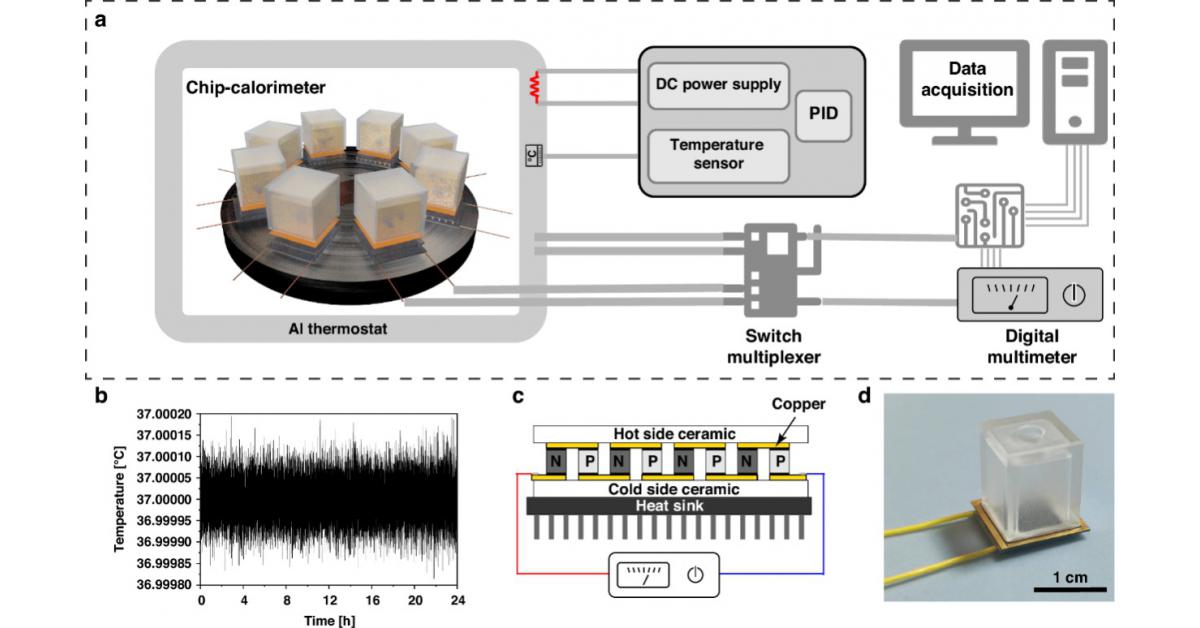
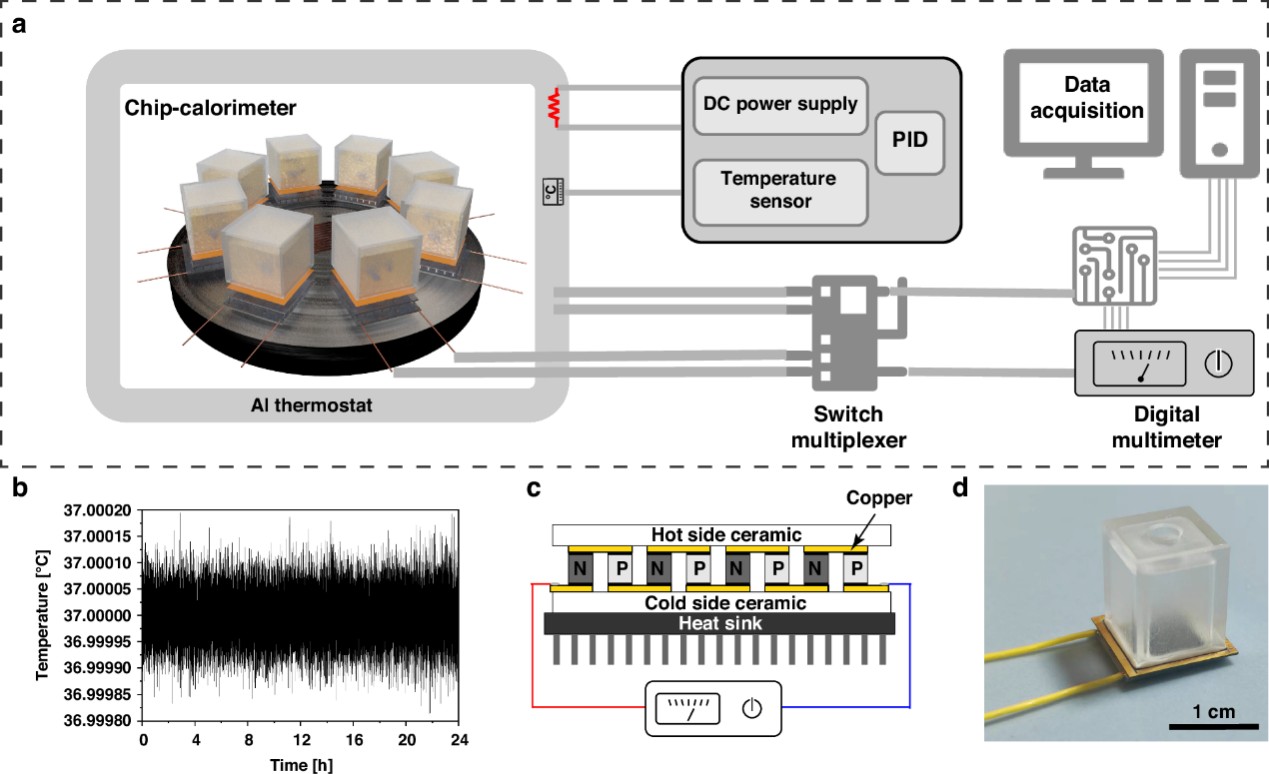
Chip calorimeter and experimental setup. a Schematic diagram of the measurement system. The chip calorimeter is housed within a box-shaped thermostat, with both components maintained at isothermal conditions through a precision PID temperature control sys
GA, UNITED STATES, February 4, 2026 /EINPresswire.com/ — Accurately tracking tiny heat changes offers a powerful way to monitor chemical reactions and living systems, but conventional calorimeters struggle with low throughput and slow analysis. This study introduces a high-throughput chip-based calorimetric platform that converts minute heat fluxes into electrical signals using an optimized thermoelectric sensor array. By integrating multiple sensing units on a single platform, the system enables parallel, real-time measurement of metabolic and reaction heat with high sensitivity. The approach allows rapid, label-free detection of biological activity and chemical processes, opening new possibilities for fast diagnostics and scalable thermal analysis in complex samples.
Heat generation is a universal signature of chemical reactions and cellular metabolism, making calorimetry a direct and information-rich analytical tool. In biological and clinical contexts, metabolic heat can reveal microbial growth and responses to external stress, including antibiotics. However, traditional calorimetric methods typically rely on single-channel measurements, complex fabrication, or long incubation times, limiting their clinical utility. Existing rapid antimicrobial susceptibility tests often depend on optical labels or imaging, which require stringent sample preparation and can introduce bias. Based on these challenges, there is a clear need to develop a scalable, sensitive, and label-free calorimetric platform capable of high-throughput measurements and rapid biological assessment.
Researchers at Beijing Institute of Technology report a high-throughput chip calorimeter based on a bismuth telluride thermopile sensor array, published in Microsystems & Nanoengineering in 2025. The study demonstrates a modular calorimetric system capable of monitoring chemical reactions and bacterial metabolism in real time. Using parallel sensing units and disposable micro-incubation chambers, the platform enables rapid antimicrobial susceptibility testing within four hours, while maintaining accuracy consistent with established clinical standards.
The core of the platform is a thermoelectric heat-flux sensor array fabricated from paired n-type and p-type bismuth telluride pillars arranged in series. Through finite-element simulations and experimental validation, the researchers optimized the geometry of the thermocouples to maximize power sensitivity while minimizing thermal conductance. Increasing thermocouple height proved particularly effective, yielding voltage responses of approximately 1 V per watt of applied heat.
The system integrates eight independent sensing units, allowing simultaneous measurements with minimal thermal cross-talk. Calibration was achieved using both electrical heating and well-defined chemical mixing reactions, confirming linear and reproducible heat-to-voltage conversion.
As a proof of concept, the system monitored metabolic heat from Escherichia coli cultures exposed to four commonly used antibiotics. Distinct heat-flux patterns revealed growth inhibition at specific concentrations, enabling determination of minimum inhibitory concentrations within four hours. Importantly, the results matched values recommended by international clinical guidelines, demonstrating both speed and reliability. The use of disposable micro-chambers further reduces contamination risks and simplifies operation, making the platform suitable for routine testing.
According to the researchers, metabolic heat provides a universal and unbiased indicator of microbial viability. By directly measuring heat output rather than secondary markers, the calorimetric approach captures the integrated physiological response of bacteria to antibiotics. The team emphasizes that combining thermoelectric sensing with parallel chip design bridges a critical gap between laboratory-grade calorimetry and clinically relevant diagnostics. They note that the system’s robustness, scalability, and compatibility with disposable sample handling could significantly lower barriers to adoption in medical and research laboratories.
Beyond antimicrobial susceptibility testing, the chip-based calorimeter has broad implications for chemical analysis, biotechnology, and point-of-care diagnostics. Its ability to quantify reaction enthalpy and metabolic activity in real time makes it suitable for screening chemical reactions, studying microbial physiology, and evaluating drug efficacy. The modular design allows future expansion to larger sensor arrays and automated sample handling, supporting high-throughput workflows. By delivering rapid, label-free, and scalable heat measurements, this technology may accelerate clinical decision-making, reduce unnecessary antibiotic use, and contribute to global efforts to combat antimicrobial resistance.
References
DOI
10.1038/s41378-025-01082-3
Original Source URL
https://doi.org/10.1038/s41378-025-01082-3
Funding information
This work was supported by National Natural Science Foundation of China No. 62203055 and China Postdoctoral Science Foundation No. 2023M730232.
Lucy Wang
BioDesign Research
email us here
Legal Disclaimer:
EIN Presswire provides this news content “as is” without warranty of any kind. We do not accept any responsibility or liability
for the accuracy, content, images, videos, licenses, completeness, legality, or reliability of the information contained in this
article. If you have any complaints or copyright issues related to this article, kindly contact the author above.

You just read:
News Provided By
February 04, 2026, 13:38 GMT
EIN Presswire’s priority is author transparency. We do our best to weed out false and misleading content. The content above is
the sole responsibility of the author who makes it available. If you have any complaints, kindly contact the author above.