

Not all whales are equally wise. Some, it turns out, know tricks that others do not, and they are willing to share them.
In the fjords of northern British Columbia, humpback whales have a spectacular way of catching fish known as bubble-net feeding. One or more will dive beneath a shoal of herring. They blow spirals of bubbles to corral the fish into a tight ball, and then surge upwards through the trapped prey, mouths agape.
Humpback whales can weigh 30 to 40 tonnes and measure up to 19 metres. Sixteen or more may take part in a single hunt. One individual usually blows the bubbles; another appears to co-ordinate the effort by making calls under the water.
Audio of the humpback whales’ calls as they hunt in groups
Éadin O’Mahony, of the University of St Andrews, said: “You could imagine them as acting like the conductor of an orchestra — there’s an acoustic signal for when to dive, when to lunge.”
“It’s honestly one of the most humbling things I’ve ever seen,” she added. “They’re intelligent, social animals that depend on co-operation in much the same way humans do. Seeing that gives me goosebumps every time.”
• Whale that repairs own DNA may hold secret of far longer life
Bubble-net feeding has been known about for decades. What is new is evidence gathered by O’Mahony and her colleagues that sheds light on how the technique spreads. A 20-year study of humpbacks in the Kitimat fjord system suggests that it does not merely arise again and again in clever individuals who devise it for themselves, nor is it innate. Instead, it diffuses through whale society much as skills spread through human communities: by individuals watching, copying and practising together.
The findings suggest that this does not happen at random. Instead, there is a kind of cetacean apprenticeship system. Knowledge accumulates in certain individuals. They become highly skilled and are very sociable. These animals are the ones that newcomers learn from. In human terms, you could consider them particularly generous teachers.
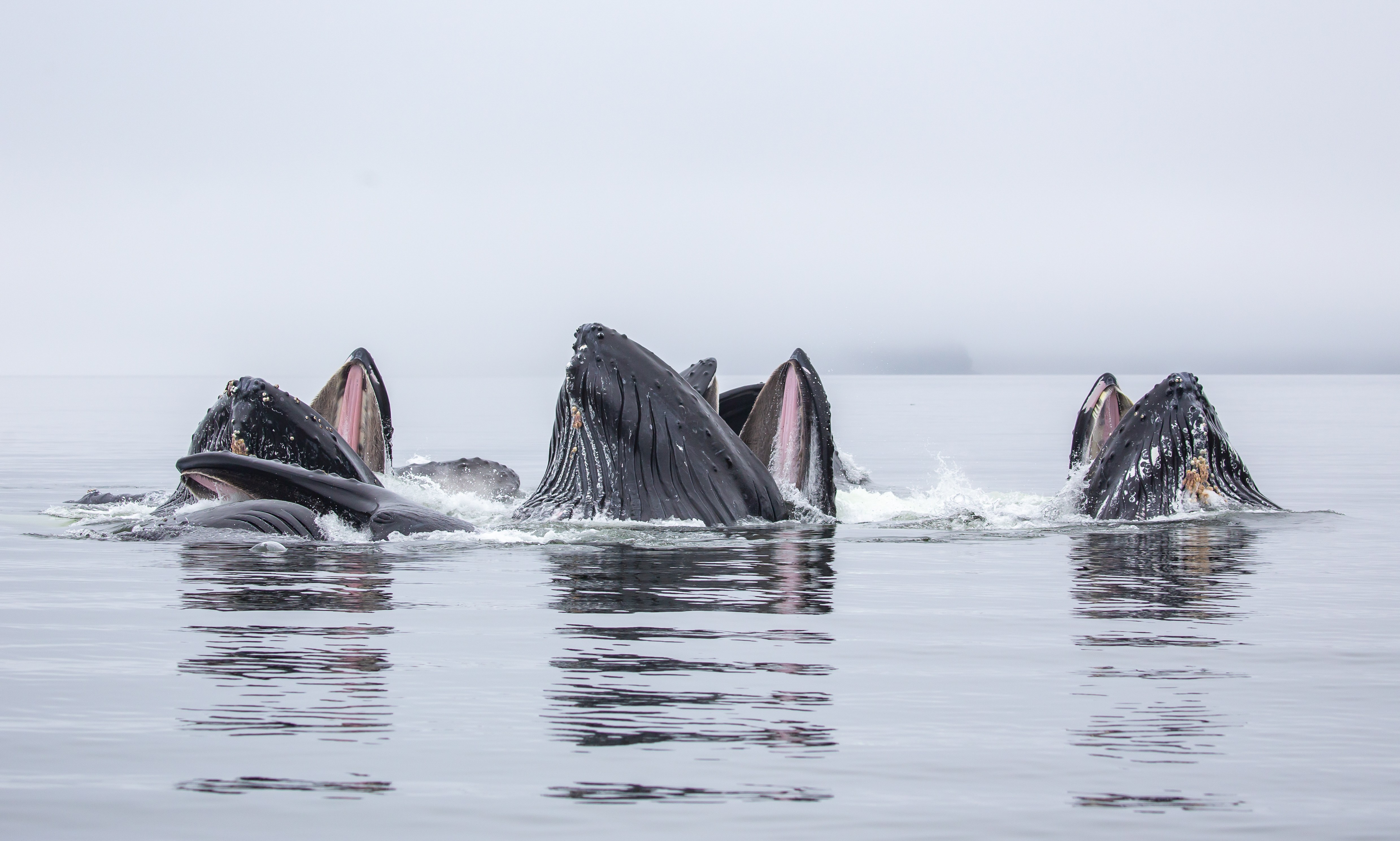
The researchers tracked hundreds of individuals over two decades, mapping who associated with whom and when each whale was first seen using the technique. They found that whales closely connected to “knowledge-holding” bubble-net feeders were far more likely to take the technique up themselves, compared with those closer to the margins of humpback society.
The idea that this knowledge is shared makes sense. Bubble-net feeding is rarely a solo act. More than 90 per cent of the time it is done co-operatively. The co-ordination does not come naturally to novices, it must be learnt and rehearsed.
• Humpback whales blowing bubble rings may be ‘greeting’ humans
The technique seems to become more common during tough periods, including a severe marine heatwave from 2013 to 2015, known as “the Blob”, that disrupted prey supplies across the North Pacific. Faced with leaner times, whales that knew how to co-operate while chasing herring were likely to have fared better than those that did not. Their shared culture — the tradition of bubble-net feeding, passed between individuals — gave them a boost.
But the study suggests this resilience is fragile. Collisions between whales and ships are expected to become more common in the region as more gas tankers transit the fjords. The study warns that if expert bubble-net teachers are removed, the loss may ripple through the population. Killing any whale is regrettable, but removing a knowledgeable one may do more damage than killing a less adept one.
This is a new idea for conservationists accustomed to counting individuals rather than skills. Wildlife management typically treats animals as interchangeable units. Whale culture suggests otherwise.