
Key Points
Six planets will appear to align in a rare “planetary parade,” with February 28 marking when they appear closest together.Four planets (Venus, Jupiter, Saturn, and Mercury) will be visible to the naked eye, while Uranus and Neptune will require binoculars or a telescope.The best viewing window is 15 to 30 minutes after sunset during the last week of February, looking toward the western sky, though a bright, nearly full moon on February 28 may make fainter planets harder to see.
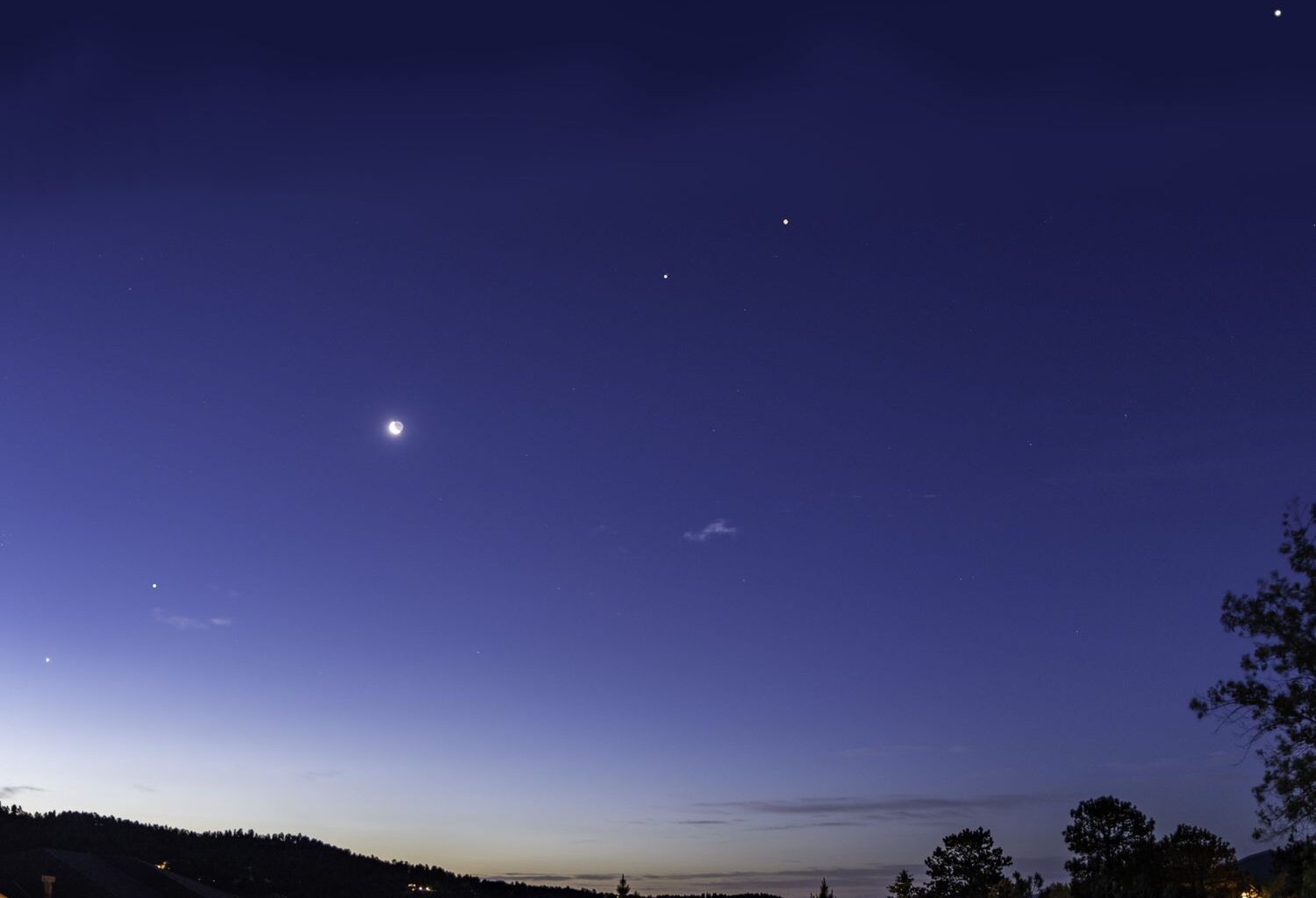
Later this month, skywatchers won’t want to miss a must-see moment when six planets—Venus, Jupiter, Saturn, Mercury, Uranus, and Neptune—appear to align in the evening sky. It’s an astronomical event that NASA refers to colloquially as a “planetary parade.”
According to the app Star Walk, February 28 is the date when the planets will appear closest together. Depending on where you live, though, the best viewing date may fall a few days earlier or later.
Four of the planets—Venus, Jupiter, Saturn, and Mercury—will be visible to the naked eye, weather permitting. Uranus and Neptune will only be visible with a pair of binoculars or a telescope. Venus, the brightest object in the sky besides the moon, will be the easiest planet to spot.
According to NASA, a planetary alignment refers to apparent lineups in our sky with other planets, the moon, or bright stars from our perspective on Earth. While planet alignment isn’t rare, NASA explains that these celestial events are special because they allow us the opportunity to observe multiple planets simultaneously.
During the last week of February, the YouTube channel “Late Night Astronomy” recommends heading outside 15 to 30 minutes after sunset and looking toward the west. Make sure you have a clear, unobstructed view of the horizon. Try to spot Venus, which will be the lowest planet, closest to the horizon. Above that will be Mercury, followed by Saturn and Neptune (which will be close together this month), then Uranus in the constellation Taurus, and Jupiter.
On February 28, the six planets will be spread across the sky from west to east. In the west/southwest, look for Mercury, Venus, Saturn, and Neptune; higher in the southwest sky, spot Uranus; and in the southeast, see Jupiter, which will be close to the moon. Keep in mind that the 90-percent illuminated moon will also brighten the sky, making faint planets like Uranus harder to spot.