

Murray Kinsella
Reports from Paris
FRANCE HAVE THE best lineout in the world.
And they are a potent force when they’ve won the ball and go to their maul.
France earned more metres per maul and won more maul penalties than any other team in top-tier Test rugby in 2025.
Those brilliant platforms give France the chance to unleash their plans for controlling games and striking in attack.
But it’s not just the set-piece attack that Ireland need to be concerned about when it comes to France.
Fabien Galthié’s side are lethal in transition, regularly pouncing after winning turnovers or receiving kicks.
Indeed, France turn 21% of the turnovers they earn into a linebreak on the same phase as the turnover, according to Opta’s data.
You’ve seen this movie. The opposition knock the ball on and France are instantly streaking away to score down the other end.
The scrum will be a key area of tomorrow’s game in Paris, of course, but Ireland are likely to have spent lots of time focusing on how they can disrupt the French lineout and maul, as well as limiting their transition chances.
France are clearly a team who spend a lot of training minutes honing their lineout, which was the best in the world by a fair distance in 2025.
France’s lineout win percentage on their own throw was 93.7%. Next best were Japan on 90.3%.
As impressive was an 84.6% clean win percentage from France, meaning instances in which the lineout delivers perfect, clean ball. That was also the best of anyone.
The French players demonstrate excellent lineout technique through accurate throwing, precise jumping, and efficient lifting.
Former Stade Français hooker Laurent Sempéré coaches France’s forwards along with experienced ex-France hooker William Servat.
Thibaud Flament has generally been their frontline lineout leader when he plays, but the Toulouse man is not available against Ireland, meaning Charles Ollivon will run their lineout.
Ollivon has lots of experience in this role. Lineout callers in France are often in the back row, so Ollivon has been doing it for most of his career. The 32-year-old has started to play in the second row for Toulon and France this season, starting the November Test win over Fiji there. He is at lock again tomorrow.
The French lineout is very difficult to defend against.
They regularly use late switches in the lineout before the throw, meaning the opposition struggle to contest in the air.
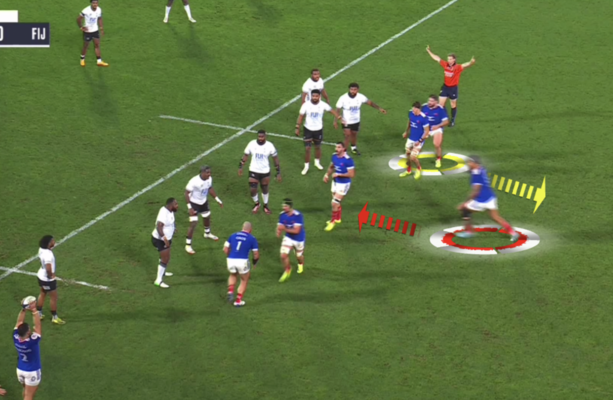
In the instance below, the receiver [red] switches into the lineout as the player at the back of the French lineout [yellow] drops out of it.
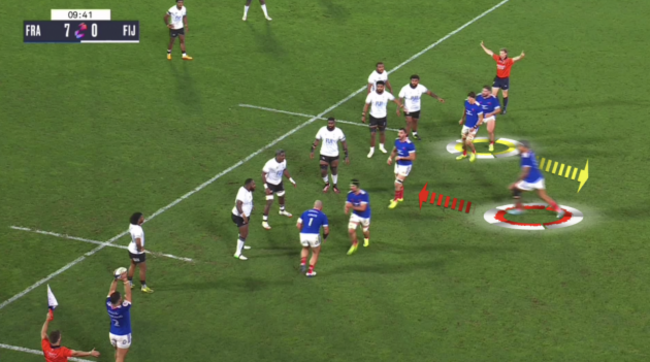
The late change in picture means Fiji don’t have all bases covered and France get a clean win in the air through Ollivon.

And with Fiji still playing catch-up, France snap muscularly into maul shape.

France surge forward and win a maul penalty.
The French also like to use ‘insert’ lifts where the receiver joins the lineout after the ball has been thrown to lift the jumper, again making it difficult for the opposition to contest.
We can see the receiver [red below] getting ready to join the lineout here, but only after the ball has been thrown.
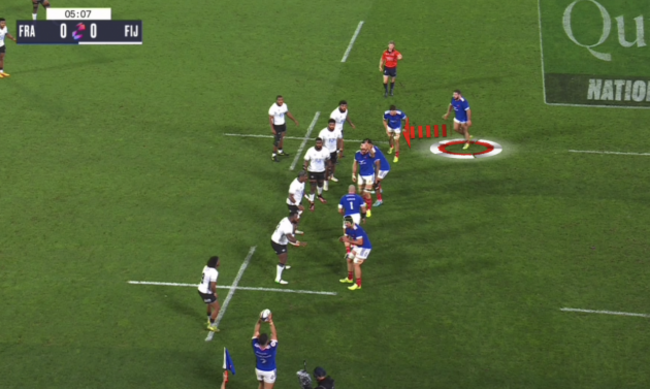
With a new lifter entering the fray just after the throw, Fiji don’t have the tail covered and lithe flanker Oscar Jégou wins the ball cleanly.
Again, France opt to drive and having tied up the Fijian forwards, they then move the ball and make a linebreak just to the right of the maul, leading to a try.
So Ireland’s task of making reads on the French lineout will be challenging.
The Springboks do a good job of dealing with a French insert lift in the instance below. Essentially, South Africa’s defensive receiver [blue] mirrors the French receiver [red], who will join after the throw to make a lift.

That means that the Boks can jump and contest at the tail, where they make a steal.
Using insert lifters and making late switches to the lineout requires great concentration and timing.
France spend a lot of time getting this stuff nailed down, but Ireland will likely have asked referee Karl Dickson and his officials to be hyper-vigilant with this part of the game tomorrow.
In the example below, the French receiver joins before the throw and no one leaves the lineout.
France are punished with a free-kick.
Once les Bleus have won the ball, they are a danger with their maul.
We already saw one maul penalty win above against Fiji.
France averaged 0.45 maul tries per game last year, a figure matched only by Ireland among top-tier rugby nations.
However, France were clearly best in terms of maul penalties per game, winning one maul penalty per game on average, while they averaged 22.6 metres of gains in mauls, again clearly the best in the world.
Their maul was arguably the winning of the game in their most recent Test against Australia in November, yielding two tries and multiple other penalties and big gains.
France are good at getting their forwards into the best place they can each do damage in the maul, again underlining how much time they spend crafting and practising their tactics.
As we’ve seen above, France often use their heavy lock in the receiver role.
In the instance below, it’s Emmanuel Meafou, who is on the bench tomorrow, so we might see the hulking figure of Mickaël Guillard there.
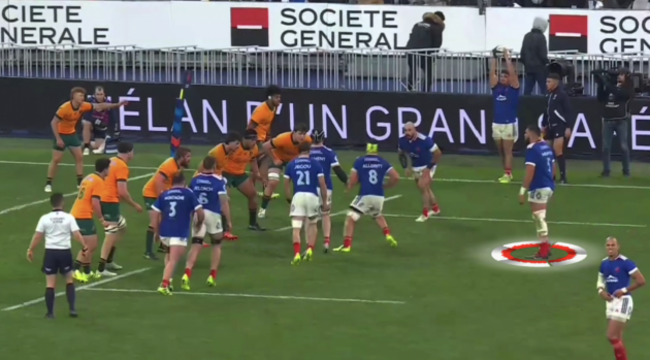
The role is often filled by a lighter back row player in other teams.
But as we see below, France are able to get Meafou’s size and power into the heart of their maul.
Meanwhile, tighthead prop Régis Montagne slots in just behind back lifter Jégou, who does an excellent job of bracing at the front of the maul after he has lifted.
Montagne has an immediate one-on-one in front of him.
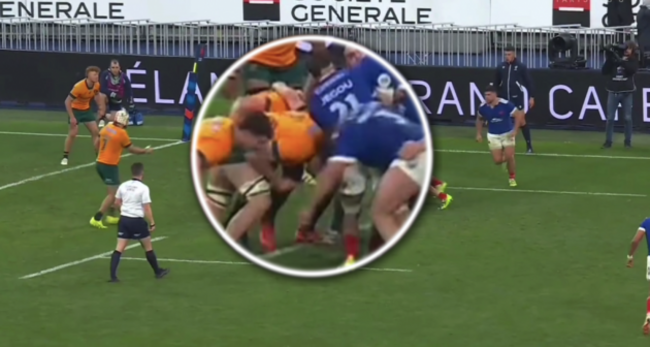
He wins his duel and gives France instant momentum as they shear their maul to the left of the jump.
With Meafou in the core of it, they thunder forward and all the way to the tryline.

On other occasions, France get their big tighthead lock into the lineout and form the maul around that heavyweight presence at the front edge.
The likes of Meafou and Guillard are very hard to shift once they have lifted, meaning France can rely on having solidity there to build around.
Indeed, France tend to attract early drive penalties from the opposition in this area because they’re often so keen to deny momentum. Ireland will have to tread that line carefully.
It will be intriguing to see what plan Ireland forwards coach Paul O’Connell has for the French lineout and maul. Cian Prendergast, who is an excellent lineout defender, will be an important figure, while tighthead lock Joe McCarthy’s ability to spoil will also be vital.
Much of France’s finest work goes on in the unglamorous areas of the game, but they can certainly turn on the razzle-dazzle too.
Their transition attack was ruthless last year.
As well as converting 21% of their turnovers into a linebreak on the same phase, France average 0.73 tries per game where the possession starts with a turnover. Only England were better in that regard.
France’s sheer speed is key to their transition attack. Oftentimes, their approach is as simple as getting the ball into Louis Bielle-Biarrey’s hands as quickly as possible. With his pace and clever attacking kicking skills, he is hard to stop.
But most of their team is quick, including out-half Matthieu Jalibert, who is one of four Bordeaux players in the starting backline along with centres Yoram Moefana and Nicolas Depoortère, as well as left wing Bielle-Biarrey.
In the instance below, France earn a defensive turnover wide on their right.
Instantly, they have a try-scoring mindset.
There’s a swift offload and then fullback Thomas Ramos looks infield to move the ball.
One of the big issues for Fiji is that the defender highlighted below goes on a solo mission trying to stop France from moving the ball any further.
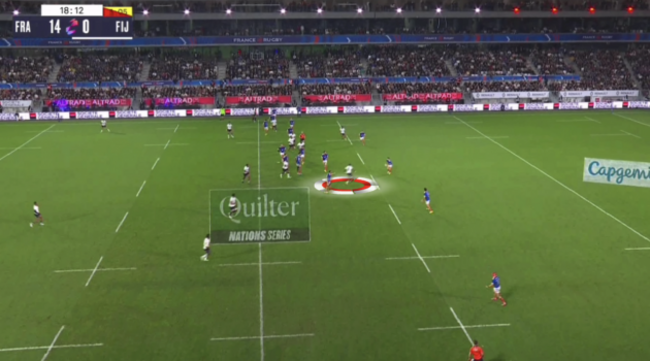
He shoots out of the line but doesn’t manage to stop the ball. In doing so, he gets totally disconnected from his team-mates and leaves them exposed.
France sense their chance. Outside centre Depoortère does a good job of getting to the left edge and freeing Bielle-Biarrey.
Bielle-Biarrey is actually indecisive in this instance, failing to fully draw in the last defender before passing inside to the hard-working Ollivon.
But the powerful French lock is able to seal the deal for a transition score on first phase.
Ireland have spoken about their need to stay connected when transitioning into defence tomorrow, as well as limiting turnovers in the first place.
The reality is that there may be times when they simply can’t deal with the speed and quality of France’s transition attack. There might be times when they’ll need to quickly shrug off moments of brilliance from the French and have a positive reaction.