
Irish property price growth will slow to 4 per cent this year, according to a nationwide survey of estate agents, most of whom see values plateauing soon following more than a dozen years of relentless gains.
But properties in key commuter counties still remain beyond the reach of many middle earners, the Society of Chartered Surveyors Ireland (SCSI) Residential Market Monitor finds.
A poll of 200 agents found that 84 per cent believe that current residential prices are either expensive or very expensive. Some 58 per cent believe they will plateau soon, while a further 23 per cent estimate that they have already peaked – even as demand continues to outstrip supply.
 Source: SCSI research
Home price inflation was running at an annual rate of 6.6 per cent in November, leaving values almost 24 per cent above their Celtic Tiger peak, according to the latest data from the Central Statistics Office.
Prices have risen consistently in recent years even as estate agents surveyed by the SCSI for its annual residential property reviews and outlooks have stated that prices were nearing a peak.
“Constrained supply is driving sustained house price growth and mounting affordability pressures for home buyers and renters,” said Gerard O’Toole, president of the SCSI. “Those trends look set to continue through 2026 and beyond.”
O’Toole said the 20 per cent increase in new home completions last year to more than 36,000 was “welcome news”, as it came in ahead of the expectations of the Central Bank and the Economic and Social Research Institute (ESRI). However, the Government still faces a big challenge in delivering 300,000 units in the six years through 2030, according to economists.
There is also a dearth of second-hand properties for sale in the State, but the SCSI report said an uptick in small landlords exiting the market is expected this year as a result of new rent rules coming into effect from the start of next month. These include restrictions on landlords selling properties with vacant possession.
Other factors
Aside from supply and demand, the agents surveyed for the report said that other factors currently influencing property prices include changes in the state of the economy; the availability of schemes designed to support potential house purchasers; changes made by banks, for example to interest rates and the availability of credit; and changes in the levels of immigration and emigration.
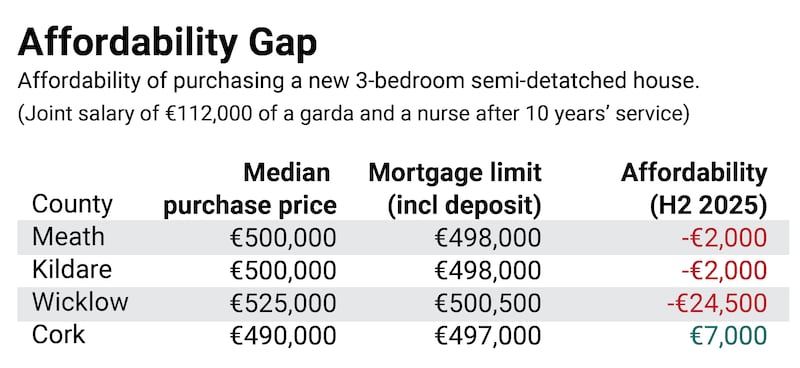
The SCSI report includes an affordability analysis for a couple – a garda and a nurse, each with 10 years’ service – on a combined income of €112,000 looking to buy different types of starter homes, including a three-bed semi-detached house in commuter counties touching Dublin, and Cork.
Able to secure a mortgage of €448,000 under the Central Bank limit of four times income for first-time buyers on top of their 10 per cent deposit, it found affordability gaps for this couple of €2,000 in counties Meath and Kildare against the median property price of €500,000.
That gap widens to €24,500 in Wicklow compared to the median price of €525,000 in the county. However, the couple could afford a house in Cork, with €7,000 of wriggle room against the median price of €490,000.
“Despite recent improvements, Government scheme ceilings of €500,000 for the First Home Scheme and Help to Buy, while helpful for some first-time buyers, are still misaligned with market values in high-demand areas,” said O’Toole. “We would call on the Government to review those ceilings on a more regular basis to ensure their effectiveness.”
But, he added, “in the long term, the only way to moderate and gradually lower the affordability gap is by ramping up the supply of new homes while doing everything possible to drive down the delivery costs of new homes”.