
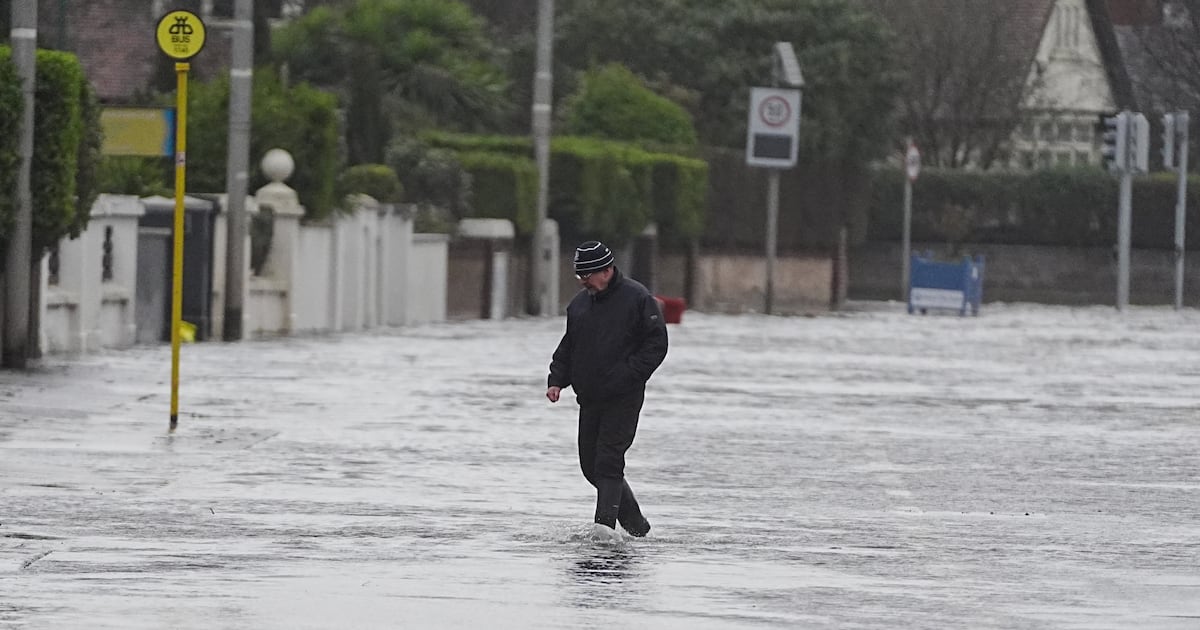
Large areas of Ireland remain on alert, with more heavy rain expected on Friday after flooding disrupted travel and public transport in Dublin and across the southeast on Thursday.
The National Emergency Coordination Group (NECG) urged people in Dublin, Louth, Wicklow and Waterford, which are all under orange rainfall warnings, to work from home on Friday if possible.
Schools in affected counties are on alert and some may not open on Friday morning because of the difficult travel conditions.
A number of rail services were cancelled on Thursday due to flooding and debris on several lines, including the Dart between Dún Laoghaire and Lansdowne Road in Dublin, and other services in Wicklow and Wexford. Further disruption of Dart and Wexford services is a strong possibility.
One of the busiest commuter routes into the centre of Dublin, the Clontarf Road, was flooded and closed on Thursday afternoon.
Keith Leonard, chairman of the NECG, said it will remain “vigilant” to rising river levels and high tides in the coming days.
“With the levels of rainfall we’ve seen and with the saturated ground that we have, we’re going to have road flooding, surface flooding and then we’ll see if any premises are affected over the next 24 to 48 hours,” Leonard said.
The NECG is due to meet again at noon on Friday. This meeting will also be attended by a humanitarian subgroup and a Liffey catchment area subgroup.
Leonard said the NECG is closely monitoring the Liffey, Dodder and Slaney rivers and coastal areas “from Louth right down to Waterford”.
“You could get flooding across any of those areas with the high tides.”
Leonard said water from the recent heavy rainfall will begin to flow down from the Wicklow and Dublin mountains over the weekend and into the Liffey and south Dublin river catchment areas, likely leading to further increases in water levels.
A status orange rainfall warning is due to remain in place for Waterford until 9am on Friday, Dublin and Wicklow until 3pm and Louth until 6pm.
Between 25mm and 35mm of rain is expected in these counties. The latest rains will coincide with a high full-moon spring tide, adding to the risk of river and coastal flooding.
Yellow rainfall warnings for several other counties are due to lift at various times on Friday.
Iarnród Éireann spokesman Barry Kenny said the flooding on the Dart line was “extreme” and he warned there could be further disruption on Friday for commuters.
Kenny said extensive coastal defences, which would protect the Dart line and train lines to the southeast, are “badly needed to protect infrastructure in a time of climate change”.
He further warned there will be difficult conditions in the coming days due to persistent, prolonged rainfall and high tides.
Local authorities on Thursday said they had made sandbags available to homes and businesses most at risk.
Dublin City Council said it was “monitoring river levels and coastal conditions closely, to ensure appropriate responses as required”.
Wicklow County Council told residents the combination of heavy rain and high spring tides could result in further overtopping of waves in Wicklow town, Bray seafront and Arklow in particular.
Louth County Council warned heavy rainfall on Friday is “likely to trigger further flooding, given current ground and river conditions”.
The Department of Social Protection has extended the deadline for applications to the first stage of its Emergency Response Payment scheme to Wednesday, February 18th. The decision was made amid continuing risk of property damage due to severe weather conditions.
Met Éireann climatologist Paul Moore blamed the incessant bad weather on the presence of high pressure to the east and north of Ireland which has displaced the jet stream to the south of Ireland.
It is picking up moisture from warmer waters and deluging several western European countries. Along with Ireland and Britain, Spain and Portugal are currently experiencing some of the wettest weather they have had in decades.