
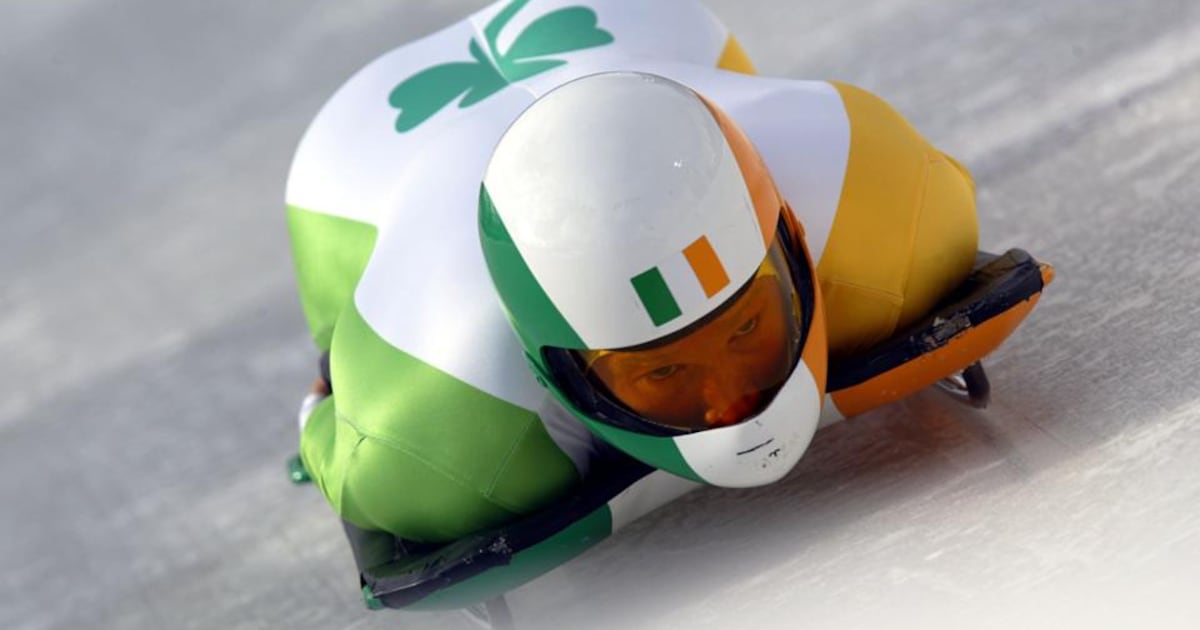
It’s no surprise to find Lord Clifton Wrottesley is somewhere on the train to St Moritz when he takes my call. By his own admission, he’s long been labelled a sort of playboy of the winter world, the glitzy Swiss resort his chosen retreat for many years.
He’s been labelled a lot of other things too, including the “Irish Lancelot on ice”, or simply the “Sliding Peer”, affectionately referencing his place in Ireland’s Winter Olympics folklore. In Salt Lake City, in 2002, he finished less than half a second off the bronze medal in the skeleton, impossibly close to hurtling himself facedown, headfirst into our sporting history.
No Irish athlete has come as close to winning a Winter Olympics medal before or since. For Wrottesley – pronounced Rottsley – the journey from his London home to St Moritz also brings him back to where it all began, first chasing his icy thrills on the revered Cresta Run as a 22-year-old, not long out of Eton, Edinburgh University, then Sandhurst.
From St Moritz, he’ll head to Milano-Cortina, taking in the skeleton and bobsleigh events next week, still as immersed in the Winter Olympics as he was when making the skeleton runs of his life in Utah. Since 2021, he’s been chairman of Ice Hockey UK, and sits on the performance advisory group and elite selection committee of the British Bobsleigh and Skeleton Association.
He’s also still passionate about bringing out the best in Irish Winter Olympians. Because the one label Wrottesley never liked was that of an Olympic tourist – or of somehow being a danger to himself in his high-velocity trips on ice.
“For me, it did start out of curiosity, as much as anything else,” he says. “I got quite good at the Cresta Run, then tried the bobsleigh. A year later, skeleton was added back to the Olympic programme for 2002. That was a medium I understood, so I committed to some training in some of the best skeleton schools.
“It was all step-by-step, proving to myself that I could do it. Maybe some people saw me as a winter sport tourist, a sort of playboy coming down from St Moritz. Did I really fit into that high-end elite athlete type? I think I proved that through my application and attitude, by putting together a mini version of a professional team around me. Then people understood that I was there to get a result, not just participate.”
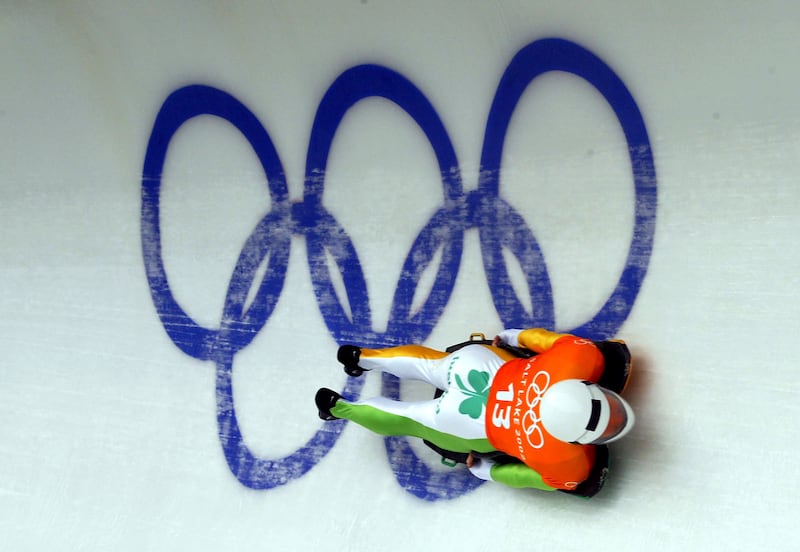 Clifton Wrottesley of Ireland practises in the men’s skeleton during the Salt Lake City Winter Olympic Games at the Utah Olympic Park in Park City, Utah. Mike Hewitt/Getty Images
His full title is the sixth Baron Wrottesley, Sir Clifton Hugh Lancelot de Verdon Wrottesley. He’s always described all that as an accident of birth, never used unless occasionally requesting a good table at a busy restaurant.
Born in Hatch Street in Dublin, he spent his first two years in Abbeyknockmoy, Co Galway, before tragedy forced him and his young mother to move to Spain. His father, Richard Wrottesley, also known for his Winter Olympics pursuits, was killed in 1970, crashing his e-type Jaguar into Ballinamore Bridge.
Wrottesley has never denied inheriting the thrill-seeking gene from his father, although, again, the skeleton was never any reckless pursuit. He was 33 by the time he qualified for Salt Lake City and he’d need to prove his dedication in the financial sense, too.
“A couple of years out from Salt Lake City, I gradually began to feel I could make a go of it. I started to get some decent results on the Continental Cups, in North America and Europe. Then in 2001, went on the World Cup circuit, qualified for the Olympics that way.”
Even with his Irish passport in hand, he still needed to charm the then Olympic Council of Ireland (OCI), even with his naturally aristocratic reserve and a cut-glass accent.
“The first people I approached were the Irish Bobsleigh Association, they just said, ‘what’s the skeleton?’ It wasn’t even on the radar then, so can’t really blame them. But in fairness, they told me if I could self-finance, they would sign off on my licence, which allowed me to take part.
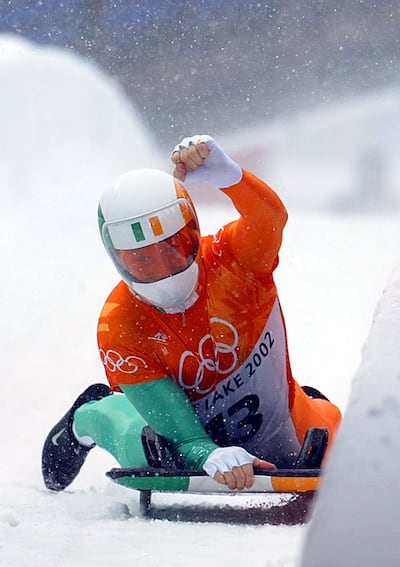 Clifton Wrottesley of Ireland celebrates finishing fourth in the men’s skeleton during the Salt Lake City Winter Olympic Games at the Utah Olympic Park in Park City, Utah. Photograph: Mike Hewitt/Getty Images
“Then I went to the Irish Sports Council, and I recall their ceo [chief executive], John Treacy, was pretty sceptical. To give him his due, Pat Hickey [then OCI president] said, ‘yes, let’s back the guy’, although he later left under a bit of a cloud. So we got a little bit of funding from the Olympic Council, but the vast majority, maybe 90 per cent of it, was self-financed.”
Already well versed in the Park City track in Utah, Wrottesley went into his first skeleton run, a large shamrock emblazoned on his rear, hoping to break into the top 10 among the 26 starters. He ended up clocking 51.07 seconds, sitting third, just 0.18 off gold.
Expectations suddenly soaring, 90 minutes later, Wrottesley possibly undercooked his start on the second run, dropping to fourth, .42 behind Gregor Staehli from Switzerland. Still, 24 years later, nothing whatsoever about that cold day in Utah haunts him.
“Okay, you do have the odd fleeting thought, ‘what might have been’, but that’s quickly replaced by the memories of the experience. I wasn’t expecting to be in the medal positions. You prepare yourself for different outcomes, so you can respond accordingly. But that was one scenario I hadn’t planned for.
“Gregor Staehli is a good friend now, runs the bob-track up in St Moritz, and I’d have felt like I’d robbed him. He’d been on the circuit for eight years, a double World Champion. So it was the right result.”
Six years after Salt Lake City, Wrottesley served as chef de mission for the OCI, and skeleton coach, at the 2006 Winter Olympics in Turin. He coached Dave Connolly to skeleton qualification that year, and in Vancouver 2010, Pat Shannon also qualified in the skeleton, along with Aoife Hoey and Claire Bergin in the bobsleigh. Seán Greenwood also qualified for the skeleton in Sochi 2014, but since then, Irish interest in the sliding events has fallen off.
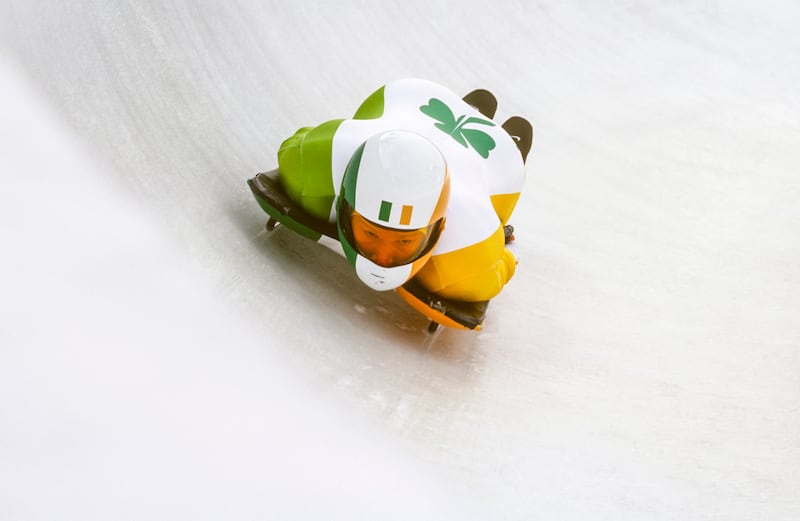 Clifton Wrottesley on a training run during the 2002 Winter Olympics at Utah Olympic Park near Salt Lake City, Utah. Photograph: David Madison/Getty Images
Only four Irish athletes have made Milano-Cortina, the smallest team since Turin 2006, and Wrottesley believes a lot more can be done. Starting with facilities and funding, Dublin being the only European capital city without a permanent ice facility. He also points to the between five and 10 medal hopes of Team GB.
“Principally because they’re well funded,” he says. “It’s not much more complicated than the support it gets from UK Sport. They saw certain sports where we had some history in, or could certainly build some momentum.
“In skeleton, Team GB have won seven medals since 2002, still don’t have a home track. It shouldn’t take much for the Irish Government to look at the benefits of putting in a permanent ice rink, such as the arena proposed in South Dublin.
“It’s not an excuse to say, ‘we’re not a winter sport nation’, because you can build programmes off the back of desire, ambition, and some vision. There are opportunities, just by putting some infrastructure in place for ice sports, everything from short-track speedskating, figure skating, to ice hockey, all out of one facility.
“You could help inspire the next generation of Irish Olympians. That reach of winter sport is not something Ireland should shy away from.
“For me, that fire still burns, even if I’m well past competing myself, I still love seeing the joy that it brings to people. Not just the experience most people will never have, [but] also how it can affect people’s life chances.”