
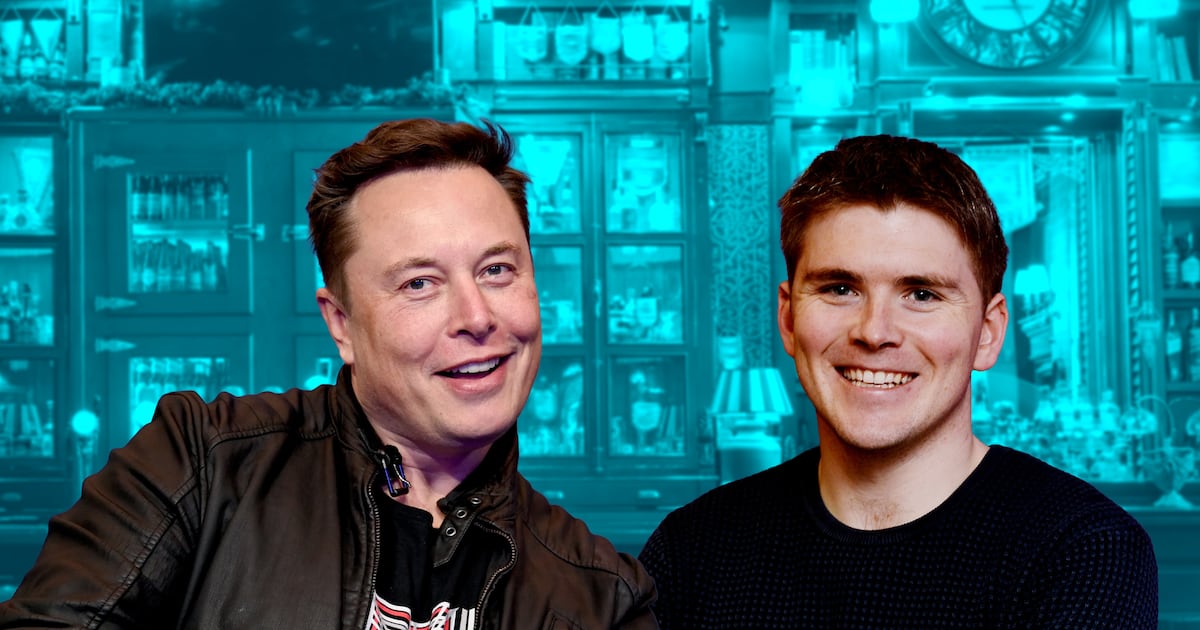
Two billionaires and a wealthy podcaster walk into a simulation of a bar. John Collison, Ireland’s second-richest man, and the podcaster Dwarkesh Patel are interviewing Elon Musk, the world’s richest man, over a “cheeky pint” (the name of Collison’s occasional interview podcast).
There are, believe it or not, many podcasts now in which billionaires sit down and discuss the future while congratulating one another. Think of 18th-century literary salons but with more business jargon.
Musk wears a black T-shirt featuring the words “Optimistic Prime” written in comic sans atop a picture of the transformer Optimus Prime (he named his Optimus robotics project after him). He has his usual halting delivery and tired, inexpressive face. When he smiles the naturally downturned corners of his mouth move upward.
Collison is wearing a dark shirt and a sceptical look. He has a relaxed posture except when the conversation moves to politics and he becomes a little fidgety. Patel sits very straight in a short-sleeved white shirt and he generally asks the harder questions. They are drinking Guinness like the common man. Musk and Collison have three pints each over the course of the almost three-hour long conversation. Patel leaves his pint largely untouched.
The conversation is by its nature mainly about Musk but it’s still relatively revealing about Collison’s worldview. For Musk watchers there’s information about his management style (annoying), technology (complicated) and some hints on his company’s future mergers (complicated and annoying). But I don’t really care about any of that. Here are my takeaways:
1. Their concerns are not our concerns. The conversation begins with Patel and Collison interrogating Elon Musk on his desire to build data centres in space.
2. Despite all three men being immigrants to the United States, when they refer to America’s future, not the future of the world, they say “we”. All rich people see themselves as Americans in waiting, ultimately.
3. They seem to see the human future as a series of technical, engineering issues. They have lots to say about putting data centres in space or moving rocket production from carbon to steel, but they have few insights about what the world will eventually look like for ordinary people.
4. Indeed, when Collison asks Musk about the more immediate impacts of AI they end up talking about how robots will replace labour in their companies. This feels like a very billionaire angle to take on the issue.
[ Michael O’Leary beats Elon Musk in the business of insultsOpens in new window ]
5. They show a general lack of interest in philosophy, psychology, sociology or, indeed, any form of knowledge outside of science. Musk’s conception of AI, for example, suggests all questions have right and wrong answers, which isn’t really how wider systems of knowledge actually work.
6. Musk believes humans will ultimately lose control of AI and he seems to have adapted his dreams of spreading humanity to the stars to dreams of spreading humanity’s machines to the stars. When Patel asks what happens to humans in this scenario, Musk references chimpanzee sanctuaries and says, “Even though humans could exterminate all chimpanzees we’ve chosen not to.” (I suspect he actually sees this as a “billionaire sanctuary”).
7. Based on this alone, I do not know why anyone listens to this man. Nobody in this conversation ever asks: “Should we do this?” It’s taken as given that technological development is inevitable and non-negotiable.
8. Musk says twice “I’m very pro-human”, which is a weirdly chilling thing to hear.
9. Musk references 20th-century sci fi – in this conversation Robert Heinlein, Arthur C Clarke and Iain M Banks – but does not seem to understand it. For example, Musk, an arch capitalist, believes the future of Banks’s Culture novels are a good template for the AI future, despite Banks describing these books as depicting “space socialism”. Banks also said this in an interview with me in 2012: “We haven’t really grasped the nettle of turbo capitalism and the ‘greedists’ … I think they’re evil and wrong.”
10. In short: Iain M Banks would hate this conversation.
[ Tesla to sell Optimus robots to public next year, Elon Musk saysOpens in new window ]
11. When discussing Doge (Musk’s Department of Government Efficiency), Musk repeats the debunked claim that 20 million dead Americans were on social security rolls. This largely goes unchallenged. Patel, in fairness, pushes back on some of Musk’s more outlandish claims but Collison just seems uncomfortable.
12. They do not ask Musk about Doge’s purge and eventual shutdown of USAid, which is estimated to have caused hundreds of thousands of deaths worldwide.
13. Collison and Patel’s relative lack of interest in Musk’s amplification of racism and transphobia on the X platform, or his appearance in the Epstein files or his relationship with Donald Trump suggests a belief, on their part, that progress is an ideologically neutral product of engineering savvy rather than social movements and ideological position. There’s almost a sense that those petty things are beneath their interest.
14. These billionaire love-ins feel cult-like. They’re a brew of 20th-century science fiction and Randian libertarianism. Increasingly, they also let autocratic tendencies go unchallenged. Silicon Valley is not ideology-free.
15. John Collison knows better than this. He and his brother have shown interest in influencing government policy in Ireland and abroad. I have more faith in them than in Musk, but I would like them to talk publicly with a wider range of people. There are people all over this city who know more about life than Musk has even dreamt of. Their choice, ultimately, will be whether they want to align themselves with other billionaires or with the rest of us.