
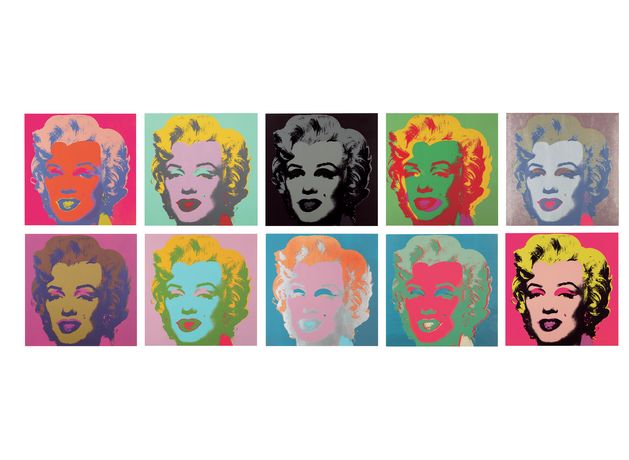
There are few prints more coveted than Andy Warhol’s Marilyn Monroe series, and they only occasionally turn up in Ireland, for eye-watering sums
Warhol’s Marilyn prints only turn up in Ireland occasionally and are beyond the reach of almost everyone. Gormley sold a green, yellow and red Marilyn for €127,013 in 2021. He’d previously sold a pink and red Marilyn for €161,657 in 2017. Some colours are more popular than others, and this has a bearing on the price, as does the condition of the print. In October 2025 a pink Marilyn sold at Sotheby’s, New York, for €240,982.
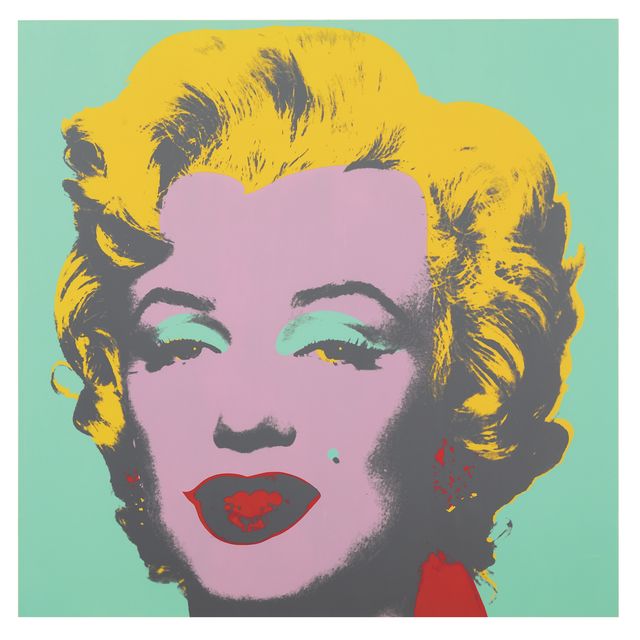
Andy Warhol Marilyn Monroe series, Factory Additions, 196. Photo courtesy of Christies
By the time Andy Warhol made his iconic print of Marilyn Monroe, the actor was already dead. Monroe died of an overdose in 1962. Her death was probably suicide, but swathed in speculation. She was 36 years old. The contrast between her dazzling on-screen presence and the mundane tragedy of her personal life transformed her into an icon, while overshadowing her considerable talent.
Warhol created the print series from a publicity still. The film, Niagara (1953) was shot in Technicolour with Monroe in the role of femme fatale. In 1967, Warhol reworked the image into a series of 10 screen prints (36 x 36 inches) in 10 colourways. Each was printed in an edition of 250 (2,500 prints in total). The prints were signed by Warhol and published by Factory Additions.
In My Art Broker (January 2026) Charlotte Stewart writes: “In the Marilyn prints, the woman is stripped of context: no background, no narrative, just a floating head against flat colour fields. The effect is closer to a religious icon than a Hollywood portrait. Identity is reduced to a mask – bright lips, heavy-lidded eyes, a graphic silhouette.” In Warhol’s treatment, Monroe’s character is erased. The person behind the print becomes a brand.
Warhol was preoccupied with celebrity and mass production, and Marilyn is the most famous (as well as the most expensive) of his prints. As Stewart writes: “It embodies his clearest thinking about fame, reproduction and surface, while offering collectors something that feels emotionally charged, historically important and commercially reliable.”
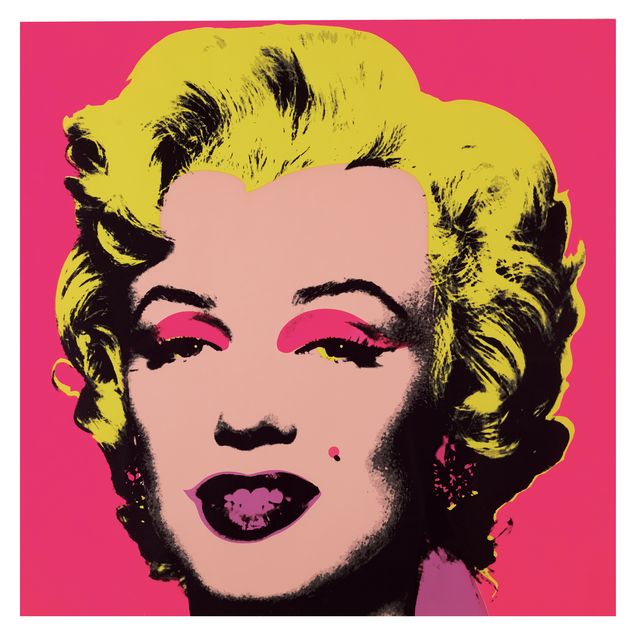
Andy Warhol Marilyn Monroe series, Factory Additions, 1967. Photo courtesy of Christies
This was Warhol’s first series of prints and established a structural template for later print editions. Originally, the portfolio was sold as sets: 10 colourways with identical edition numbers across all ten sheets. Now, matching-number sets are rare. In December 2025, a series of 10 Marilyn prints sold at auction in Munich for €3,600,000.
In 2022, Warhol’s Shot Sage Blue Marilyn sold for $195 million at Christie’s, New York. It became (briefly) the most expensive 20th century artwork ever sold at public auction. This was an original artwork, not a print, but the high price underscored the power of the image. Christie’s described it as “one of the rarest and most transcendent images in existence.”
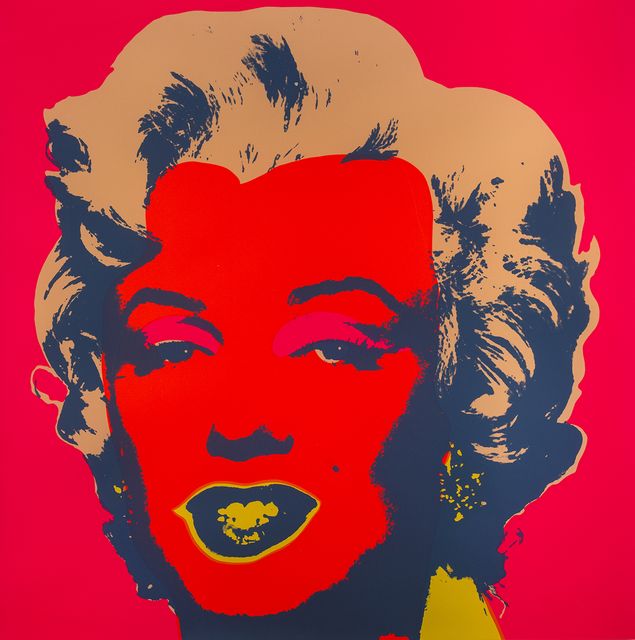
Marilyn Monroe 11.31 Sunday B. Morning screenprint. Photo: Bernard van Giessen
In 1970, Warhol began collaborating with Sunday B. Morning, a printing company in Belgium, on a second series of Marilyn prints. These were based on the negatives to his Factory Additions series, with additional colourways, and had a black ink stamp on the back: “fill in your own signature.” The idea, presumably, was to play with mass production and disrupt the relationship between authorship and value.
After this, the story becomes hazy, but it seems that Warhol got cold feet. He severed ties with Sunday B. Morning, but the print company already had the negatives and colour codes. In 1970, they published three series – Marilyn, Flowers, and Campbell’s Soup Cans – in editions of 250. Warhol, who now disapproved of the enterprise, signed several of the Sunday B. Morning prints: “This is not by me. Andy Warhol.” The layers of irony are multiple. Their value soared.
The original 1970 Sunday B. Morning Marilyn prints are rare and valuable. More recent reproductions are stamped in blue, instead of black, and sell for hundreds rather than thousands. They’ve no particular investment value, but it’s an affordable way of buying into the legend and having a Marilyn on your wall.
There are three 2018 Sunday B. Morning Marilyn prints (each est. €800 and €1,000) at Lot 100’s Modern & Contemporary Art sale, which closes on 10 February.
See gormleys.ie and lot100.ie.