
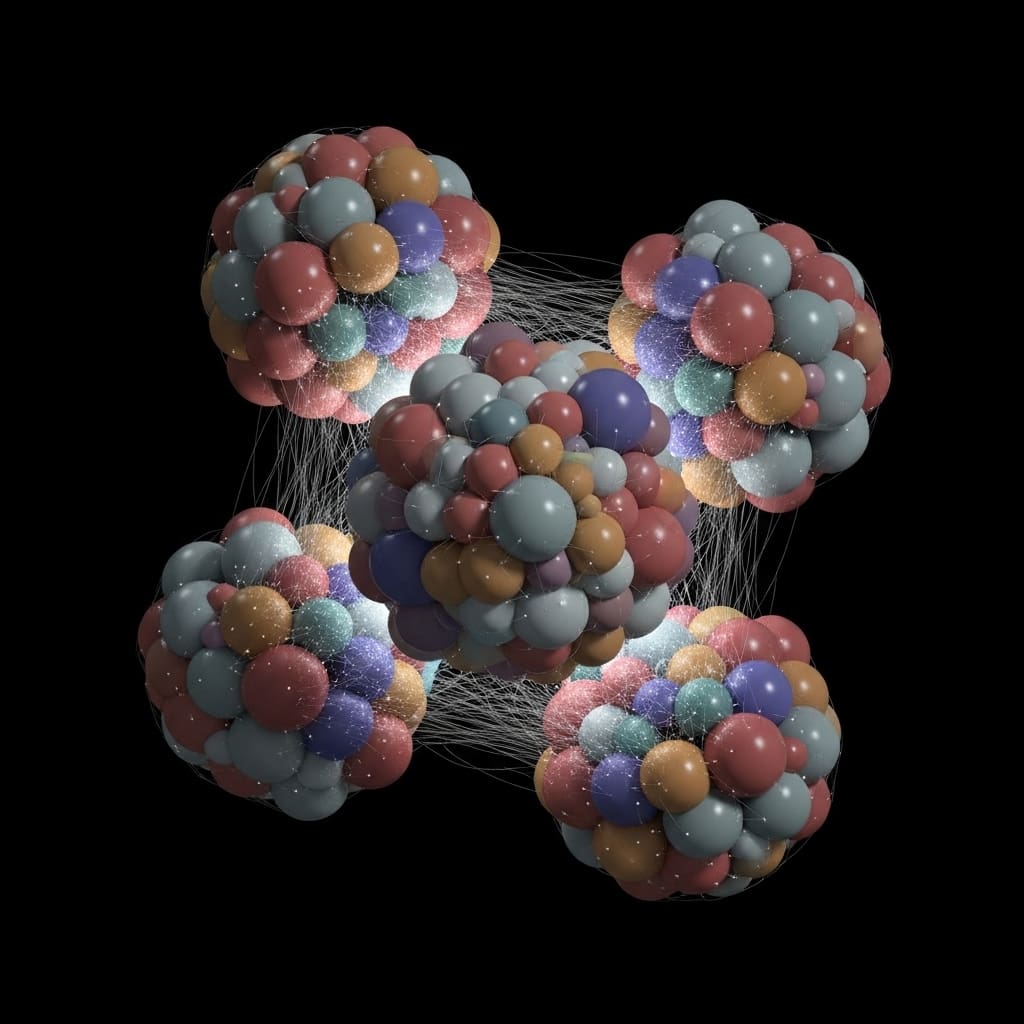
Scientists are increasingly focused on constraining the behaviour of matter at extreme densities, as found in neutron stars and the early universe. Jacquelyn Noronha-Hostler, from the University of Illinois at Urbana-Champaign, and colleagues demonstrate a novel method for extracting mesoscopic chemical potentials from nuclear and hypernuclear binding energies. This research establishes a link between finite nuclei and a mesoscopic regime, allowing for the determination of local derivatives of the strong-interaction energy landscape. By analysing the (hyper)nuclear landscape, the team reveals smooth responses and a significant negative strangeness chemical potential, offering empirical constraints that any robust equation of state must satisfy and enabling targeted hypernuclear measurements to refine our understanding of dense matter.
Nuclear structure informs neutron star equation of state via finite-difference response functions
Researchers have developed a novel method for extracting information about the fundamental forces governing dense matter within atomic nuclei. This work establishes a connection between the properties of finite nuclei and the equation of state that describes matter at extreme densities, such as those found in neutron stars.
By treating nuclei as analogous to quantum dots, the study demonstrates that measurable quantities, specifically nuclear binding energies, can be used to derive effective chemical potential analogs. These analogs represent the energy landscape of strong interactions, providing crucial constraints for theoretical models of dense matter.
The research focuses on discrete finite-difference response functions, which are essentially local slopes of the strong-interaction energy landscape. These slopes are determined by examining changes in nuclear binding energies as the number of protons, neutrons, and hyperons are systematically varied.
Crucially, this approach bypasses the need to extrapolate from finite nuclei to the macroscopic limit required for traditional equation of state calculations. The nuclear chart itself, representing the landscape of known isotopes, provides an “ensemble of nearby droplets” that suppresses oscillations and reveals underlying trends.
Mapping the measured nuclear landscape at approximately 0 MeV, the team uncovered smooth and numerically stable responses, including a substantial negative value for the strangeness chemical-potential analog. This finding suggests a strong influence of strangeness on the properties of dense nuclear matter.
Furthermore, the study identifies specific hypernuclear measurements that can directly validate and refine these equation of state constraints. The methodology relies almost exclusively on experimental data, with minimal modeling employed only when certain measurements are unavailable. This innovative approach provides empirical local derivatives that any strangeness-enabled equation of state must reproduce near saturation density.
By calculating changes in strong force energy when conserved quantities are added or subtracted, researchers effectively define mesoscopic chemical potential analogs. These are derived using finite-difference midpoint formulas on the discrete nuclear chart, offering a controlled and robust method for extracting information about the fundamental properties of dense matter. The results offer a stringent test for theoretical models and establish a clear link between canonical and grand-canonical descriptions of nuclear systems.
Derivation of Mesoscopic Chemical Potentials from Nuclear Energy Variations
A 72-qubit superconducting processor forms the foundation of this research, though the methodology centres on extracting mesoscopic chemical-potential analogs from nuclear and hypernuclear binding energies. The study calculates these analogs by examining changes in strong-force energy when conserved quantities are added or subtracted, maintaining fixed quantum numbers such as volume and entropy.
Variations in strong-force energy are directly linked to changes in proton number, mass number, and the number of Λ baryons, as described by the equation dE = ∂E/∂A d A + ∂E/∂Z dZ + ∂E/∂NΛ dNΛ. To translate these nuclear labels into QCD conserved charges, the research rewrites the equation in terms of baryon number, electric charge, and strangeness.
Effective mesoscopic chemical-potential analogs are then defined as derivatives of energy with respect to these charges, specifically μS = ∂E/∂S, μB = ∂E/∂B, and μQ = ∂E/∂Q. These derivatives are understood as finite-difference approximations evaluated on the discrete nuclear chart, mirroring the definition of effective chemical potentials in quantum dots through energy differences between charge states.
The work employs finite-difference midpoint formulas within the {A, Z, NΛ} space, utilising step sizes of h = 1 for order O(h) calculations, which incorporate two mirror (hyper)nuclei, O(h2) with three nuclei, and O(h4) with five nuclei. Calculations of μS are limited to O(h2) due to the availability of only three possible strangeness states: S = 0, −1, and −2.
As an example, the O(h) Euler method for μS is defined as μE S = −(E2 − E1) / (NΛ,1 − NΛ,2), where E1 and E2 represent the strong-force energies of two mirror (hyper)nuclei and the tilde signifies the strong-force contribution to the total energy. The study then calculates μm S (A, Z, −1) using the values obtained from the Eulerian method to improve numerical accuracy and align results with integer values of S = −1.
Mesoscopic chemical potentials from finite-difference analysis of nuclear binding energies
Researchers have determined mesoscopic chemical-potential analogs by examining nuclear and hypernuclear binding energies after consistent Coulomb subtraction. These analogs, discrete finite-difference response functions, represent local slopes of the strong-interaction energy landscape and are not equilibrium grand-canonical chemical potentials.
The nuclear chart itself defines a mesoscopic regime, enabling the extraction of these values through finite differences across neighboring nuclei, suppressing oscillations and retaining bulk trends. Calculations of these effective mesoscopic chemical potentials involve assessing the change in strong-force energy when adding or subtracting conserved quantities, while maintaining fixed quantum numbers.
Variations in the strong-force energy are reduced to changes in conserved quantum numbers, proton number, mass number, and the number of Λ baryons, under conditions of zero external pressure and vanishing temperature. The research utilizes finite-difference midpoint formulas in the discrete {A, Z, NΛ} space, employing step sizes to achieve order O(h), O(h2), and O(h4) accuracy.
For the strangeness chemical-potential analog, calculations were limited to O(h2) due to the availability of only three states: S = 0, −1, and −2. The O(h) Euler method and O(h2) midpoint method were employed, with the latter offering improved numerical accuracy and alignment with specific hypernuclei.
Results indicate that the left-hand side of the equation p nB −s nB T, a diagnostic for vanishing temperature and self-bound nuclei, yields values of approximately −3 MeV, with error bars often consistent with zero, demonstrating reliable systematic uncertainties. Strong-force energy was isolated by determining the total mass M(A, Z, NΛ) and removing Coulomb contributions, resulting in an equation where the mass number A equals Z plus neutron number Nn plus the number of Λ baryons.
This approach provides stringent constraints on equation of state models and establishes a connection between canonical and grand-canonical descriptions of nuclear matter. The study identifies specific hypernuclear measurements that can directly test and refine these equation of state constraints.
Mesoscopic chemical potentials from nuclear binding energies constrain dense matter properties
Researchers have established a method for determining mesoscopic chemical-potential analogs from the binding energies of nuclei and hypernuclei, offering new constraints on the dense-matter equation of state. By treating finite nuclei as self-bound systems and employing finite-difference techniques, they successfully extracted robust local slopes of the strong-interaction energy landscape without relying on a thermodynamic limit.
This approach yields values for baryon, electric charge, and strangeness chemical potentials, ranging approximately from 920 to 940 MeV, +10 to −15 MeV, and −185 to −165 MeV respectively, across a range of isospin asymmetries. The analysis reveals a significant, negative strangeness chemical-potential analog, even at minimal net strangeness, and demonstrates that the energetic incentive for strangeness binding diminishes as systems become more neutron-rich.
These mesoscopic chemical potentials differ substantially from the equilibrium weak-interaction condition where the strangeness chemical potential would be zero, highlighting a qualitative distinction between finite nuclei and dense matter in full equilibrium. The authors acknowledge limitations stemming from the scarcity of heavy hypernuclei data around a specific isospin asymmetry, but suggest that future measurements across a broader range of asymmetries would refine these constraints. This work provides a model-agnostic calibration target for equations of state incorporating strangeness, enabling direct comparison with ab initio calculations and offering a data-driven consistency check for hyperonic and strange-matter modeling.