
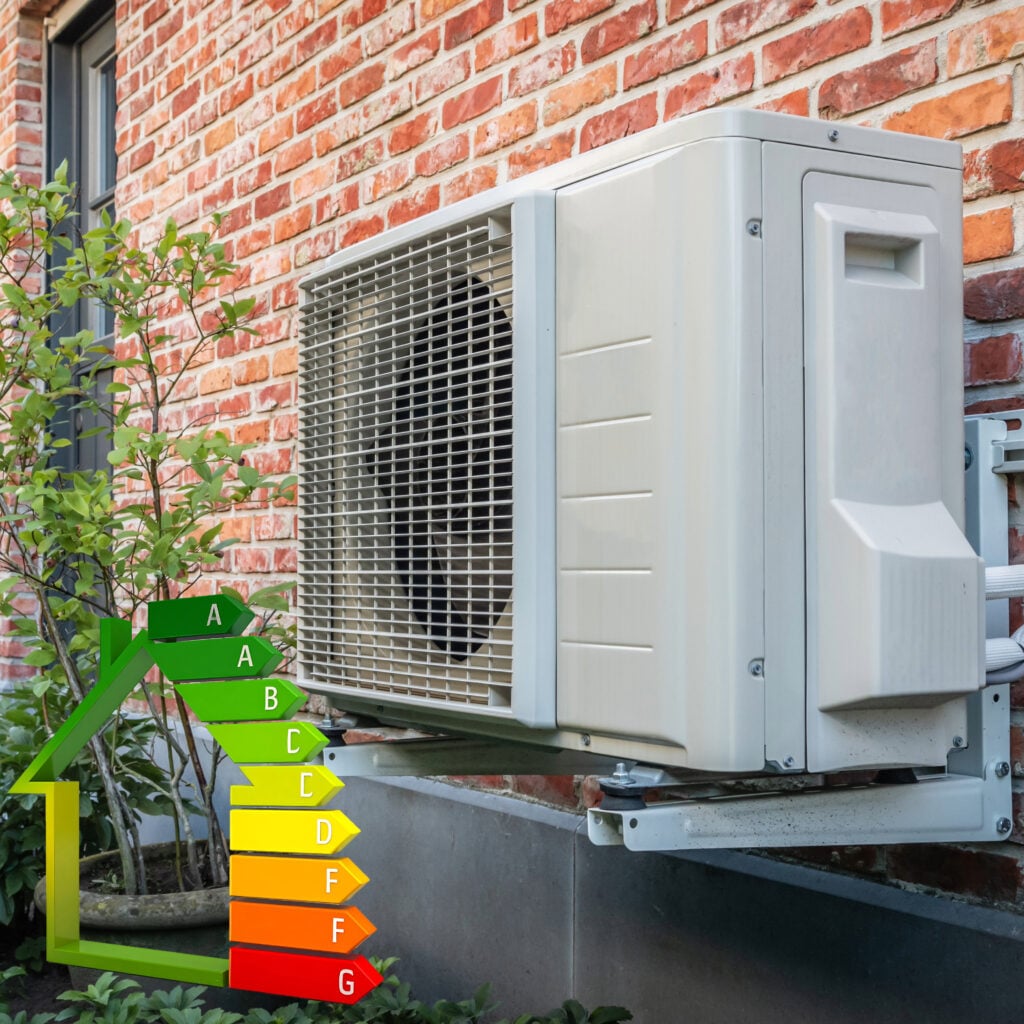
Landlords could be forced to install heat pumps to meet EPC C targets, as rumours suggest the government is considering rules that could prevent properties with gas boilers from achieving an EPC C rating.
A story in The Telegraph claims that with the government changing the way EPCs are calculated using a new metric system that measures a property’s fabric performance, smart readiness, energy cost and heating system, ministers could decide to include a cap on the maximum rating a home heated by fossil fuels can achieve.
The news comes as the government announced all private rented properties will need to meet EPC C targets by 2030.
Electric heat pump would meet EPC C standard
The Telegraph claims landlords must hit an EPC C rating for fabric performance, which looks at insulation and windows, and can then choose two other metrics.
The smart readiness metric scores a property’s ability to generate its own electricity, with a C rating usually requiring solar panels and a smart meter.
The Telegraph claims the government is considering rules that would stop properties heated with fossil fuels, such as a gas boiler, from achieving a C under the heating system metric, while an electric heat pump would automatically meet the standard.
An industry body warns that forcing landlords to install heat pumps could be costly and difficult, especially in older properties.
Installing heat pumps is neither straightforward nor affordable
Tim Thomas, senior policy and campaigns officer from Propertymark, told The Telegraph: “Under the reformed EPC framework, many landlords will effectively be forced to install specific technologies, such as heat pumps or solar panels, in order to meet an EPC C rating.
“For a large proportion of the existing housing stock, particularly older, rural, or hard-to-treat properties, this is neither straightforward nor affordable.”
He adds: “There is currently insufficient skilled workforce capacity, limited access to grants or long-term financial support and ongoing uncertainty around how the new EPC metrics will operate in practice.
“Existing funding schemes are also highly restrictive, with strict eligibility criteria often dependent on tenant circumstances, household income thresholds or whether a property is located in a deprived area.”
Every renter deserves a decent and affordable home
According to the National Residential Landlords Association (NRLA), landlords can still meet the fabric performance metric with a gas boiler.
The NRLA explains on its website: “It is agnostic of the heating system, meaning a gas boiler does not prevent a property from meeting the fabric standard. That said, properties with solid walls or complex layouts may face additional challenges, and the final methodology will determine how factors such as heat-loss perimeter are assessed.
“While a gas boiler is unlikely to meet the heating system metric under the new EPC, landlords can instead choose to meet the smart readiness metric, for example, through measures such as solar PV or smart controls. This provides flexibility and avoids forcing premature or impractical heating system changes.”
According to The Telegraph, the government’s own impact estimations of the EPC rules predict that landlords will install 937,698 solar panel systems and 108,749 heat pumps by 2030.
A Department of Energy Security and Net Zero spokesman told The Telegraph: “Landlords will not be forced to install a heat pump.
“We stand by the principle that every renter has the right to a decent, safe and affordable home, and almost half of privately rented homes already meet the standards.
“The new standards have been welcomed as a positive step forward by both tenant and landlord groups.”
Have your say by commenting below