

“Try to keep your cool,” my 16-year-old daughter instructed as I left the house to interview Andrew McCarthy.
The night before we had rewatched one of his most enduring movies from the 1980s, Pretty in Pink. That movie turns 40 years old this year, but the universal language of teenage longing is so perfectly expressed in John Hughes’ script (and exceptional soundtrack) that it seems to defy the decades, appealing to 16-year-olds both then and now.
Key to the film’s endurance is the performance of fresh-faced McCarthy, who plays sensitive high school heart-throb Blane to Molly Ringwald’s red-haired thrift store heroine Andie. It’s a movie that perfectly captures what it’s like to be a teenager in love.
Everybody, including my daughter, knows those teenage feelings are so powerful, so deeply felt that they can easily resurface in, say, a journalist in her mid-50s, even in a professional setting. Of all the movie stars of the 1980s, McCarthy, star of St Elmo’s Fire, Mannequin, Less Than Zero and the gloriously silly Weekend at Bernie’s, was the heart-throb who stole my teenage heart. As he sits before me sipping coffee in an inner-city Dublin hotel, 63 now, brow slightly more furrowed, but still unmistakably Andrew McCarthy, I try to keep my cool.
He’s here to talk about his role in The Crucible, Arthur Miller’s allegorical play about the Salem witch trials of the late 17th century. It’s a play about mass hysteria, paranoia and false accusations. It feels timely? “Unfortunately, it’s always timely,” says McCarthy.
Rehearsals for the show, which also stars Charlene McKenna and Rory Nolan, are taking place nearby. He’s enjoying the challenge; it’s 20 years since he has acted on stage. “I always thought, when I got old I would go back to it. And now I’m old I think I should go back to it while I can still walk,” he smiles. He does a fair bit of hot yoga, so the not walking part is probably still a while off.
In the past 20 years he has carved out two other careers, becoming an acclaimed travel writer and editor-at-large for the National Geographic, and the author of several compulsively readable travel books/memoirs. His work as a director includes shows such as Orange Is the New Black and Gossip Girl. But it was acting that always helped him “make sense to myself … when I look back on being in plays, it was the happiest time. It was just a lovely way to be.”
His role in The Crucible was the bright idea of casting director Maureen Hughes. McCarthy hired Hughes 25 years ago when he was working on his first feature as a director: a short film of the Frank O’Connor story News for the Church that was shot in Ireland and later screened at the Galway Film Fleadh, where he first met his Dublin-born wife, the film-maker and playwright Dolores Rice (more on that real-life romcom later). The couple have homes in Dublin and New York, and two children, Willow (19) and Rowan (11), together. McCarthy has another son Sam (23) from his first marriage, to actor Carol Schneider.
At the moment, Rice is back in New York. “I was walking down Dame Street earlier, on a call to her, and she was saying how strange it is that I am here and she’s over there,” he says. “She asked if I was enjoying myself, and of course I am. No matter where they are, actors always enjoy it when they are doing good work.”
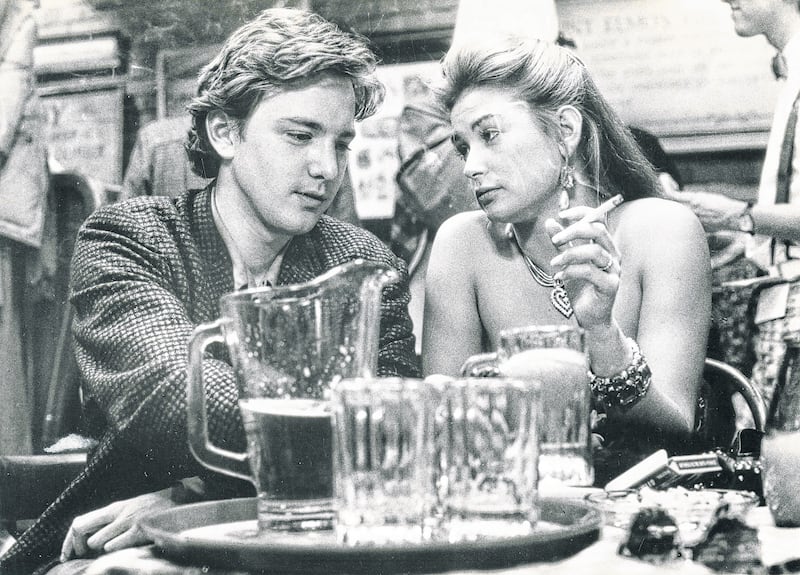 Demi Moore and Andrew McCarthy in St Elmo’s Fire
The Crucible, one of the plays most frequently performed around the world, is “good work”. Writing in the New York Times in 1996, 50 years after he wrote this theatrical allegory for the anti-communist McCarthy era in America, Miller reflected on his inspiration. He could have been writing about America today: “Gradually, all the old political morality had melted like a Dali watch … the thought that the state has lost its mind and is punishing so many innocent people is intolerable. And so the evidence has to be internally denied.”
“He was a very smart man, wasn’t he?” McCarthy says when I read him the quote.
In his memoir Brat: An ’80s Story, the actor gave a compelling account of another McCarthy era, when young actors such as James Spader, Rob Lowe, Demi Moore and Ally Sheedy came to prominence under the Brat Pack tag coined by a writer in New York magazine.
McCarthy made it big but got lost for a while in a haze of fame, fear and alcohol addiction. His early life in showbiz had a much more wholesome origin story. At 15, he was cast as the Artful Dodger in his New Jersey High School’s production of Oliver!
“Acting saved my life,” he writes in the book. “When I stepped on stage as the Artful Dodger, all those years ago, a light went on inside me that has never gone out. I came close to extinguishing it through alcohol, but my subsequent recovery, like a crucible, has only changed its form and added another you to its flame.” He has been sober for 34 years.
It’s interesting, given his latest role, that he used the crucible metaphor for his struggle with alcohol. We talk about our shared experiences of giving up drink, him decades ago, me more recently, the miraculous gift of it. For McCarthy, quitting was “an example of grace, exerting itself in my life. Something happened to me that I did nothing to earn, and it’s my obligation to acknowledge that every day. Because as any good drinker will tell you, all bets are off for tomorrow. My part of the deal is to acknowledge that grace acted upon my life. If I just acknowledge it every day, it’s like I’ve paid my parking for that day.
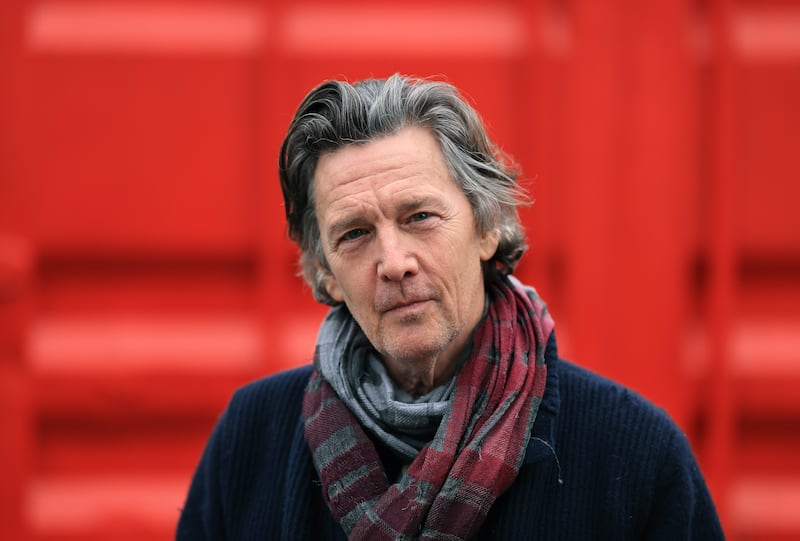 Andrew McCarthy: ‘Acting saved my life when I was young. Anybody who gets to do that for a living, to have a creative life, is very lucky … it’s a wonderful gift.’ Photograph: Dara Mac Dónaill
“There are moments in your life when you’re in a crucible, and they’re just awful. And the only thing you can do is wait for the transformation and just keep going. In hindsight we look back on them and say, ‘Okay, that moment happened in a crucible and thank God it did.’ But at the time, you know, it’s just hell.”
This is what McCarthy finds so captivating about the play. McCarthy plays Deputy Governor Danforth, the judge presiding over the witch trials.
“They’re in the middle of it, in this f**king hell, and everybody is right, everybody on every side is right. It’s just like in life. I’m playing this guy, he’s absolutely right, as far as the information they had at the time. There are witches, they are absolutely real, and my character thinks, ‘If we don’t do this as a society, we will perish and our souls will be damned to hell. I seem to be alone in having to save this,’ you know what I mean? It’s all life and death … Miller is accused of being such a moralist and you can take whatever side of that you like.”
McCarthy was in London recently to watch another Miller play, All My Sons, starring Bryan Cranston. “It’s the same thing, the inexorable tightening of the screws to the end. It’s just monumental on an emotional level. And Arthur Miller demands the truth.”
It’s the ultimate challenge. “You have to go there otherwise you risk a very embarrassing, cringey moment if you don’t fill it with truth … you can’t casually act your way through Arthur Miller. There are shows you can cover your ass with, but you can’t do that here. There’s nowhere to hide. You have to meet it and whether you’re able to meet it or not is another question. You’re going to find out.”
He seems to be relishing his impending return to the stage. As a young man he was a member of the “off, off Broadway” company Ensemble Theatre. He studied acting in NYU before he was kicked out for not attending classes.
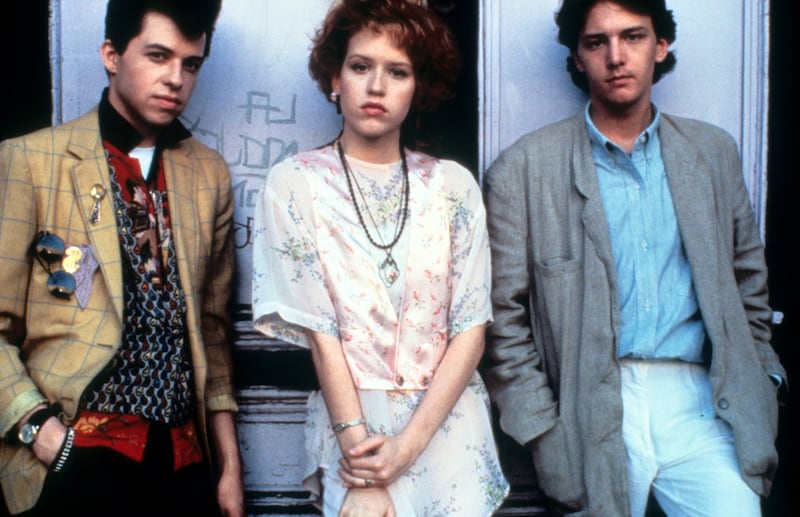 Jon Cryer, Molly Ringwald and Andrew McCarthy on set of the film Pretty in Pink, 1986. Photograph: Paramount/Getty Images
“All I ever thought about was being in plays, that’s what I was hoping to do. Then I was plucked from the weeds to be in a movie [Class] that changed the whole trajectory of my life. But it wasn’t the plan … there’s that sense of camaraderie in theatre. Because it’s a lonely business, right? You are on your own doing it. I happen to be a person who likes to be on their own, but when you get in the company of people it’s a nice feeling.”
In 1985, after filming Pretty in Pink, he starred in Boys of Winter on Broadway, a play about Vietnam veterans, with Matt Dillon, Ving Rhames and Wesley Snipes. “It was a wonderful play. It was before Vietnam became fashionable, at the time it wasn’t spoken about.”
His head was shaved for Boys of Winter, which became a problem when he was called back to Los Angeles to shoot a new ending for Pretty in Pink. The original ending had Andie, Molly Ringwald’s character, getting together with her kooky friend Duckie. But in test screenings teen audiences loved the movie but hated that conclusion, demanding the fairytale, Andie ending up with McCarthy’s character Blane. McCarthy had to wear a wig to shoot the reworked final scene at the prom where he whispers, “I love you, always,” into Andie’s ear. “It was a terrible wig. It’s really just bad wig acting,” he smiles.
It took McCarthy years to come to terms with how deeply people like me felt about his films, especially Pretty in Pink. In his memoir, he says the film represents “a moment of youth that transcends acting, that freshness was a quality not a skill”.
Forty years later he has come to understand why the film means so much to so many. He describes it now as being “like that five minutes at dawn … that moment in life when you are blossoming and it’s a beautiful, precious, fleeting moment. It’s thrilling. And everybody wants a piece of that, they want to recapture what that felt like … people come up to me and other people from that era or the Brat Pack and their eyes start glazing over. They’re not talking to me. They are talking to that moment in their own lives when your life is a blank slate to be written on … it took me decades to appreciate it and to realise what a gift that is, so I could just stand there and receive that gratitude from them. That’s what I think I am. An avatar of youth.”
I’m hoping my eyes aren’t glazing over (“try to keep your cool”) as we talk and I ask, as a sensitive person who enjoys solitude, whether he was suited to the level of fame he experienced in the 1980s. He doesn’t think anybody is.
 Andrew McCarthy on fame: ‘Everyone loses their shit over Hollywood success … sometimes when I observe it I lose respect for people.’ Photograph: Dara Mac Dónaill
“I always understood that it had no inherent value and that it wasn’t going to do what you hoped it would. I like the perks of it, but then again are they particularly good for me? No. Because the perks of fame involve vanity, ego and sex, and all three of those get you into trouble and we want them all. But is that the best thing for our development as human beings? Probably not, and yet you can still crave it because there is no stardom like movie stardom. I’ve seen people who are wildly successful in other fields lose their dignity over someone who is show business famous. And I’m amazed. Everyone loses their shit over Hollywood success … sometimes when I observe it I lose respect for people.”
Inevitably, fame altered some of his friendships and family ties. He already had a volatile relationship with his father as a younger person. “No son of mine is going to become a f**king thespian,” was his father’s reaction when he wanted to study acting. Later, when McCarthy became well known and wealthy, his father would often ask him for money. Later still, when his father was dying, McCarthy went to his bedside despite the fractured bond.
“I went for simply selfish reasons, to be a better parent to my own kids. We didn’t solve our past, we just put it down and that was wonderfully liberating.” How did it help his parenting? “It helped me get back to the love as opposed to the fear and resentment.”
For a long time, fear was a constant in McCarthy’s life. He has spoken and written about it a lot. “Fear was so ever-present that I was unaware of its existence. It’s like the old joke of the fish. Two fish swim by each other and one says, ‘Ain’t the water fine today?’ and the other one says, ‘What water?’ Many people refuse to acknowledge the fear, because it can be construed as weakness, particularly for a man. I found fear to be a dominant characteristic in my life. Why? I don’t know and it doesn’t matter. But I’ve experienced a great deal of it.”
His mother died recently; she had left his father decades before. He was with her, too, when she died. He mentions in passing that it was his wife, Dolores, who encouraged him to go to his father at the end. “She said, you need to go see your dad and I realised she was right.” In the acknowledgments of one of his books, he thanks Dolores, “who raises the bar on everything”. “Women tend to be wiser,” he says when I bring it up.
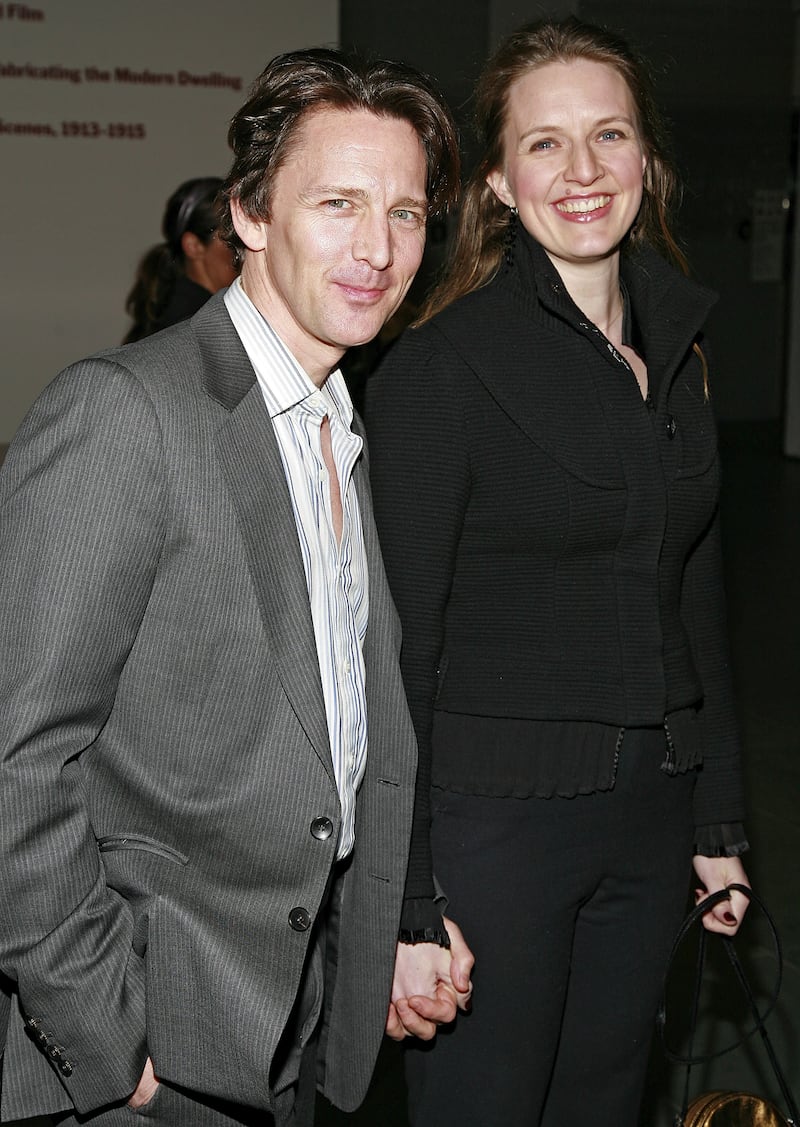 Andrew McCarthy with his wife, the Dublin-born film-maker and playwright Dolores Rice, in April 2008. Photograph: Charles Eshelman/FilmMagic
The story of how Andrew McCarthy ended up with Dolores Rice would make a fantastic, if slightly unbelievable, movie plot. At the age of nine, the story goes, Rice watched Catholic Boys at home in Dublin with a friend and announced, “When I grow up I’m going to move to America and marry that boy.” In 2004, all grown up, she spotted McCarthy in the lobby of the former Great Southern Hotel after a screening of his film. She went over to say hello and compliment his movie. They shook hands – a brief encounter that stayed with the actor for weeks afterwards.
In one interview, Rice told a journalist that during that short meeting she jokily relayed her childhood prediction of marriage to McCarthy. McCarthy is unsure about this. “I think if she told me that I probably would have run for the hills,” he says with a grin. Either way, a couple of weeks later he emailed the festival organiser for Rice’s contact number, pretending he’d mislaid it. They met for coffee when he was back in Ireland and spent the next several days together. His excellent and deeply personal book The Longest Way Home: One Man’s Quest for the Courage to Settle Down tells the story of how in the months leading up to their wedding day he went travelling alone to places as remote as Patagonia and Kilimanjaro as a way to prepare himself for that next momentous step in their relationship.
“That whole book is about the questions of how do we have intimacy and keep our inherent solitude? I think the answer is that it’s impossible but it’s the only game in town. I couldn’t be in a relationship where it’s ‘we’re together, we’ll do everything together’. His wife, he says, is “wildly extroverted and I’m on the other end of the scale. I can tip over from my solitude easily into isolation, which isn’t good for anyone. So it’s a balance game.”
I don’t think people or countries get rich gracefully and Ireland certainly didn’t
— Andrew McCarthy on the Celtic Tiger
It all worked out nicely in the end. In August 2011 McCarthy returned from his travels and Rice married “that boy”, celebrating with an al fresco party in Dublin’s Dartmouth Square.
McCarthy’s first trip to Ireland was back in 1986 where he met Tommy Ahern, a former captain of Lahinch Golf Club, who gave him an overseas life membership to the Co Clare course. He’s written a lot about Ireland, tracing his roots to Duagh, Co Kerry. How does he feel about how the country of his ancestors has evolved?
“When I first came things were pretty tough economically and then I saw the Celtic Tiger, when I think the Irish would be first to say they lost the run of themselves. I remember seeing someone decant white wine, that was a moment. I don’t think people or countries get rich gracefully and Ireland certainly didn’t. And then when it all fell apart, it came back to itself. I can’t speak politically, I don’t follow Irish politics, but Ireland seems to be in a nice place.”
His next book is called Who Needs Friends: An Unscientific Examination of Male Friendship Across America. The idea for it started with his son Sam. A couple of years ago Sam was sitting on the floor with his guitar, telling a story about one of his friends. “And then he looked up at me and said, ‘You don’t really have any friends, do you, Dad?’ The way a kid will just sort of say the truth from his perspective. And I said, ‘I do have friends, Sam, I just don’t see them, but I know they are there and that’s enough.’” His elder son went off to see his girlfriend. “I sat there with that. And I thought, ‘That’s not enough.”
McCarthy thought about the friends that were instrumental in his life. Like him, they’d moved on, had kids and lived whole lives. He hadn’t seen some of them in decades. “I needed to go and see these people. So I got in my car and drove 10,000 miles across 22 states and saw my old friends.”
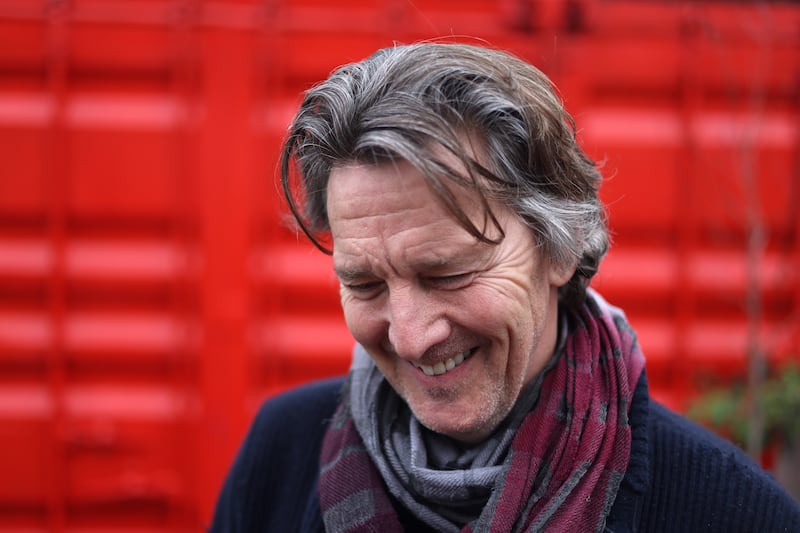 Andrew McCarthy on The Crucible: ‘The deeper you dig the more gold there is.’ Photograph: Dara Mac Dónaill
Along the way he started talking to other men, strangers, approaching them on the street to ask about their friendships. “There’s this loneliness epidemic. The statistics are staggering about men without friends. There are so many men that have no connections with other men. I’m very much a loner, someone who is happy in my own company. I can spend days without talking, but at a certain point it crosses that line, so it was great for me to go back and see my friends. It felt like suddenly there was a safety net under me that I don’t usually have or usually feel. That was a relief.”
As he drove across the US, he talked to his friends and strangers about the value of their platonic relationships. He didn’t talk politics with the new people he met. “It was clear where most people stood, and anyway, when you talk politics, there’s anger and defence and judgment. I wasn’t interested in that.”
Does he tend to avoid politics generally? “No, I get into it,” he says, laughing at the contradiction. “Just myself, on my phone, I try not to, I fail. I actively have to remind myself that I don’t need to listen to him speak again.” (He doesn’t need to explain who he means by “him”.) “You definitely come to the point where the time in front of you is limited, it’s like, I don’t want to be wasting my f**king time here.”
How are The Crucible rehearsals going? “I’ve spent so much of the last decade and a half directing television, where you’re the grown-up in the room solving problems quickly. This is not that. This is much more about process … this is a big play. The deeper you dig the more gold there is.”
He’s interested in observing himself as an actor. He’s noticing things: “Oh, this is easier now. Oh, that’s harder now. Oh, this is no effort at all.” He mentions Bob Dylan, “not that I am comparing myself to Dylan”, who was once asked to sing one of his early songs and said “I don’t do that any more, I do other things now”. Understandably, McCarthy can no longer capture the innocence of something like Pretty in Pink, “but I have other things I can do”.
Two of his three children are actors. His daughter Willow starred in Matilda on Broadway. His son Sam has been in television shows, most recently Goosebumps. Do his children ask him for advice about acting? “Well, not any more,” he laughs. “My son is smart enough to go, ‘If anybody else told me that, Dad, I’d think it was good advice. You telling me? I just can’t.’”
Given what he said earlier about fame, you might expect him to be wary of his children being actors. In fact, he is happy for them. “Acting saved my life when I was young. Anybody who gets to do that for a living, to have a creative life, is very lucky … it’s a wonderful gift. It’s a wonderful life. When all is said and done it’s been pretty good to me.”
Andrew McCarthy stars in The Crucible by Arthur Miller at the Gaiety Theatre from February 9th to March 21st