
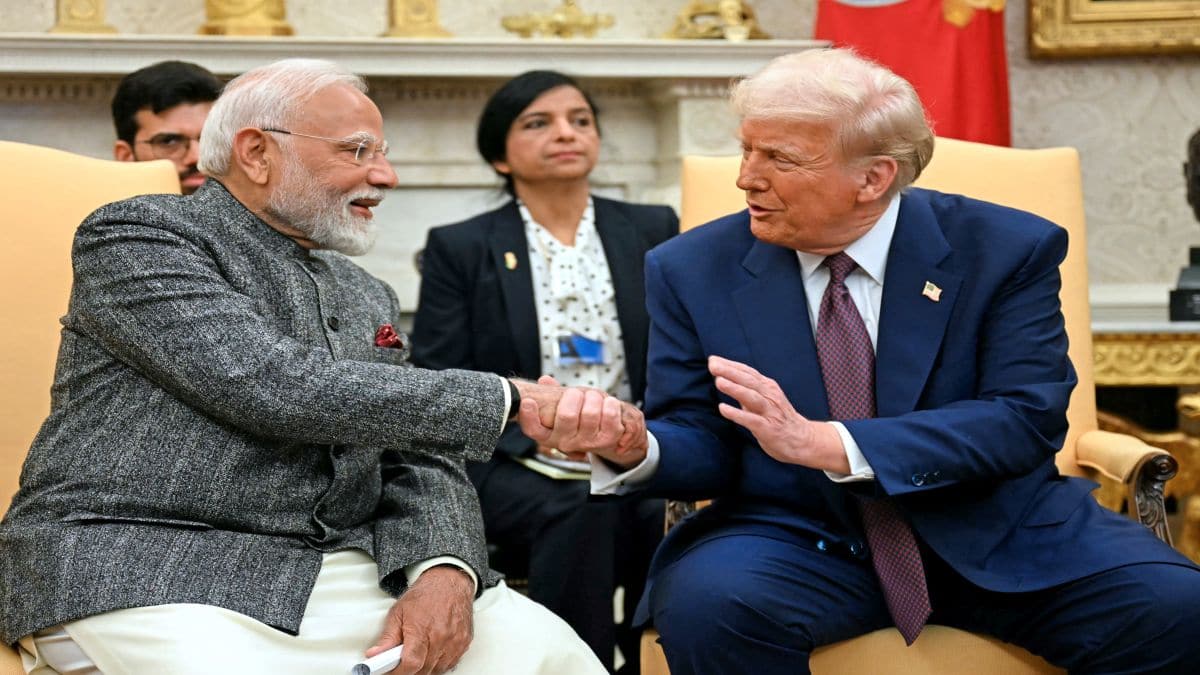
A trade deal reached between India and the United States is being projected as more than a transactional lowering of tariffs. It is being read correctly as a signal of deeper geopolitical alignment and as a catalyst for India’s long-cherished ambition of becoming a leading global manufacturing hub. Yet, as with most headline-grabbing trade announcements, the fine print remains elusive, the timelines vague, and the promises politically inflated. The real story lies not in the dramatic numbers being floated, but in the structural direction India appears to be taking.
STORY CONTINUES BELOW THIS AD
US President Donald Trump’s announcement that Washington would reduce tariffs on Indian imports to 18 per cent from 25 per cent, and scrap an additional punitive tariff linked to India’s purchase of discounted Russian oil, represents a significant de-escalation from the earlier hardline stance. Indian Prime Minister Narendra Modi’s confirmation framed around the boost to “Made in India” products underlines New Delhi’s core priority: export competitiveness and manufacturing scale.
At one level, the deal is a clear economic win. The United States remains India’s single largest export market, accounting for nearly 18 per cent of goods exports last year. Indian manufacturers in sectors such as textiles, engineering goods, pharmaceuticals and light manufacturing stand to benefit almost immediately from a more level playing field vis-à-vis Southeast Asian competitors. After years of tariff uncertainty under Trump’s “America First” doctrine, the reduction also brings a degree of trade policy stability, an underrated but crucial factor for exporters and investors alike.
At another level, however, this deal cannot be divorced from geopolitics. As Shilan Shah of Capital Economics observes, a durable rapprochement with Washington could pull India closer into the US strategic orbit. This is precisely where scepticism arises within India’s strategic community. Since independence, New Delhi has guarded its strategic autonomy fiercely, first through non-alignment, and later through “multi-alignment”. Any perception of India drifting wholesale into a US-led bloc is politically sensitive, even if practical cooperation has deepened over the past decade.
The question of Russian oil illustrates this tension perfectly. Trump’s claim that India would stop buying discounted Russian crude is widely viewed as implausible. Energy security, diversification of supply, and price arbitrage have driven India’s purchases from Russia since the Ukraine war. Analysts across the board agree that while India may gradually reduce its dependence as discounts narrow or geopolitical conditions change, it is highly unlikely to abruptly sever energy ties with Moscow. Strategic autonomy, in this case, is not an abstract principle but an economic necessity.
STORY CONTINUES BELOW THIS AD
Similarly, the headline figure of US$500 billion in promised American exports to India should be treated with caution. As Divakar Vijayasarathy notes, this is best read as a “political signalling number”. India’s current import capacity, balance of payments considerations, and domestic substitution goals make such a surge unrealistic in the short to medium term. What is far more credible is a targeted increase in imports, particularly in defence and aerospace, energy (including LNG and equipment), high-end machinery, and advanced technology. These are areas where India’s needs align with US strengths, and where long-term contracts, rather than one-off purchases, will shape outcomes.
What makes this deal especially significant is its timing. It comes on the heels of India’s much-touted trade agreement with the European Union, the so-called “mother of all deals”, and a string of other agreements with the UK, New Zealand and Oman. As Vivek Mishra of the Observer Research Foundation points out, Washington likely moved quickly to conclude talks to avoid being left out as India diversified its trade partnerships. This sequencing matters. It suggests India is negotiating from a position of growing leverage, not dependency.
STORY CONTINUES BELOW THIS AD
Collectively, these deals are anchoring India as a key manufacturing node in the global supply chain. For multinational companies looking to de-risk from over-concentration in China, India is becoming increasingly attractive not just because of its market size or labour force, but because preferential access to major consumer markets is now being stitched together through trade agreements. As EY India’s Saurabh Agarwal argues, this marks a shift from India being primarily a services hub to aspiring to be the world’s factory floor.
Yet ambition alone will not deliver this transformation. Tariff reductions abroad must be matched by domestic reforms at home on logistics, labour, land, and regulatory certainty. Trade deals create opportunity; they do not automatically generate competitiveness. The scepticism expressed by analysts about inflated promises is therefore healthy. It serves as a reminder that structural change is incremental, not declaratory.
In the final analysis, the India-US trade deal is best understood as a strategic nudge rather than a dramatic pivot. It nudges India closer to the US economically and geopolitically, while still leaving room to manoeuvre with Russia and others. It nudges global investors to take India’s manufacturing ambitions more seriously, without guaranteeing overnight success. And it nudges New Delhi further along a path where trade policy, foreign policy and industrial strategy are increasingly intertwined.
STORY CONTINUES BELOW THIS AD
For India, that may be the most important takeaway. In a fragmented global economy, the ability to balance alignment with autonomy and aspiration with realism will determine whether this deal becomes a footnote or a foundation.
(The writer is a techie, political analyst, and author. He pens national, geopolitical, and social issues. His social media handle is @prosenjitnth. Views expressed in the above piece are personal and solely those of the author. They do not necessarily reflect Firstpost’s views.)
HomeOpinionBeyond Trumpian tariffs: Trade deal fortifies India-US ties, boosts global supply goalsEnd of Article