
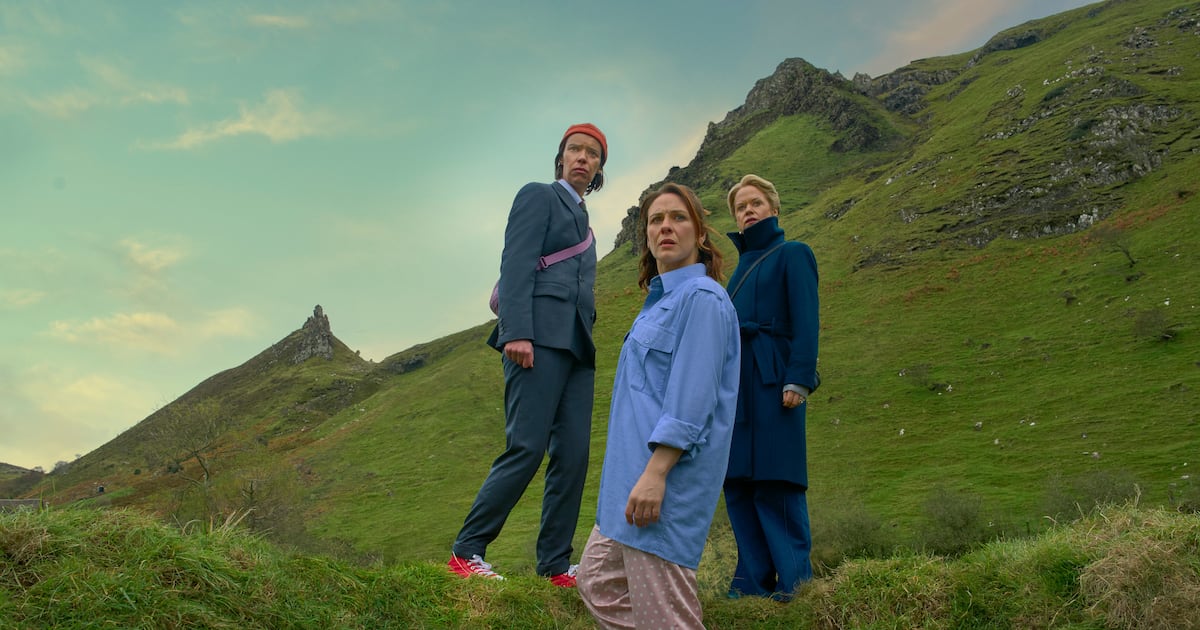
In a small, cramped room in Belfast a group of people are huddled in the cold, watching live footage of three women entering the same hotel room again and again. This is not some sort of law-enforcement sting operation but the set of How to Get to Heaven from Belfast, Lisa McGee’s excellent new comedy thriller.
Behind the scenes of a TV production is not hugely glamorous. The small room is in a huge warehouse-type space at Titanic Studios in which has been built a very convincing-looking hotel corridor and the hotel room on which we are spying.
All of the crew are wearing warm jackets. It’s pouring rain outside. The three women being surveilled are the actors Roísín Gallagher (also in The Dry and The Lovers), Sinéad Keenan (Being Human and Unforgotten) and Caoilfhionn Dunne (Industry and Britannia), who play Saoirse, Robyn and Dara, three schoolfriends from Belfast, now in their late 30s, who have reconnected for the funeral of a fourth friend, who has died in mysterious circumstances and with whom they share a terrible secret.
McGee calls the Netflix show “a messed-up cousin of Derry Girls”. This is partly, she says, because she based the core characters of both on the same people – Michelle, Jamie-Lee O’Donnell’s character in Derry Girls, and Robyn from How to Get to Heaven from Belfast draw on the same person, for example.
“I was always part of a group of friends that were, you know, dicks. We were never cool. I think it really resonates with people … being not cool together. I love that … I take real people that I enjoy being around, or I find funny, and I put a spin on them or put them in a situation.”
In this instance: “Wouldn’t it be funny if they were made to solve a mystery?”
Almost all of McGee’s output, from Being Human to London Irish to Derry Girls to this production, has been about quirky friend groups, and almost all of her core characters are based on her real friends.
“I feel like I’m sort of obsessed with friendship, and especially friendship over a long period of time and people who’ve seen the different versions of you,” she says.
“Here they literally know where the body is buried. In a friendship group there are things you don’t want to talk about, because you’re not proud of that person that you were, but these people know everything about you. I’m fascinated by that.”
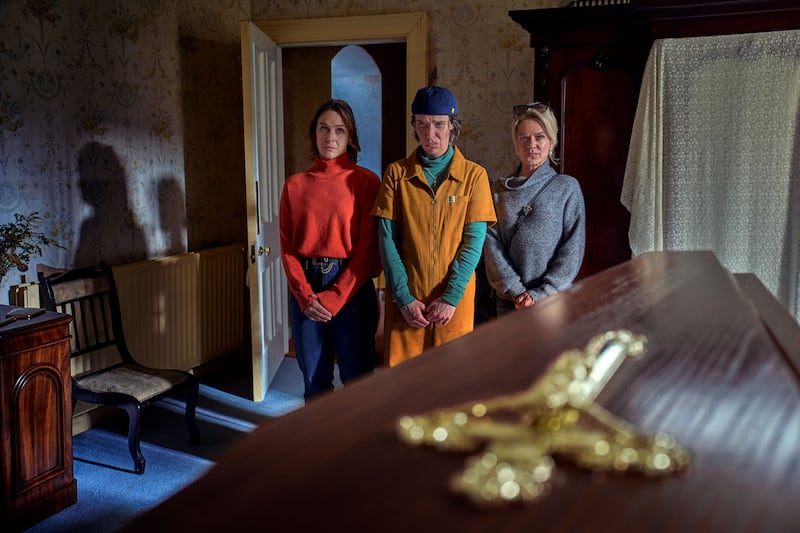 How to Get to Heaven from Belfast: Róisín Gallagher, Caoilfhionn Dunne and Sinéad Keenan in the new Netflix production. Photograph: Christopher Barr/Netflix
How do McGee’s friends feel about being story fodder? “I’ve used actual things and forgot to tell them,” she says. “There’s a bit in Derry Girls where the grandfather meets a new woman – and that happened. My friend’s dad, his wife died, and then he meets this new woman at chapel.
“All her sisters were furious. I just used that, changed it a wee bit, and then forgot to tell her. And she was, like, ‘What the hell?’ I just go, ‘You shouldn’t tell me!’”
Her friends are also hilariously uninterested in what she does, she says. “They say, ‘Lizzie, it’ll be an Oscar next.’ And I’m, like, ‘It can’t be an Oscar!’” – because she writes television, not film. “And they’re, like, ‘Don’t put yourself down!’”
She laughs. A little later she says, “I’m convinced my best friend doesn’t even know what I do.”
Her skill at writing about groups of friends makes it easy for the actors, according to Keenan. “She describes the girls like a three-headed beast. They’re three separate entities, but they also move as one. Each character is so well written and defined, you kind of stick to your brief – and you can’t really go wrong.”
That friendship leaked off-screen. “I’d not met either of them,” Keenan says of Dunne and Gallagher. “And then you just kind of find yourself going, ‘Are we …’ ”
Gallagher finishes the sentence: “Are we friends?”
They have a running joke about the word “guffaw”, because they did a lot of guffawing on set. Gallagher refers to it as “the G-word, the G-bomb.”
Why haven’t they used it yet today, she asks.
“Because you slagged me for using it!” Keenan replies.
“We chortled, we belly-laughed – laughing like you might actually wet yourself,” Gallagher says. “We had so much fun.”
That’s why they all leapt at doing a Lisa McGee project, according to Dunne – “the opportunity to muck around. I personally got tired of crying for money.”
Women characters are still more likely to feature in domestic or love stories than in productions like How to Get to Heaven from Belfast, she says. “I think it’s so rare to see women of our age on adventures.”
“It’s a caper,” Keenan says.
“A caper with women knocking on 40, which is very rare,” Dunne adds.
McGee has had the title How to Get to Heaven from Belfast for years. She got it from a sign she saw held by a preacher in the city. Does she worry the move to Belfast will alienate Derry?
That’s why she cast Bronagh Gallagher in an important role, she says. “Because the minute you have a Derry icon in it they can’t say, ‘Why did you set it in Belfast?’ So I hope that cunning plan has worked.”
McGee was a huge fan of Columbo and other crime dramas as a child. “I remember when I was little watching Murder, She Wrote in the late 1980s, early 1990s in Derry, and saying to my mammy, ‘Why does nobody get murdered here?’ And she said, ‘Lisa, what planet are you living on?’
“But I wanted a fancy Murder, She Wrote murder. Someone being murdered with a fountain pen in a library.”
 Writer Lisa McGee with Derry Girls cast members Nicola Coughlan , Louisa Harland, Dylan Llewellyn and Saoirse-Monica Jackson. Photograph: Niall Carson/PA Wire
Combining mystery with comedy also allowed McGee to get over a certain paralysis after the enormous success of Derry Girls. Though, again, pitching a mystery story is an old obsession. Her original idea for Derry Girls was, in fact, to have the characters investigating crimes against the backdrop of the Troubles. Where did she come up with the idea for the new show?
“I went back to see my old school, where Derry Girls was set, and it had been lying empty for 20 years,” she says about Thornhill College, which she fictionalised as Our Lady Immaculate.
“They built a nicer, fancier school, but because it was a convent they couldn’t do anything with the [old] premises, so it just sort of lay there empty, as if people just walked out during a zombie apocalypse.
[ Real-life Derry Girls: ‘The nuns are gone but the pupils are the same’Opens in new window ]
“I had heard it had become a place for ghost hunters to go and visit, so I asked my husband to let me go and have a look around. And so he drove me – and he wouldn’t come out, because he was too scared. I walked around, and it was really weird. There were literally school scarves hanging up, writing on blackboards and wildlife growing over things …
“I just got this feeling I was going to bump into myself as a teenage girl. I thought, What would she think of me and my choices and how I conduct myself now? And then I came up with these characters.”
Like Derry Girls, How to Get to Heaven from Belfast is filled with unapologetic local slang and references despite being aimed at an international audience. (The project was originally with Channel 4, which commissioned Derry Girls, but Netflix ultimately became its home as the new series grew in scale.)
Depicting such unabashed Irishness in an international show would have been almost impossible a few years ago, she says. “When I was starting out you couldn’t. You just weren’t allowed. And I just love it so much.
“I know it can be very problematic at times, being Irish, and our history is so complicated, but I really, really do love it … I love the landscape and I love the sense of humour.
“I feel like I’m finally getting away with doing the thing I’ve always wanted to do, and I’m going to just keep doing it until they tell me to stop … It feels more truthful, honestly.”
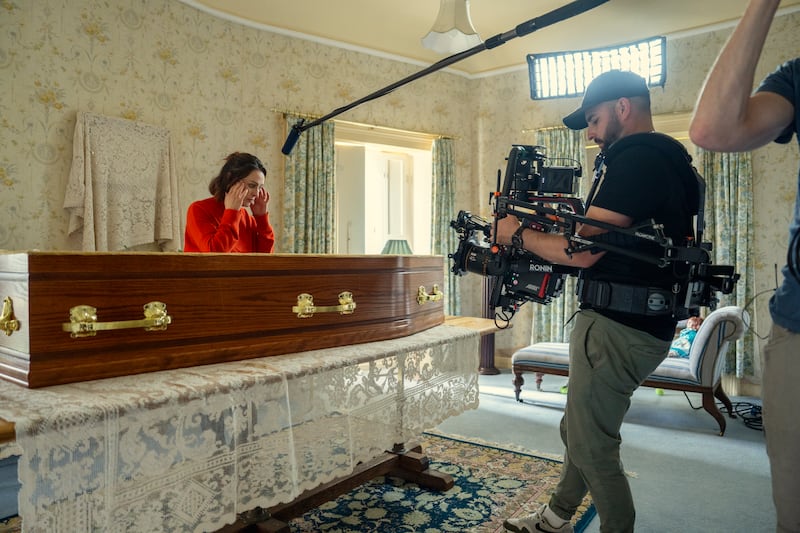 Behind the scenes of the programme with Roísín Gallagher. Photograph: Netflix/Christopher Barr
The cast maintain that it was McGee herself, with Derry Girls, who kicked down doors in this regard. “When I first started out,” says Gallagher, who was born in Belfast, “someone told me that I would ‘need to get rid of the little leprechauns’ in order to have a career.”
“Whaaat?” Keenan says with horror.
“The joy I have now in being a part of this Netflix show that is going to go on a global platform where I didn’t have to slow down and I didn’t have to amplify or Americanise my speech in order to tell this really important story,” Gallagher continues.
“I think the reason why Derry Girls was such a success is because it’s true. It’s funny because it’s true. It’s funny because that is how fast we speak. It’s funny because this is the people that you meet, and they weren’t softened and they weren’t watered down.”
The trio say they’re in awe of McGee’s attention to detail. “If the rhythm of something isn’t quite working,” Keenan says, “she’ll step in and go, ‘Will you try and move that word there?’ It’s so exact and particular, yet so natural, the way she writes.
“She is involved in everything, but not in a controlling way – in a very ensemble, team, how-do-we-do-this-best? way.” She pauses. “It’s like music.”
Gallagher’s character, Saoirse, is closest to McGee herself. She’s a writer and the creator of a fictional crime drama called Murder Code that she has begun to hate but can’t quite quit.
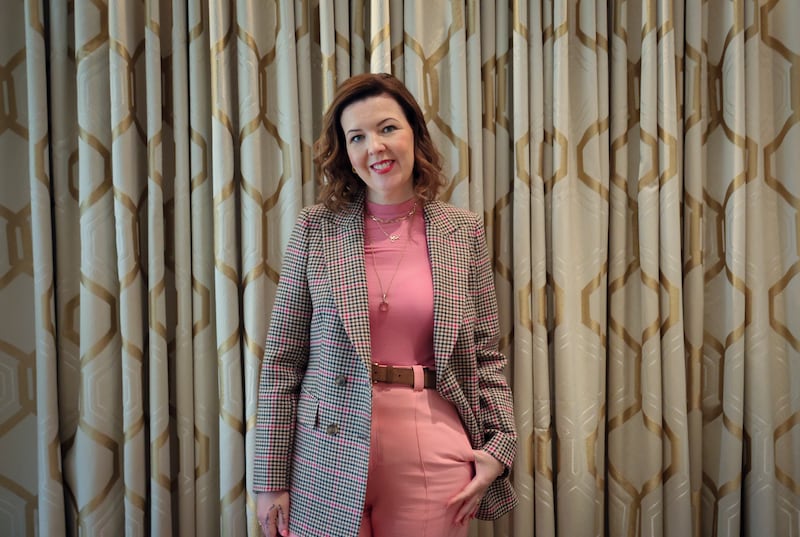 How to Get to Heaven from Belfast writer and creator Lisa McGee. Photograph: Lucy Curran/Netflix
Was McGee working through her own issues in writing this? She laughs. “I think so.” She “vented a lot” in the original scripts “about being a writer, and a lot of that got cut”. Liz Lewin and Caroline Leddy, two of the show’s executive producers, “who I’ve worked with a long time, said, ‘This is not plot, and it’s not actually that funny. It’s just you raging.’”
What sort of things was McGee raging about? She laughs. “How hard writing was,” she says. “I wrote a whole speech about how hard it was to get something made.” She shakes her head in mock annoyance at herself. “But nobody wants to hear that.”
The reality, she says, is that Saoirse’s situation is very different from hers. McGee has always worked on finite projects that she loves. If there is any commonality between the two of them it’s that they both sometimes feel they should become a more “serious” type of writer.
But McGee has had a change of mind on that. She increasingly regards comedy as a very grave business indeed. “Since Derry Girls, and since hearing people talk to me about Derry Girls and their own experiences, I would say now I take my silliness very seriously, because I think it is so important to bring a wee bit of joy and laughter to people. It sounds like a cliche, but comedy is important.”
How to Get to Heaven from Belfast is the first time she has worked with a writers’ room. That process of collaborating with other comedy writers “was such a gift”, she says.
She also marvels at her actors and wonders at the awards judges who seem to think comedy acting is easier than the dramatic kind. “Comedy actors can do the serious stuff, but it doesn’t always go the other way.”
McGee is now working on a mockumentary, among other projects. “I would still love to have a crack at the studio sitcom,” she says.
The comedies that inspired her when she was younger were things like Seinfeld and Friends and Frasier, multicamera sitcoms made in a studio and running for three-quarters of a year.
“What I worry about is we’ve taken so much time out from that [format] that we’ve lost those writers,” she says. “That was a whole other level of writer. That was hard-core.”
She recently rewatched every series of Frasier. Sometimes, in the middle of an episode, she would hit pause to see if she could work out where she would take the story. “And I never, ever got anything nearly as good. They’re just so friggin’ good.”
McGee has also been craving the comfort of a fixed, recurring set because she and the cast and crew of How to Get to Heaven from Belfast had to schlep their way all over Ireland.
“It’s been crazy,” she says. “So next time I’m going to do a studio comedy where there’s a coffee machine and I have a comfortable chair.”
How to Get to Heaven from Belfast is on Netflix from Thursday, February 12th