
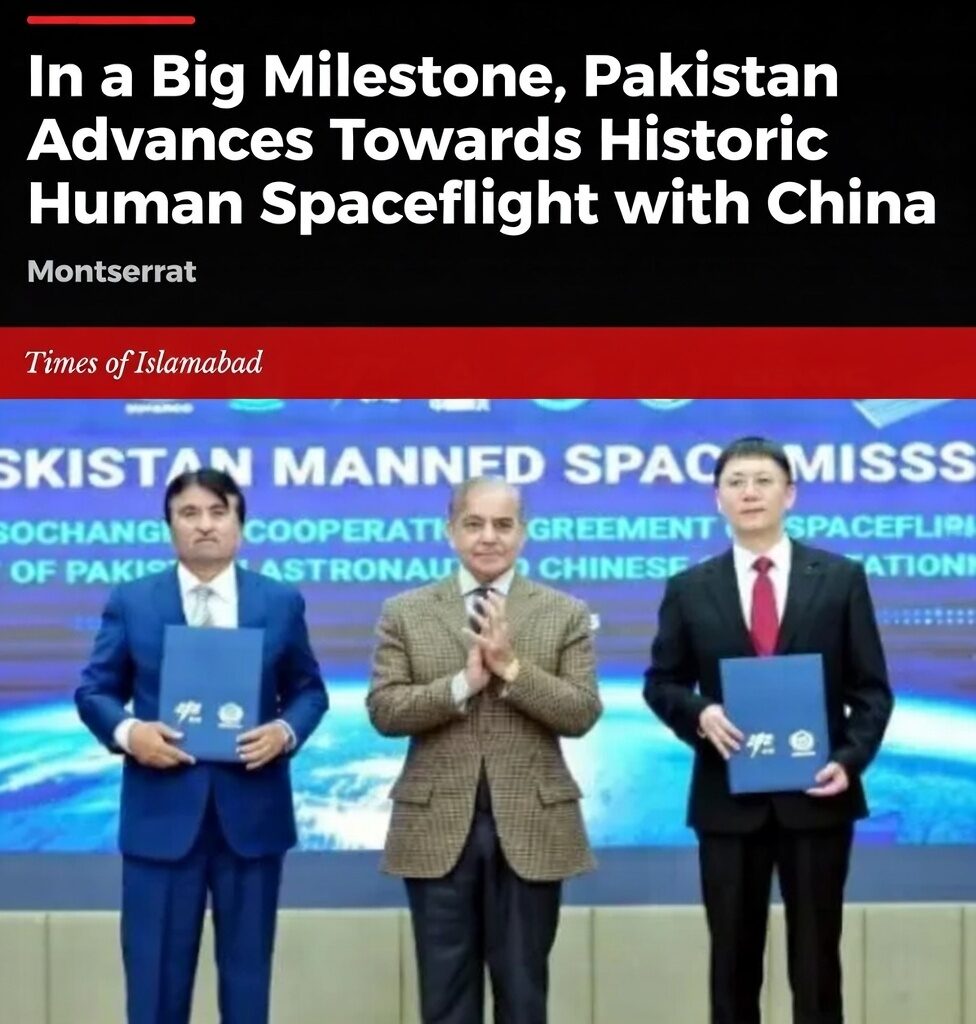
ISLAMABAD: Pakistan has reached a pivotal milestone in its Human Spaceflight Programme as two candidates have been shortlisted by the Astronauts Centre of China following rigorous evaluations, the Inter-Services Public Relations announced on Saturday. This development stems from a bilateral cooperation agreement signed in February 2025 between the Pakistan Space and Upper Atmosphere Research Commission and the China Manned Space Agency, paving the way for one Pakistani to participate in a mission aboard Beijing’s Tiangong space station in late 2026. The selection underscores deepening Sino-Pakistani ties in space exploration and marks Pakistan‘s entry into crewed spaceflight.
The agreement, formalized under the leadership of Prime Minister Shehbaz Sharif, represents China‘s first initiative to train and include foreign astronauts in its manned space programme. It positions Pakistan as the inaugural international partner for missions to the Tiangong station, which has been fully operational since 2022 and serves as a platform for scientific research in microgravity environments. The pact outlines comprehensive training and mission participation, highlighting mutual technological exchange and strategic collaboration between the two nations.
The shortlisting followed an initial screening phase conducted domestically in Pakistan, where potential candidates were evaluated for basic qualifications. The selected individuals then proceeded to the Astronauts Centre of China for advanced assessments, including detailed medical examinations, psychological profiling, and aptitude tests. These evaluations adhered strictly to international human spaceflight standards, ensuring only the most capable candidates advanced to the next stage of preparation.
Completion of this secondary selection phase signifies a substantial achievement for Suparco, which has long focused on satellite technology, remote sensing, and atmospheric research but is now expanding into human spaceflight capabilities. The process reflects careful planning and international benchmarking, with assessments designed to identify individuals resilient to the physical and mental demands of space travel, such as high-altitude simulation, centrifuge testing, and cognitive challenges under stress.
The two shortlisted candidates will now commence six months of advanced astronaut training at the Astronauts Centre of China. This intensive programme will cover essential skills, including spacecraft operations, extravehicular activities, scientific experiment handling, and emergency procedures. Training will integrate them with Chinese astronauts, fostering interoperability and shared expertise in preparation for orbital missions.
Upon successful completion of the training regimen, one of the two candidates will be finalized for a spaceflight mission to the Tiangong space station, tentatively scheduled for October or November 2026. The mission is expected to be of short duration, with the Pakistani astronaut serving as a payload specialist responsible for conducting scientific experiments on behalf of Pakistan alongside routine station duties. This role will enable valuable data collection in fields such as materials science, biology, and Earth observation.
The Tiangong space station, comprising multiple modules with advanced life support systems and research facilities, has hosted numerous Chinese crews since its assembly. It represents Beijing’s independent capability in sustained human presence in low-Earth orbit, following the retirement of the International Space Station partnership for China. The inclusion of a Pakistani astronaut will be a landmark event, symbolizing expanded international access to the station and reinforcing diplomatic bonds.
This collaboration aligns with broader Sino-Pakistani strategic partnership, including initiatives under the Belt and Road framework that extend to space technology transfers and joint projects. Experts note that such partnerships enhance scientific capacity building for Pakistan while allowing China to diversify its astronaut programme and promote global cooperation in space. The mission also carries symbolic importance, inspiring future generations in Pakistan towards STEM fields and space ambitions.
Suparco‘s progress in this domain builds on decades of foundational work in space applications, now evolving to include human elements through trusted alliances. The government’s support, evident in facilitating the initial agreement, has been instrumental in accelerating these developments. As training progresses, further details on the candidates and experiments are anticipated, potentially including payloads focused on national priorities.
The initiative not only elevates Pakistan‘s stature in the global space community but also contributes to peaceful uses of outer space through bilateral frameworks. With the 2026 mission on the horizon, anticipation builds for this historic achievement, which promises to yield scientific benefits and strengthen enduring ties between Islamabad and Beijing.
ogimageimage-name