
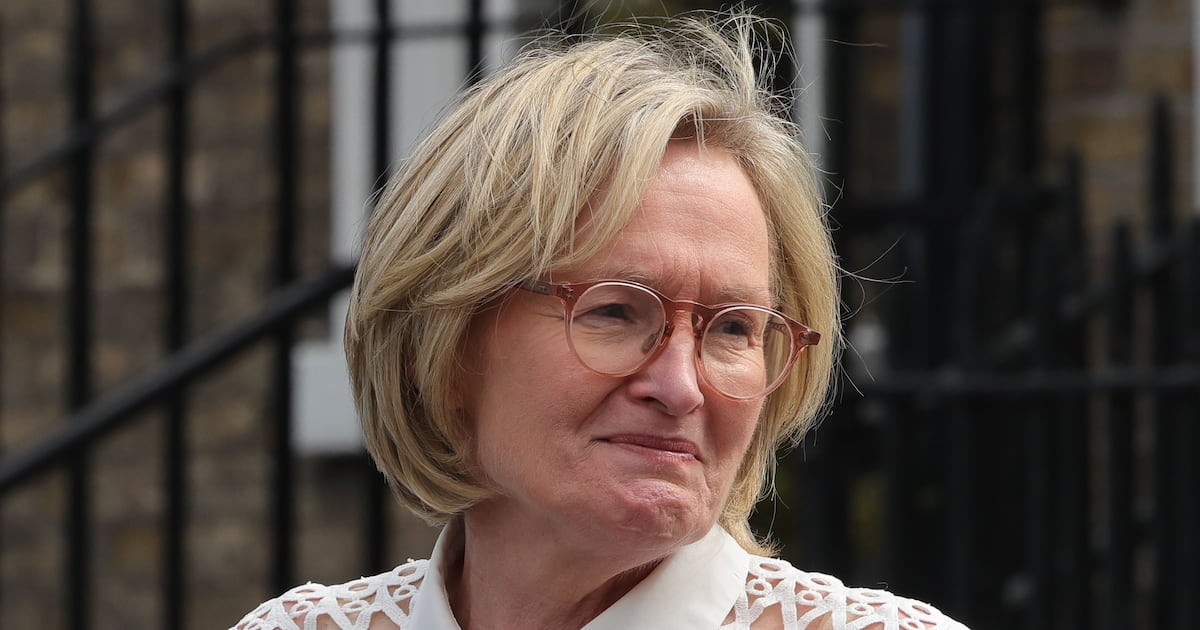
Former European commissioner Mairead McGuinness has said she withdrew from last year’s presidential election campaign as a result of a severe bout of post-viral fatigue syndrome.
The former MEP and broadcaster cited health reasons when she announced last August that she would not be contesting the election for Fine Gael.
She said the diagnosis came as “a bolt from the blue” and left her “knocked sideways” and with no choice other than to pull out of the campaign.
“Every part of me, I wasn’t well. I was physically drained. I had lost loads of weight. I wasn’t sleeping, and it crept up in me very quickly,” she said in an interview on RTÉ Radio’s Brendan O’Connor show.
McGuinness (66) also said she was shocked by rumours about her having a terminal illness and only months to live that circulated after she pulled out. She said she is feeling good now but was very weak at the time.
Post-viral fatigue syndrome happens when people have an extended period of feeling unwell and fatigued after a viral infection. Other symptoms include brain fog and muscle pain that persist for weeks or months.
Asked if she felt burnt out at that point, McGuinness replied: “It’s a good description. It’s almost as if every part of you is raw. You’re not able to do normal things.”
She said she was advised to lay on the couch and “watch rubbish on TV”, which was not something she was used to and found difficult.
McGuinness said that having to withdraw was disappointing, but more so for those who had supported her during her more than 20 years in politics.
“I’m a great believer in what is for you won’t pass you,” she said. “It doesn’t cause me sleepless nights. That ship has passed.”
[ The winners and losers of the presidential electionOpens in new window ]
She said the experience has made her better able to say “no” than in the past. “I now know that no is a full sentence.”
She said she feels “hale and hearty” and that having a wake-up call was “no harm”. She said she realised she did not have to keep up the level of intensity at which she had been operating.
McGuinness said it was difficult to not be able to say she was unwell to anyone for fear it would leak out and derail her campaign. “I wasn’t codding myself … I thought I was going to get better.”
She ultimately informed Fine Gael of her health issue and wanted to inform her family, friends and former colleagues as she did not want them to “hear it on the radio”.
“I don’t think I have ever been at that point before,” she added. “I was emaciated … I was eating but not eating … I was very, very tired.”
She said that when she told Fine Gael of her decision it was immediately accepted “once they saw me actually and once they heard what I was facing from a health point of view”.
“Privately they must have been tearing their hair out but they were very good and very decent, as I expected they would be, because I think the one thing we all realise is that your health is your wealth and that at the end of the day, and I say this very philosophically, particularly in political circles, you’re really important until you’re gone.
“And if you’re dropped, there’s always somebody else so I had no sense that this is such a terrible thing to do, that I’m irreplaceable. I really figured that the world keeps spinning.”
McGuinness said she followed the presidential campaign as it continued without her but only in the sense that it was central to the news agenda for much of the autumn.
She described it as “a hard one for the country” but she downplayed the failure of Heather Humphries, the candidate who took up the mantle for Fine Gael.
“Heather is a very decent human being but what happened to Heather and her family around sectarian abuse is despicable and no one should have to go through that … I think it dragged us backwards not forwards.”
McGuinness said she did not expect she would run for political office again but did not fully rule out the possibility.
[ Social Democrats, Labour and the Greens have some serious thinking to doOpens in new window ]