

For what shall it profit a man, if he shall gain the whole world, and lose his own soul? That’s some biblical wisdom that TD Eoin Hayes may be meditating on as the shares he liquidated on entering politics continue to soar in value.
Overheard revealed in September 2024 that the Social Democrats newbie had recently sold his shares in software company Palantir, as recorded in his Dublin City Council ethics declaration. He later – after his election to the Dáil – landed himself in trouble over the timing of his divestment and spent a period in party political Siberia as penance.
The company was controversial at the time primarily because the Israel Defense Forces used its technology to select targets in Gaza. The contrite Hayes eventually returned to the Soc Dem fold, but what has Palantir been up to? Maximising shareholder value, according to a report in the Financial Times. While Europeans show “real hesitance” to adopt its wares, the company’s chief executive, Alex Karp, hailed an “increasingly discerning” set of US customers for the modern tech business with the fantasy name.
Among them is US Immigration and Customs Enforcement (Ice), the immigration enforcement force deployed most notoriously to Minneapolis. It has $81 million in contracts with Palantir, the FT said.
It is boom time for the share price. Hayes sold up in July 2024, with shares hovering below $30 at the time. This week they were more than $150 at times. Hayes made €199,000 from his divestment in 2024, but had he held on, he could have made €1 million – almost enough for a house in his leafy Dublin Bay South constituency.
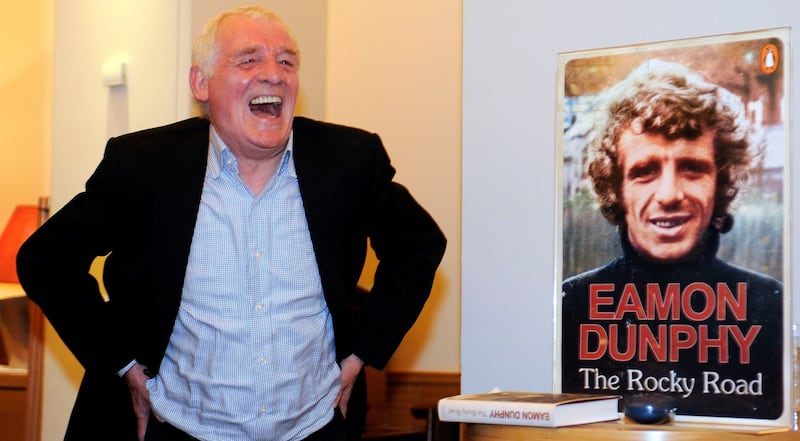 Eamon Dunphy at the launch of his memoir The Rocky Road, which took place in Restaurant Patrick Guilbaud in 2013. Photograph: Dave Meehan Dunphy the Michelin man
The Michelin star ceremony descends on Dublin for the first time next week, with all eyes on Parnell Square’s Chapter One, tipped to become Ireland’s first-ever three-star restaurant in front of a home crowd. The restaurant’s €235 tasting menu offers dishes such as the complicated-sounding but probably delicious “saddle of Wicklow sika deer, morel farcie, foie gras, apple, braised spelt with tongue and truffle, BBQ vinegar, deer sauce infused with Ethiopian pepper”.
It’s far from morel farcie the Dublin public were raised.
Overheard was reminded of the surprising role of Eamon Dunphy in the capital’s culinary progress. In his 2013 autobiography The Rocky Road, he describes attending a dinner in Paris in 1980 to convince young French chef Patrick Guilbaud to bring his fine food to Dublin. “It was to be a culinary version of the Shamrock Rovers project,” Dunphy wrote, and his job was to be a former “colleague of George Best” who could convincingly argue that 1980s Ireland was the place to be.
It worked, and Guilbaud introduced nouvelle cuisine to Ireland, where he faced “savage” reviews and recurrent criticism for failing to put salt and pepper on the table. “You’ll leave feeling hungry with a lighter wallet,” one reviewer is quoted as saying. Restaurant Patrick Guilbaud survived: it secured a Michelin star in 1989, and became the first to secure two stars in 1996, which it has held ever since.
Ireland now has 16 one-star and five two-star restaurants, serving cuisines both nouvelle and not. It’s time for a hat trick.
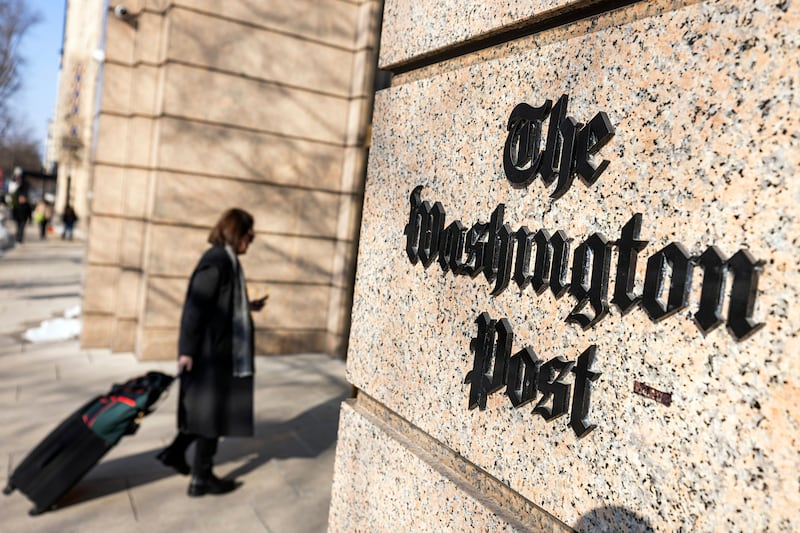 Washington Post headquarters in Washington, DC. Photograph: Jim Lo Scalzo/EPA Darkness descends on the Post
“Democracy dies in darkness” was the slogan adopted by the Washington Post in 2017 when Donald Trump was first elected to the White House. Darkness of another kind descended this week on the venerable US newspaper known worldwide for breaking the Watergate scandal in the 1970s, costing Richard Nixon his job.
On Wednesday, the Post laid off a third of its staff across all departments as it struggles to turn a profit. Owner Jeff Bezos, one of the world’s richest men through his Amazon fortune, ignored the petitioning of reporters this week as his executives made deep cuts to local, international and sport coverage.
They were so severe that Peter Finn, editor of the international section, asked to be laid off rather than being involved in planning the cuts once he realised how severe he would be, according to a New York Times report.
It was a touching act of solidarity from Finn, who is a native of Roscommon and a UCD graduate. He managed more than 60 reporters, editors and other journalists in Washington and across 23 locations around the globe. While national security editor from 2013 to 2022, he oversaw teams that won three Pulitzer Prizes.
His decision to depart with his reporters made sense once the impact of the job cuts were felt.
Lizzie Johnson, the Post’s Ukraine correspondent, tweeted on Wednesday: “I was just laid off by The Washington Post in the middle of a war zone. I have no words. I’m devastated,” reposting a recent photo of herself in Kyiv, writing into a notepad by torchlight after waking up with no power, heat or running water.
Overheard hopes the experience and expertise of those cast aside finds good use at other outlets post-Post.
 People gather at the Hill of Uisneach for an Imbolc & Brigid celebration last weekend. Photograph: Nick Bradshaw Pagans gain ground
Another successful campaign concluded for the word “Imbolc”, the resurgent term referring to the pre-Christian Gaelic fire festival around February 1st.
Gaining ground on the nonpagan St Brigid’s Day, it featured widely in media coverage and startled Overhead by appearing on Google alongside a local hardware shop’s hours. “Imbolc may affect these hours,” we were informed on the bank holiday Saturday.
Overheard is pretty sure it wasn’t always this way. We asked An Coiste Téarmaíochta, word watchdog at Foras na Gaeilge, whether Imbolc was even a word in modern Irish, which, it turns out, it is not. It is the pre-Christian name for the spring festival and there “isn’t a modern Irish equivalent”, Jenny Ní Mhaoileoin of the coiste said. “If used in Irish it would be treated as a borrowing from the Celtic and left with that spelling.”
According to search data, 2026 shows a significant spike in interest for Imbolc, above even the peak for Bealtaine, which has the head start of being Irish for the month of May.
Are we pronouncing it right? Probably not. To Dr David Stifter, professor of Old and Middle Irish at Maynooth, the spelling is “a very unfortunate choice”. “The alternative spelling in Old Irish is ‘Imbolg’,” he said, “and it would have been more fortunate and practical if it had been chosen for the modern English usage.
“The word is pronounced with a -g at the end,” proven by a rhyme in a medieval Irish poem, he says, “so there is absolutely no doubt about it.” To UCC linguist Dr Aidan Doyle, scholarship suggests something like “imolg” or “imolog” – certainly not “im-bulk”.
Whatever way it is pronounced, it appears to be back – at least until St Patrick returns next month to recivilise the pagans.