
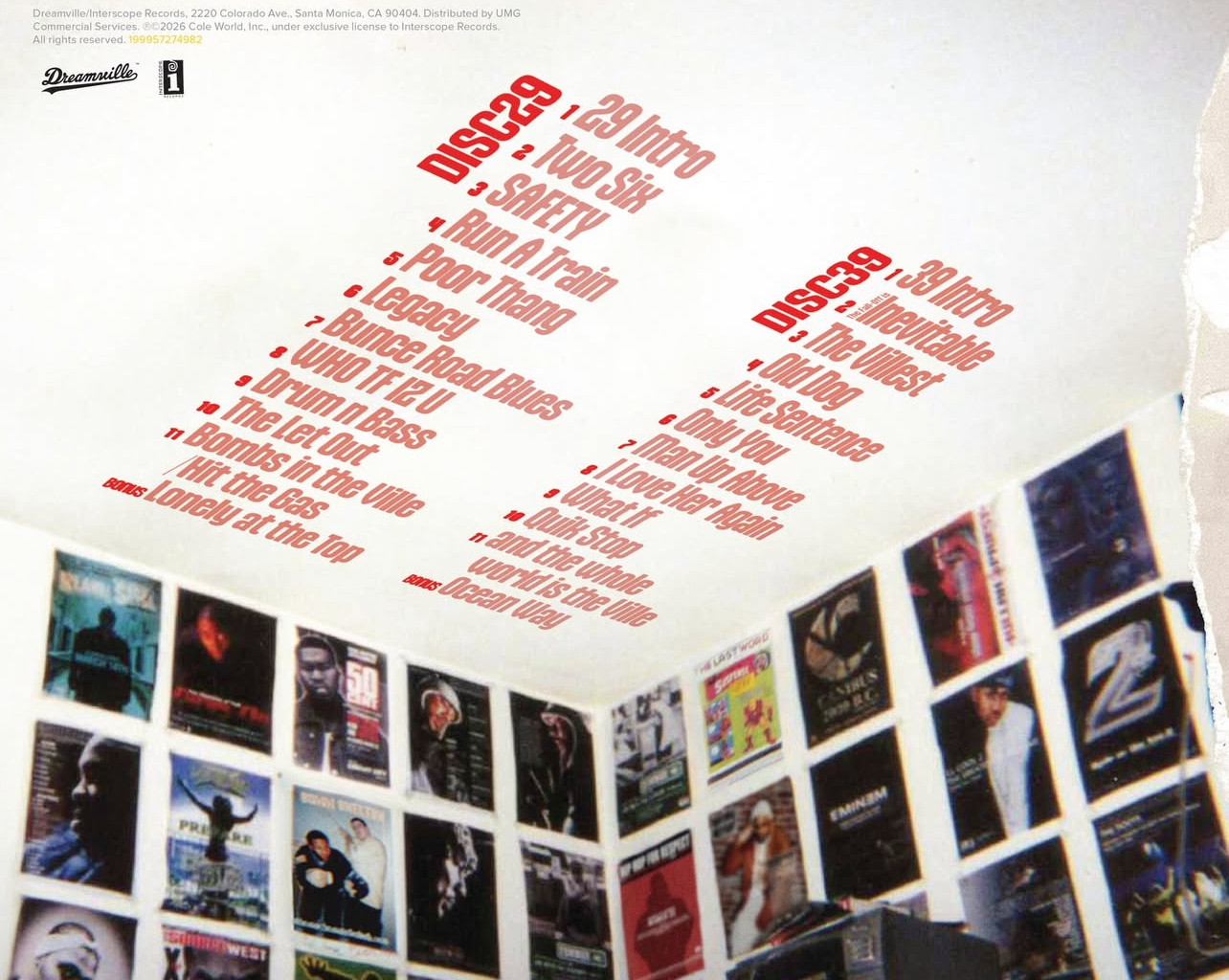
There’s a photograph on the back cover of The Fall Off that tells you everything you need to know about where this story ends. It’s a bedroom in Fayetteville, North Carolina, walls plastered with posters of Tupac, Biggie, 50 Cent, Eminem, DMX, Scarface, Mobb Deep, Wu-Tang Clan. Movie posters for Juice and Paid in Full hang alongside them. The kid who took this picture with a disposable camera at fifteen had no idea he’d one day stand shoulder-to-shoulder with those legends. But J. Cole never forgot that bedroom. And on The Fall Off, he finally brings us back home.
This isn’t just an album. It’s a thesis written in hindsight, a time capsule sealed by someone who finally knows how the story ends. After ten years of meticulous crafting, Cole has delivered what he promised: his best work, his final word, and a monument to everything that shaped him—his hometown, the culture that raised him, and the music that saved him. The Fall Off is an homage in the truest sense, a 24-track double album that pays reverence to hip-hop’s past while securing Cole’s place in its hall of fame.
The Ville, Forever
Fayetteville runs through the veins of this album like blood. It’s there in the title of “Bunce Road Blues,” named after a street near where Cole grew up. The Alchemist’s production strips everything down to raw emotion and Cole’s voice fills every corner. It’s there on “and the whole world is the Ville,” a penultimate anthem that makes it clear: no matter how far he traveled, no matter how many arenas he sold out, Cole never left home. He just carried it with him.
The album’s structure itself is a homecoming story told twice. According to his tracklist reveal on Instagram, Disc 29 chronicles Cole’s return to Fayetteville at age 29, caught between three loves: his woman, his craft, and his city. It’s the disc of a man still figuring things out, still hungry, still wrestling with what it means to be from somewhere and for somewhere simultaneously. Disc 39 revisits that same journey a decade later, Cole now 39, wiser and closer to peace but still tethered to the same coordinates.
On “Old Dog,” Cole brings that connection full circle by tapping North Carolina legend Petey Pablo for a high-octane banger that honors his state’s lineage. The two blitz the track with the kind of ferocity that only comes from people who know what it means to put Carolina on the map. Cole name-drops DaBaby and other NC brethren, making it clear that this isn’t just his story—it’s theirs too.
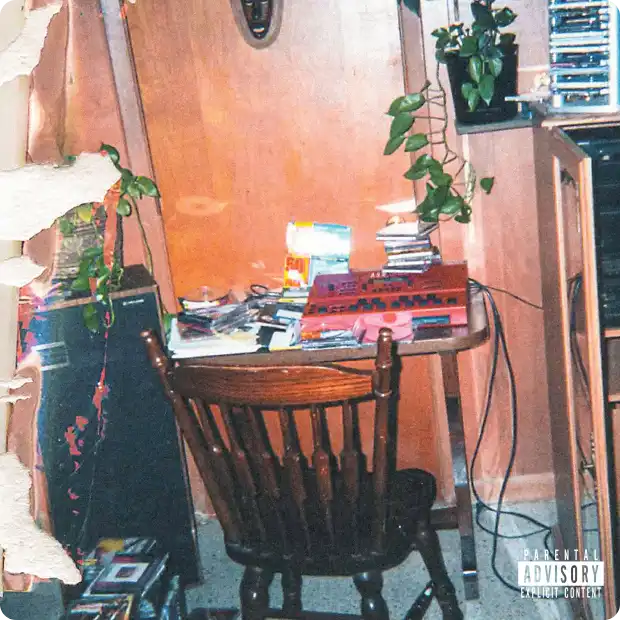
But the deepest Fayetteville moment might be the album artwork itself. Cole revealed that every photograph used for The Fall Off was taken by him, including that bedroom shot from when he was fifteen. The kid who idolized those legends, documenting his own ascension with the same camera, the same eye, the same reverence. When Cole looks back in twenty years, he’ll see exactly who he was when he finished the work that took a decade to complete.
Hip-Hop as She: The Love That Never Dies
The most striking thread running through The Fall Off is how Cole personifies hip-hop as a woman—sometimes a lover, sometimes a mistress, always complicated. It’s a familiar metaphor, but Cole makes it feel lived-in rather than literary.
“I Love Her Again” is the album’s emotional centerpiece and its most direct lineage to hip-hop’s storytelling tradition. The track is a reworking of Common’s 1994 classic “I Used to Love H.E.R.,” which personified hip-hop as a woman Common once cherished before she changed, commercialized, and lost her way. Cole samples Common’s “The Light” (produced by J Dilla) and inverts the premise entirely. Where Common mourned what hip-hop used to be, Cole celebrates what she still is to him.
The timing is crucial. Cole entered the game during an era when hip-hop was routinely declared “dead,” when think pieces mourned the genre’s golden age and dismissed its present. But Cole never stopped believing. He had faith when others lost theirs, and The Fall Off is his testimony to that faith being rewarded. He didn’t just witness hip-hop’s resuscitation—he had a major hand in it, keeping the culture’s heartbeat steady through introspection and craftsmanship when others chased trends.
On “I Love Her Again,” Cole raps about falling in love with the genre and watching it migrate from New York to Atlanta, its home base shifting but its spirit intact. But the second verse is where things get personal. He recalls a moment when hip-hop told him he could be “the one,” something special among a field of contenders. Then jealousy crept in, and he watched two of his peers start to beef over that same validation. The bars land like a confession: “Now when it comes to love, jealousy will often creep / Them type of games is why two of my homies start to beef/ To both of them she said, “You the best I ever had’/ And the whole time that bitch was saying that type of shit to me.”
That “Best I Ever Had” reference—a clear nod to Drake’s 2009 hit—firmly roots this in the Drake-Kendrick Lamar feud that consumed the culture in 2024. Cole briefly entered that battle with “7 Minute Drill,” a diss track aimed at Kendrick that he quickly pulled and publicly apologized for. The moment could’ve been career-defining in the worst way, but Cole turned vulnerability into fuel. Instead of shrinking from the embarrassment, he let it reshape the album, expanding The Fall Off into a double disc after becoming “incredibly re-inspired” by the whole ordeal.
“I Love Her Again” positions that beef not as a personal failure but as hip-hop’s nature—she makes promises to multiple suitors, and jealousy is inevitable. The track isn’t bitter; it’s resigned and, ultimately, still loving. Cole admits he let her slip away at times, acknowledges that no one person owns the culture, and accepts that hip-hop belongs to everyone and no one simultaneously.
The following track, “What If,” continues the meditation on hip-hop legacy by doing something audacious: Cole raps from the perspectives of The Notorious B.I.G. and Tupac Shakur, imagining alternate histories where things might’ve gone differently. It’s a bold, creative exercise that honors the genre’s greatest martyrs while acknowledging how fragile and fleeting greatness can be. Coming right after “I Love Her Again,” it’s a reminder that the beef Cole stepped away from could’ve spiraled into something far darker. He chose peace. He chose to still love her.
Cinema for the Ears and Eyes
The visuals Cole has released so far are proof that his artistry extends far beyond the booth. The music video for “The Fall-Off Is Inevitable” is nothing short of stunning—a visual meditation on life in reverse that mirrors the song’s Benjamin Button concept and nods directly to Nas’s “Rewind,” a fitting reference given Cole’s long-stated reverence for his favorite rapper. Shot by director Simon Chasalow, who also helmed the “Two Six” video, the visuals lean into atmosphere rather than excess, letting presence, memory, and environment carry the weight.
The “Two Six” video is particularly striking in how it tributes Fayetteville. Gritty, well-framed collages of North Carolina sights unfold across the screen—Cole riding his bike with wired headphones, standing on train tracks, moving through the Ville with the quiet resolve that defines much of the album. The color treatment is gorgeous, and the framing feels intentional in a way that makes every shot count. These aren’t flashy big-budget productions designed to go viral; they’re intimate visual letters to the city that shaped him.
If these early releases are any indication of what’s to come, the visual companion to The Fall Off could stand as its own artistic statement. Cole’s ability to translate the album’s emotional depth into cinema speaks to how seriously he takes every aspect of his craft. The fact that he shot the album artwork himself at fifteen and is now directing the visual narrative of his finale shows an artist in complete control of his story. If he continues to roll out videos with this level of care and intention, it’ll be a perfect testament to how great his artistry truly is—not just in the music, but in every frame, every shot, every deliberate choice that honors the work.
A DJ’s Crate Worth of Reverence
If The Fall Off is a love letter to hip-hop, the samples and interpolations are Cole’s citations, his annotated bibliography proving he’s done the reading. The album is full of references. There are over a dozen nods to the genre’s lineage woven so seamlessly you almost miss them on first listen.
Cole samples Lil Boosie’s “Set It Off,” OutKast’s “Elevators (Me & You),” and Usher’s “Nice & Slow,” pulling from Southern rap’s golden era and R&B’s smooth moments with equal reverence. He interpolates DMX’s “How’s It Going Down,” bringing that raw Yonkers energy into his own narrative. Mobb Deep gets sampled twice—once on “The Villest,” where Cole flips “The Realest” into something that honors Prodigy and Havoc’s original while carving out new space. Erykah Badu’s ethereal background vocals on “The Villest” (via her Alchemist-produced remake) add a layer of soul that feels like anointing.
T.I.‘s “24’s” gets a nod. So does Marvin Sapp’s gospel classic “Never Would Have Made It.” Queen Latifah’s “U.N.I.T.Y.” makes an appearance. Even Jennifer Lopez’s “Jenny From the Block” and Ludacris’s “What’s Your Fantasy” find their way into the sonic tapestry. These aren’t lazy chops or cheap nostalgia plays. They’re carefully chosen threads that tie Cole’s story to the culture’s larger narrative.
The samples work because they’re thematic. Lil Boosie represents Southern resilience. OutKast represents innovation and refusing to be boxed in. Mobb Deep represents East Coast grit. Marvin Sapp represents faith when the odds are stacked against you. Cole isn’t just paying homage—he’s showing his work, proving he came up studying the masters and internalized their lessons.
Most tracks stretch beyond four minutes, structured like old-school records with three verses and room to breathe. It’s a deliberate rejection of the streaming era’s two-minute attention spans. Cole wants you to sit with these songs, to let them unfold. It’s the kind of intentionality that defined albums in the ’90s and early 2000s, when hip-hop records were events, not algorithms.
The Features: Chosen Family
For an artist known for going feature-less on entire albums (2014 Forest Hills Drive went double platinum without a single guest), the fact that The Fall Off includes collaborators at all is noteworthy. But Cole didn’t just throw big names on tracks for streaming numbers—he curated voices that enhance the narrative.
Future appears twice: on “Run A Train” and “Bunce Road Blues” (alongside Tems). Future’s inclusion is fascinating because he represents everything Cole typically isn’t—melodic trap, auto-tuned introspection, a different corner of hip-hop entirely. But that’s exactly why it works. Cole isn’t gatekeeping; he’s showing range, proving he can hold his own next to artists whose sound diverges from his while still maintaining his identity. On “Bunce Road Blues,” Tems adds a smooth, soulful atmosphere that balances Cole’s introspection with warmth. The Alchemist’s production ties it together, creating a space where all three artists breathe comfortably.
Burna Boy lends his voice to “Only You,” bringing Afrofusion influences that expand the album’s sonic geography. It’s a subtle nod to hip-hop’s global reach, a reminder that the genre Cole fell in love with has transcended borders and continues to evolve in ways his fifteen-year-old self could never have imagined. These aren’t random picks—each artist adds a specific flavor, a particular texture that serves the song’s purpose.
The Career Arc: From The Come Up to The Fall Off
Understanding The Fall Off requires understanding the full trajectory. This isn’t just an album—it’s the conclusion to a story Cole’s been telling since 2007’s The Come Up mixtape. That title was prophetic: a kid from Fayetteville climbing his way into a culture that didn’t owe him anything. The Fall Off brings that concept full circle, bookending a career built on patience, introspection, and refusal to compromise.
After The Come Up, Cole endured what he called “label purgatory,” writing hits for others to earn his debut while simultaneously releasing modern classics like The Warm Up and Friday Night Lights. Cole World: The Sideline Story (2011) announced his arrival with hunger and ambition. Born Sinner (2013) showed his range. Then came 2014 Forest Hills Drive, the album that changed everything—a handwritten letter to his younger self that went double platinum without features, proving good work speaks for itself.
4 Your Eyez Only (2016) split its narrative between Cole’s perspective and the ghost of a friend killed while dealing drugs, expanding his empathy and storytelling scope. KOD (2018) diagnosed modern addiction—to drugs, phones, money, sex—while introducing his alter ego kiLL edward and concluding with “1985 (Intro to ‘The Fall Off’),” a prescient warning to the SoundCloud generation about the industry’s disposable nature.
The Off-Season (2021) was Cole sharpening his blade, proving he could still rap with the best of them, still compete, still dominate. It debuted at No. 1 and earned Grammy nominations, setting the stage for the final act.
Cole revealed he began recording The Fall Off in 2016, the same year he teased “thoughts of retirement” on DJ Khaled’s “Jermaine’s Interlude.” Songs from this era have been sitting, tweaking, evolving for years. Even “Middle Child,” released in 2019, was originally intended for this album. Cole’s been living with these tracks for nearly a decade, refining them until they could carry the weight of a finale.
In his statement accompanying the album, Cole wrote that he wanted to “do on my last what I was unable to do on my first.” By that measure, The Fall Off succeeds resoundingly. Where Cole World announced arrival, The Fall Off confirms permanence. Where the debut was hungry, the finale is satisfied. Not complacent—satisfied. There’s a difference.
Hall of Fame Secured
What makes The Fall Off a hall of fame-worthy project isn’t just the music—it’s what the music represents. Cole built a career on principles that seemed obsolete: patience over virality, introspection over spectacle, craft over clout. He never chased the biggest features or wildest controversies, or compromised his message for a hit single. He just kept releasing platinum albums, selling out arenas, building Dreamville Records into a home for artists like JID and Bas, and earning respect that few can match.
Six platinum albums. Millions of records sold. A label that’s become a creative haven. A career that proved the long game still works if you’re willing to play it. The Fall Off cements all of it, not by shouting about legacy but by embodying it. The album sounds like someone who’s accomplished everything he set out to do and has the wisdom to recognize when the work is complete.
The closing track, “Ocean Way,” is telling. It features no rapping at all—just Cole’s voice, subdued and resigned, accepting that everything ends eventually. It’s the sound of someone at peace, someone who’s said what he needed to say and is ready to walk away. In a culture that celebrates excess and perpetual motion, that kind of quiet exit feels radical.
The Farewell That Feels Like Forever
The Fall Off doesn’t feel like an ending in the traditional sense. There’s no desperation, no nostalgia-fueled attempt to recapture past glory. Instead, it feels like arrival—Cole reaching the summit of the mountain he’s been climbing since he was a kid taking disposable camera photos in his bedroom.
The album’s title, once a source of anxiety about being stuck in a comfort zone, now reads as prophetic wisdom. Cole understood something fundamental: in a culture obsessed with perpetual ascent, sometimes the most radical act is recognizing that everything—fame, influence, even genius—has its season. The fall off isn’t failure. It’s nature. And there’s grace in accepting that while you still have the pen to document it.
If this truly is J. Cole’s final album, he’s leaving hip-hop exactly as he entered it: on his own terms, with nothing left to prove, and everything to show for it. The Fall Off is a love letter to Fayetteville, to hip-hop, to everyone who believed in him and everyone who doubted. It’s proof that the kid from Bunce Road made it to the pantheon not by changing who he was, but by refusing to be anyone else.
The bedroom walls on the back cover tell the story: a kid surrounded by legends, dreaming of joining them. The album itself is the answer: mission accomplished. The fall off, when it comes, will be from a height few ever reach. And Cole’s at peace with that.
The Fall Off is available now on streaming services. Album cover images courtesy of Dreamville.

Alyshia is the Interviews Editor for InBetweenDrafts. A self-proclaimed pop culture enthusiast, she watches B-movies in her spare time and hopes to make one some day. Apart from writing, she is a publicist fully immersed in the world of entertainment.
Like this:
Like Loading…
Related