
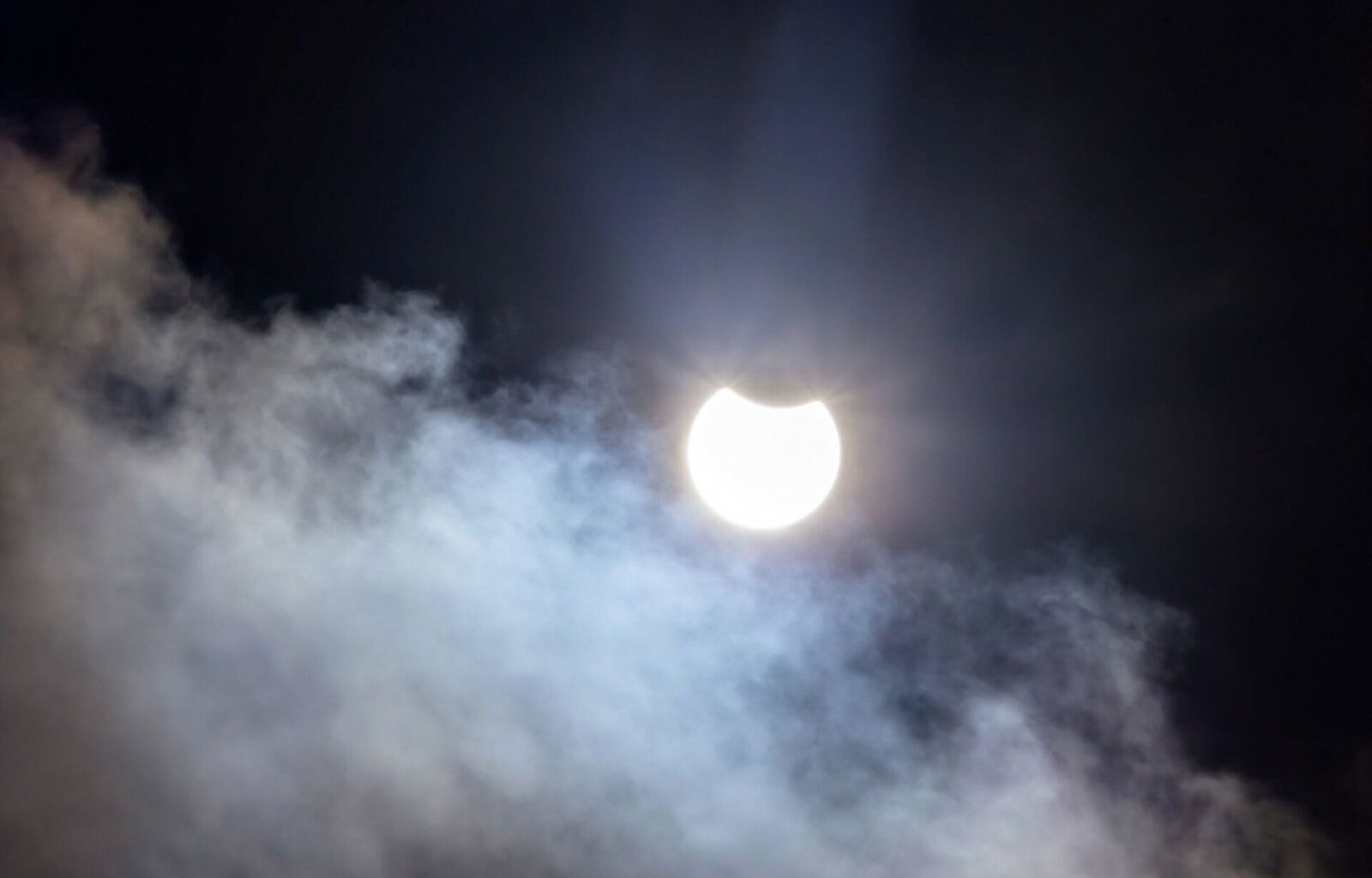
A controversy over whether a group of spruce trees in Northern Italy predicted a partial solar eclipse is heating up as scientists attempt to debunk the claims as pseudoscience.
Alessandro Chiolerio and colleagues published their initial claim in the journal Royal Society Open Science, stating that a sudden, synchronized increase in electrical activity prior to a partial solar eclipse provided evidence that the trees were anticipating and preparing for the eclipse 14 hours in advance.
Now, an opinion piece in the journal Trends in Plant Science seeks to debunk this claim as pseudoscience, citing a local thunderstorm as an alternative cause for the electrical activity.
Pseudoscience Pushback
“To me, this paper represents the encroachment of pseudoscience into the heart of biological research,” said first author Ariel Novoplansky, an evolutionary ecologist at Ben-Gurion University of the Negev in Israel. “Instead of considering simpler, well-documented environmental factors, like a heavy rainstorm and a cluster of nearby lightning strikes, the authors leaned into the more seductive idea that the trees were anticipating the impending solar eclipse.”
There is some rational basis to the idea that plants can respond to environmental conditions, sometimes even before they happen. However, these are significant events tied to the plant’s survival, such as impending stressors or encroaching competition, not relatively benign events such as eclipses.
“The eclipse only reduced light by about 10.5% for two short hours, during which the level of sunlight was approximately twice what the trees could practically use,” says Novoplansky. “Frequent fluctuations in cloud cover at the study location change light quality and quantity by much bigger amplitudes.”
Exploring Plant Predictions
Predictive reactions are triggered by clear cues that alert plants to approaching environmental changes. The eclipse in question was the 53rd in the Saros 124 sequence, which recurs every 18 years, 11 days, and 8 hours. Additionally, Chiolerio and colleagues made the even more incredible claim that the eclipse represented a kind of “deep memory” in plants, rather than merely a response to stimuli.
Fundamentally, their claim is that the older trees showed the greatest increases in electrical activity, seemingly indicating that they communicated with younger trees to “warn” them of the oncoming event, displaying a form of long-term “memory” paired with extremely accurate timekeeping based on past experiences with these recurring eclipses.
Running counter to such claims, these eclipses, despite their predictable recurrences, are still unique in their paths, magnitudes, and durations. Therefore, even if trees possessed such incredible predictive capabilities, they would not likely have anticipated the specific conditions of the most recent eclipse with such accuracy.
Chioelo et al. also claim that the trees may actually be responding to gravitational changes caused by the eclipse, but skeptical scientists argue that those changes are similar enough to those produced by a new moon as to be indistinguishable.
Closing the Door on Pseudoscience
The final nail in the coffin, according to the debunkers, is Chiolerio et al.’s extremely small sample of three living trees and five stumps. They caution that this is an example of media outlets going to press with a fantastical story, despite a lack of evidence and convincing reasoning.

“The electrical activity of trees is a real phenomenon but it’s still a nascent field of inquiry,” says Novoplansky. “The idea that variations in electrical signals, observable even in dead logs, might encode memory, anticipation, or collective responsiveness requires a few extraordinary leaps, none of which were supported in the study.
“The forest is wondrous enough without inventing irrational yet superficially fantastic claims of anticipatory responsiveness or communication based only on correlation,’ Novoplansky says.
Novoplansky and colleagues note that novel observations of plant behavior are a perfectly valid field of inquiry. However, in this instance, these particular claims ignore simple answers in favor of more fantastical ones that are fundamentally difficult to support.
The paper, “Eclipse of Reason: Debunking Speculative Anticipatory Behavior in Trees,” appeared in Trends in Plant Science on February 6, 2026.
Ryan Whalen covers science and technology for The Debrief. He holds an MA in History and a Master of Library and Information Science with a certificate in Data Science. He can be contacted at ryan@thedebrief.org, and follow him on Twitter @mdntwvlf.