
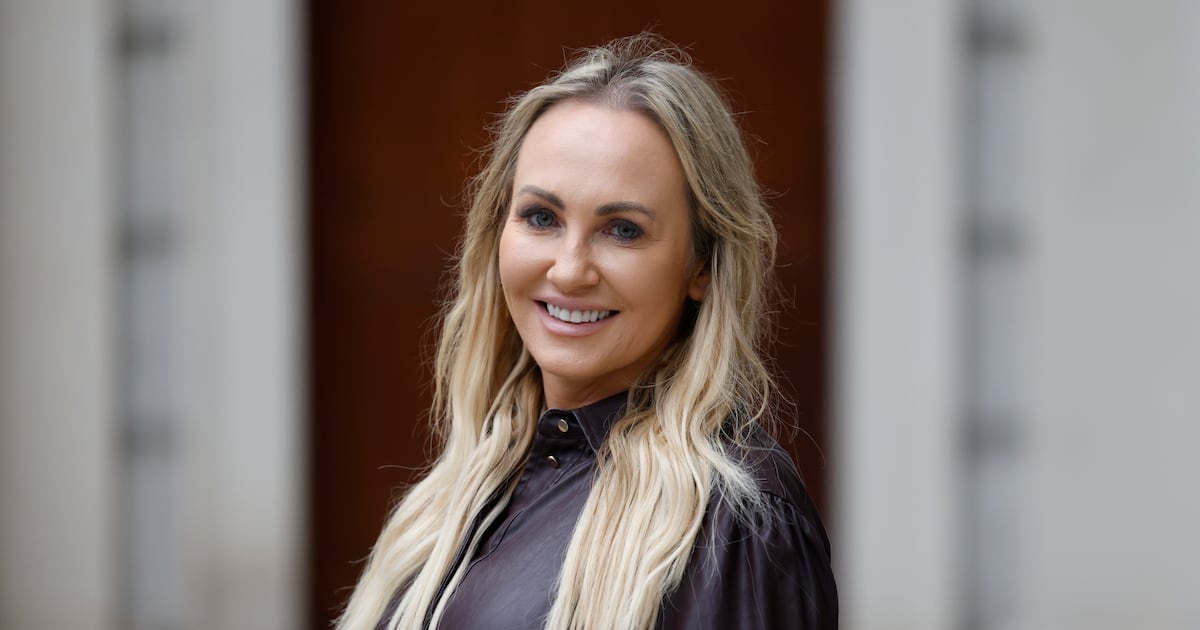
Wearer of outrageously large sunglasses. Fifth-generation working-class Tallaght woman. Breast cancer survivor. Almost 22,000 followers on TikTok. Spice bag gourmand. Likes to lip-sync (badly) on Instagram. A member of the agricultural panel in Seanad Éireann. Passionate advocate for access to drugs for rare conditions.
Oh, yes, and a member of Fianna Fáil.
Most of the above list marks Teresa Costello out as being a little out of the ordinary as a politician. Strangely enough, the thing that sticks out for me is that a working class urbanised person from Tallaght is on the agricultural panel of the Seanad. But we will come back to that later.
Costello has a big interest in style, appearance and fashion. Today she is wearing a dark faux-leather coat that is buckled at the waist. She also has a range of Jackie O-style oversized sunglasses that have become a bit of a signature on her Instagram and TikTok pages.
The interview takes place to coincide with World Cancer Day. Twelve years ago, at the age of 36, Costello was diagnosed with breast cancer and went through a number of operations and many months of treatment.
Coming through the experience became an inflection point in her life, transforming her from being a private citizen to a public figure, initially advocating for survivors of breast cancer, more latterly as a career politician.
As a politician she is both traditional and modern. In terms of issues and concerns, she stays close to the Fianna Fáil party lines. Her focus has been very local to Tallaght, both as a councillor on South Dublin County Council since 2019, and as a senator since early 2025. She is unapologetically Tallaght-focused, much in the mould of former Fianna Fáil TD for the constituency Charlie O’Connor.
“My family have been there for generations,” she says. “I grew up around the Waterworks in Bohernabreena, and we lived in Melrose Park – one of the oldest social housing estates in Tallaght,” she says.
But from a presentation point of view she is avowedly modern, harnessing social media to craft her messages with clever takes and a digital nous. With 21,500 followers on TikTok, she is almost up there with Social Democrats leader Holly Cairns, Michael Healy-Rae, and Simon Harris. She mixes weekly advice on housing rights and new vacancies on the rental market with personal posts about Tallaght life, her own activities and a dog who goes by the name of Frank. Like the Social Democrats’ Jennifer Whitmore, she has no hesitation in publicly tackling those who want to insult or body shame her.
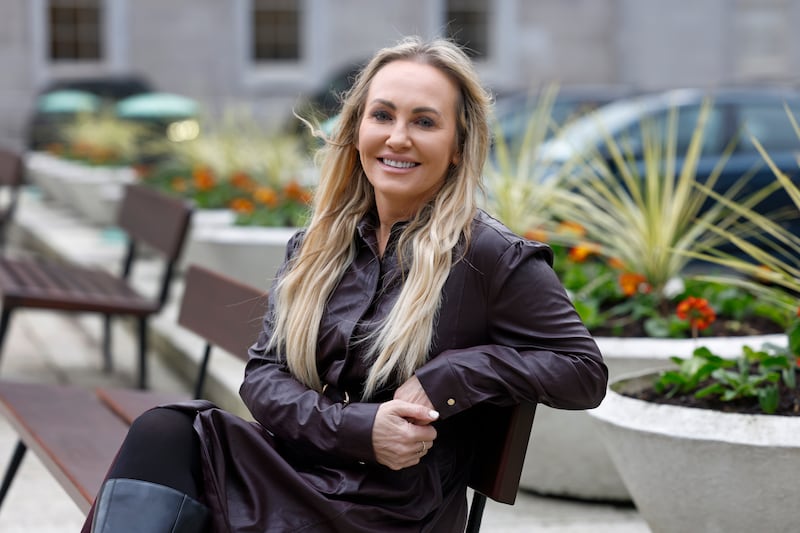 Teresa Costello: ‘Having been through what I have been through, I have seen the best of people. It gives you a different perspective.’ Photograph: Nick Bradshaw
In the run-up to the 2024 election, a man commented on a picture showing her with Micheál Martin and Jack Chambers. “Why does the short blonde, in front of Martin, have male pattern baldness?”
She replied: “After having cancer and having to take Tamoxifen for the foreseeable future I am at a loss to understand what the side effects of my breast cancer that has impacted my appearance has on politics and how anyone could think it okay to remark on a person’s appearance in such a manner … The only impact will be to make this little cancer survivor a bit more self-conscious.”
She also told my Irish Times colleague Sarah Burns in 2024 that a man phoned her to say: “Are you Teresa Costello?’ You look like a porn star. How could you be capable of doing anything for your community, with your dyed blonde hair, your fake face and teeth?”
She made the indisputable point to Burns: “Would a man get that call?”
Costello’s career has stemmed from survival, a potentially fatal diagnosis that made her rethink everything that had happened before and gave her a new purpose.
Before that, her world had been very unpublic indeed.
As a teenager, she says she had no set plans.
“I probably wanted to be an actress, that kind of airy-fairy stuff. I didn’t really know what I wanted to do.”
She started doing office-based work, building a career in procurement with United Drug, the pharmaceutical company. She worked there until she was 36. By then, she had already experienced marriage and divorce, had become a mother at 30, and was raising her son as a single parent.
“I had a normal life,” she says. “I owned my own house. I worked. I went to the gym.”
But then one morning, while showering, she found a lump. She went straight to her GP, half expecting reassurance. “I would have thought I was invincible. I just thought I was never going to get sick.”
I was always very focused on my appearance. And suddenly it meant nothing
— Teresa Costello
She had never checked herself before. She did not know the signs or symptoms of breast cancer.
“I genuinely didn’t think it could be me.”
The GP said she was young and healthy but referred her on, to err on the side of caution.
At St James’s Hospital, she was examined by consultant surgeon Dr Terry Boyle. He looked at her before examining her.
“He said, ‘Just by looking at you, I’m concerned.’”
The physical examination revealed three tumours, not one. There was severe indentation of the breast, swelling – classic symptoms, she now knows.
She was stunned.
“I was very health-conscious, very self-conscious,” she says. “And I still didn’t notice.”
That day, she underwent a biopsy, mammogram and ultrasound. With each process, there was a new layer of concern.
“Every person I met was saying, ‘This isn’t good’.”
Before she left the hospital, Boyle spoke to her again.
“He said, ‘Next time you come back, we’ll be telling you that you have breast cancer. Bring someone with you’.”
She asked if there was any chance he was wrong.
“He said, ‘I hope I am. But I’m never wrong on this’.”
Two weeks later, the diagnosis was confirmed. What followed was a different kind of terror – a new world of scans, tests and treatments and the purgatorial wait to find out whether the cancer had spread.
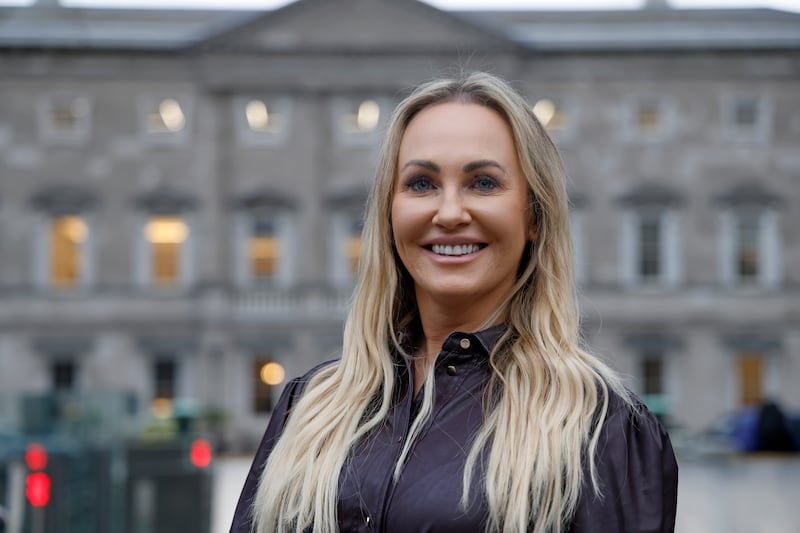 Teresa Costello at Leinster House. ‘I’ve lived in a working-class area my whole life. I know the challenges. I don’t want to live anywhere else,’ says the Fianna Fáil senator. Photograph: Nick Bradshaw
“That’s when your world really opens up,” she says. “Because you’re thinking: is this treatable, or is this terminal?”
Chemotherapy was scheduled immediately. There was no time for deliberation or for preparing or looking to contingencies, like freezing eggs.
“They said, ‘This is aggressive. We need to get you in’.”
She was still grappling with the basics.
“I remember saying, ‘I don’t think I’ll take chemo because I don’t want to lose my hair. Could I just do radiotherapy?’ I was completely clueless.”
Her son had just turned six. His birthday was the day before her first chemotherapy session, on September 13th, 2013 – a date she will never forget.
“I was sitting there, all my family around me, and I was looking at him thinking: Jesus will I be here next year?”
There was no family history of breast cancer. No warning.
“It hits you all at once, your mortality. The fact that there are no guarantees.”
She underwent eight rounds of chemotherapy – four of Taxol (intravenous chemotherapy medication) and four of AC (Adriamycin and Cyclophosphamide) – losing her hair and energy. By this stage, she was too exhausted to work. The chief executive of United Drug, Liam Fitzgerald, and her colleagues were all really supportive of her.
For a person for whom image had always been important, she had to make radical readjustments. The loss of her hair, in particular, was always going to be difficult.
“I was always very focused on my appearance,” she says. “And suddenly it meant nothing. You’re stripped back to the basics. You realise how quickly everything can be taken from you.”
The cancer had not spread to her lymph nodes, a fact she attributes entirely to early diagnosis. She underwent a mastectomy and immediate reconstruction, followed by 25 sessions of radiotherapy.
“If I’d been sent away that day and told to come back in six months for a scan,” she says, “I have no doubt I’d have been stage four.”
That early diagnosis, she says matter-of-factly, “could have been the difference between life and death”.
During radiotherapy she spotted a man she knew from Tallaght, Thomas, who had been friends with her brother. He was there with his father and came over to her to say he’d heard about her diagnosis.
At the start, it was conversations but over time it developed into a relationship and marriage, and a newly extended family: Costello, Thomas, her son Ryhs, and his daughter Georgina. Amid the chaos of chemo, it all brought a chink of light.
“It was a positive out of a dark time in my life,” she says.
Costello’s cancer was hormone-driven. It necessitated ongoing treatment with Tamoxifen, a drug that blocks oestrogen, to reduce the risk of recurrence. Even a decade later, she says the anxiety can still crop up.
“I live with the fear every day. You get triggered very easily, especially if you’ve lost friends.”
One close friend, diagnosed at around the same time, died within two years.
I’ve lived in a working-class area my whole life. I know the challenges. I don’t want to live anywhere else
— Teresa Costello
Around February 2014, when she was getting the mastectomy, she realised there were no real support groups online for people who had gone through an experience like hers and wanted to share it. She set up a new community on Facebook, with the clever name Breast Friends.
“I want to set up something where people could ask questions and speak openly, and it would be a safe environment.”
The page took off from day one and became a big success. It now has more than 10,000 members on its public page and 3,500 on the private page. Costello moderates it daily.
Through the group, she often hears about policy issues before they surface publicly.
“There was a decision about two years ago when Stephen Donnelly was minister for health. Funding was reduced for breast prosthesis. Literally, the ink wasn’t dry on it being changed [before] my page was flooded with mails.
[ Róisín Ingle: The day before the scan results, I remember I have cancerOpens in new window ]
“I messaged him and asked what was going on.”
Donnelly had been blindsided and wasn’t aware the funding was being cut. It was quickly reversed.
Costello became an advocate for breast cancer survivors and spoke to groups in Dublin and elsewhere. She was approached by Dublin South West Fianna Fáil TD John Lahart who had been impressed by her advocacy. He asked her to consider running for the party.
“A lot of what Fianna Fáil stands for aligns with how I see the world,” she says. “I don’t come from a place of outrage. I personally don’t think Ireland is ruined.
“Having been through what I have been through, I have seen the best of people. It gives you a different perspective.”
She also knew Charlie O’Connor, who continued as a TD. What impressed her was that he was everywhere and so devoted to Tallaght. “That is what you want. I tried my best to be exactly the same.”
So she has a modern iteration of the O’Connor outlook and devotion to Tallaght. On her first go at council elections in 2019, she was elected, to her own surprise. She says she has never looked back.
In 2024, she ran for the Dáil on the same ticket as Lahart and finished in sixth place, the last to be eliminated, albeit 2,000 votes shy of the person who won the last seat. It was a solid performance. On the back of it, she was elected to the Seanad on the Agricultural Panel, which might not strike people as a natural fit for a working-class kid from Tallaght. Her family has strong connections going back many years with greyhounds.
The issues that emerged in her own life inform her political priorities: women’s health, early cancer diagnosis, rare diseases, and access to medication.
One current focus is Duchenne muscular dystrophy and a drug that could slow its progression.
“There’s a young boy in Tallaght with it,” she says. “If there’s any way I can keep pressure on so a drug doesn’t sit waiting for approval [for a long time], I’ll do it.”
Politics, for Costello, is not ideological.
“I’m not overly political,” she says. “But I know what’s right and wrong. I know what I can stand over.”
She does believe in diversity and that includes having working-class voices in Irish politics.
“I’ve lived in a working-class area my whole life. I know the challenges. I don’t want to live anywhere else.”
It’s her cancer, though, and her recovery from it, that has defined her political journey.
“You learn very early that everything you think matters can disappear in a moment.”
World Cancer Day was Wednesday, February 4th; its theme was ‘United is Unique’.