

On the back of the cover was a small logo saying Demonware, the company he co-founded in Dublin, which was sold to giant game publisher Activision in 2007 for €17m. “That was our first big game,” he said.
“They paid us, I think, €50,000 for the software and maybe some more for the extra support. We had one engineer here and maybe two onsite in Activision in Santa Monica working around the clock back to make it happen. It was our first real customer.”
Over 30 years, Blanchfield has become one of Ireland’s most consistent serial tech entrepreneurs who, from his college years, has been founding, building and selling interesting tech companies.
These have included the salon software firm Phorest, Demonware and the ad-blocking tech firm PageFair. He’s now back with Jentic, an AI company, co-founded with Dorothy Creaven, Michael Cordner and Tilman Schaefer.
.jpg)
Jentic founders Sean Blanchfield, Dorothy Creaven and Michael Cordner
His first company, Phorest, is now a major company with revenue of at least €50m, although Blanchfield stepped away from it before its breakthrough financial success. It was built with (current) CEO Ronan Perceval and Dylan Collins while they were all still at university.
It was a common college start-up story.
“I was in the student union. Ronan [Perceval] was a journalist in the Trinity News and Dylan was the head of finance of the publications committee,” Blanchfield said. “And we all had that entrepreneurial bug. They needed a geek. I needed business people to collaborate with. And that was it. We were trying to figure out the next idea.
“The obvious one at the time was text messaging, something kids did and grownups didn’t know about. So we developed a website where you could text groups of people and that launched the whole business.
“Over time it grew into a salon management business, for appointment reminders and that kind of thing. Ronan basically led that business to the success it is today, because now it’s very big, employing hundreds of people.”
Before Phorest got off the ground, they were already thinking about Demonware.
.jpg)
Sean Blanchfield
Today’s News in 90 – Thursday February 5
“I was doing a PhD and was the part-time CTO of Phorest. We knew that every computer lab in college at 5pm would just turn on [the video game] Quake. This was basically online play,” Blanchfield said. “We could see it coming because we were in college, but it hadn’t gone mainstream. You couldn’t do it on Xbox or PlayStation.
“In Ronan’s flat one day, Dylan asked whether there was something we could do like Havok, but with networking stuff? We thought that multiplayer was going to go big and we could see the business model because of what Havok was doing, selling physics. So we set off at the age of 22 in 2002 to go raise venture capital in Ireland in the post dotcom bubble era.”
I got a million or so, which was great. I was over the moon
That worked spectacularly: Demonware went on to be acquired for €17m by Activision five years later. For twenty-somethings, it must have seemed like a lot of money. But Blanchfield said it wasn’t life-changing.
“From my end of it, I got a million or so, which was great. I was over the moon, even if wasn’t retirement money,” Blanchfield said.
Looking back, he now realises how big it could have become.
”At the time we sold, we felt we had to because we didn’t have many other options. It was 2007. The bubble hadn’t burst yet, but we were still in Ireland and Ireland was in Europe and there was no follow-on capital available,” he said.
There wasn’t the idea of, say, taking the player accounts we had in our database across all platforms and doing something more interesting with it, like trying to build Steam or a major distribution platform for PC games. I think we could have done that. We had that idea, but we couldn’t see a way to capitalise it.
“We sold it because it was the right thing to do for the company. But if we had that today, with the 300 million player accounts in a database, knowing who they played with and what they liked to play and how good they were at every game, it would be a unicorn. It was a social network without a user interface.”
A few years later, Blanchfield founded PageFair with Brian McDonnell and Neil O’Connor, a company set up to help companies seeing ads being blocked online. It was acquired by a Canadian company, Blockthrough, in 2018, but didn’t have the kind of financial success of Demonware.
After that, he hunkered down during the pandemic but by 2022, “the start-up itch had returned and it was time to go again”.
He became an ‘entrepreneur in residence’ in Dog Patch Labs in Dublin.
“That basically means I got to hang around the place and advise other companies while trying to cook up my next thing, which suited me”, Blanchfield said.
I was going through my list of 50 ideas and I just crossed them all off
“I was there about a year-and-a-half, a period that overlapped with the launch of ChatGPT. So I started playing with that and working with other start-ups in Dogpatch Labs and the National Digital Accelerator program and thinking, ‘okay, how does this change the whole nature of software?’ How does this change the nature of starting a company?
“If you’re a software entrepreneur, what are you to do? I was going through my list of 50 ideas and I just crossed them all off one by one because, in an age of AI, none of them made sense because AI had taken over.
“We spent 15 years building SaaS [software as a service] applications, that live in the cloud. That makes sense if the human is doing the work. But in an AI age, we’re building an agent that’s going to try to directly connect to the database or the data sources and do the work.
“That agent doesn’t need a SaaS application, doesn’t need the user interface and doesn’t need its hand held to go use a computer. It is a computer.”
These thoughts led him to thinking about what would become Jentic, a new start-ups to help control what AI can access and how to use it efficiently in big businesses.
“Let’s say that you’ve got a company and you’ve got all kinds of software systems in there,” Blanchfield said.
”You’ve got accounting software, you might have email, you might have Microsoft Office, you might have a couple of other bits of common software.
“If you’re a big company, it’s more complicated. You have your own software. You have stuff that’s running on your own servers, stuff you’ve built up over time, bespoke software that maybe could be 30 years old or more. This is how your business actually runs. So for you, AI is a nice chat bot like Copilot, that kind of runs out of steam in terms of its usefulness pretty quickly.”
To get to the real work, he said, is a lot messier. “Let’s say a customer emails looking for a refund or they want to cancel an order that you shipped,” Blanchfield said.
”A human operator would probably look that up and say, who is this customer? What did they buy? And they’d look that up in some logistics system to determine whether it was shipped or not and whether it could be cancelled, whether it had left the warehouse, all of that workflow.
“Now if you want AI to automate that, you have to hook it, the AI, up to all those systems. That means CRM, the billing system, the logistics system, the inventory system. And that’s difficult. You want a central switchboard that all of this flows through when it’s communicating, not just lots of point-to-point connections. If you don’t have it in a managed way, you have no way to observe or to govern it, to say what happened or why something went wrong.
“You can’t even begin to approach being compliant. And security is out the window. So the answer is that you need a system in the middle, so that if you have AI hooking up to your systems, it all runs through this one chokepoint where you provide access and you can govern the access. So you can say what happened and you can prevent bad things from happening, like the wrong kind of system getting access to stuff that it shouldn’t have.”
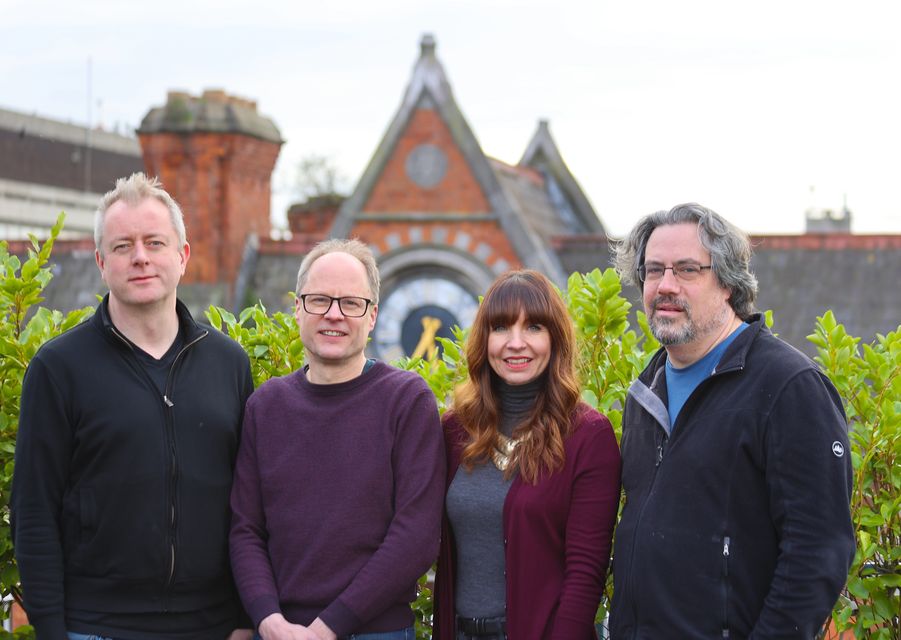
The team behind Jentic: Sean Blanchfield, Tilman Schaefer, Dorothy Creaven and Michael Cordner
One of the reasons for all of this, Blanchfield said, is ‘data sovereignty’. This is the notion that things are moving so quickly, with platforms hoovering up so much, that a premium is will grow on having total control of your own stuff.
“If you move forward with your AI automations and do it in this format [through a central control point], you’re not just giving your business processes to Sam Altman or into any of the other platforms that will happily allow you to put your business logic into them and they’ll run it for you,” he said.
“In two or three years time, we’ll be looking at this and it’ll be very important if you’re in business that you actually have your own business logic under your control. Because if you don’t, what do you actually have? You’re just reselling someone else’s product.”
As for the impact AI is having on jobs and industry, Blanchfield is not in any doubt there is a wave of automation on the way, rarely seen in the jobs market.
“We don’t actually code per se anymore,” he said. “We just go in and debug and check stuff. AI has taken up the reins of the actual writing of the code.
“The question of what it should write, the architecture and seeing if it’s all fitting together is still a human activity for now. But sitting down there on the keyboard and typing the code in is not something that people are doing anymore.
“As software engineers, we’re automating our own work first. The coding agents are the most advanced agents that are out there and it’s surprising what you can get them to do, right? I think you can kind of look at software engineering for the leading indicators of what’s coming in every other field.”
Like other AI-adjacent founders, Blanchfield worries about Europe trying to over-regulate AI and missing out on opportunities for companies here.
“I managed to read 200 pages of the [Mario] Draghi report last Christmas,” he said.
“It wasn’t what I expected. It’s absolutely scathing of the EU and this is an EU commissioned report. It really calls out the EU AI Act and the comparison I think it made was that Europe essentially missed out on digitisation with the web. In the mid 1990s, European GDP and US GDP were approximately the same.
“Since then, American GDP has soared ahead. All of the big tech companies are American. We didn’t build them here. Instead, what we do here is that we buy their technology. In Europe we spend something like €270bn a year on American cloud software, which is a result of that. And it’s all about to happen again.
“And what are we doing? We’re trying to regulate it before we can even clearly say what we think it is. I’m not against regulation, by the way, I’m not one of those guys. I actually really like the GDPR. We do need regulation. But this one is unclear.
All of which destabilises Irish and European prospects, Blanchfield said.
“It seems to me that it’s clearly China versus America leading the race here,” he said. “Whoever wins this really wins a lot of the future. Europe thinks it’s at that table. I don’t think that it’s in the building. I think probably India is the next to get to that table. Europe is not being real right now.”
What does Ireland need to do? Do we have any role in this discussion or what happens next?
“There are a few things,” he said.
“I’m not sure we’re doing them. Energy is one piece. We are very good at data centres. A disproportionate amount of the global cloud runs out of Ireland. We can do the same for AI. It needs to run somewhere, but we’ve walked ourselves into the situation where we need to choose it or houses, which is ridiculous.
“Then you could talk about regulation. Obviously we have a national competency of being seen as a pragmatic location to base yourself, to be regulated if you’re going to address the European market. I don’t think we’re going to produce the actual foundational models from Ireland, or catch up with the bigger companies that are leading that.
“But we do have this very interesting economy where we have all of these global companies concentrated in this small society, where we all know each other and we all talk to each other. Big Pharma and Big Tech are on our doorstep. Banking and insurance clusters are here, too.
“This can be a place where we can connect AI into those companies and lead at the applied edge of it. And that’s the side of it that we’re trying to lead into in Jentic.
“So if not quite a vacuum, there’s certainly an opportunity for us here, given our history, context and position. And I think it’s incredibly important.”
.….
This article was updated on Feb 5th 2026 to clarity a reference to the financial crash in 2008.