
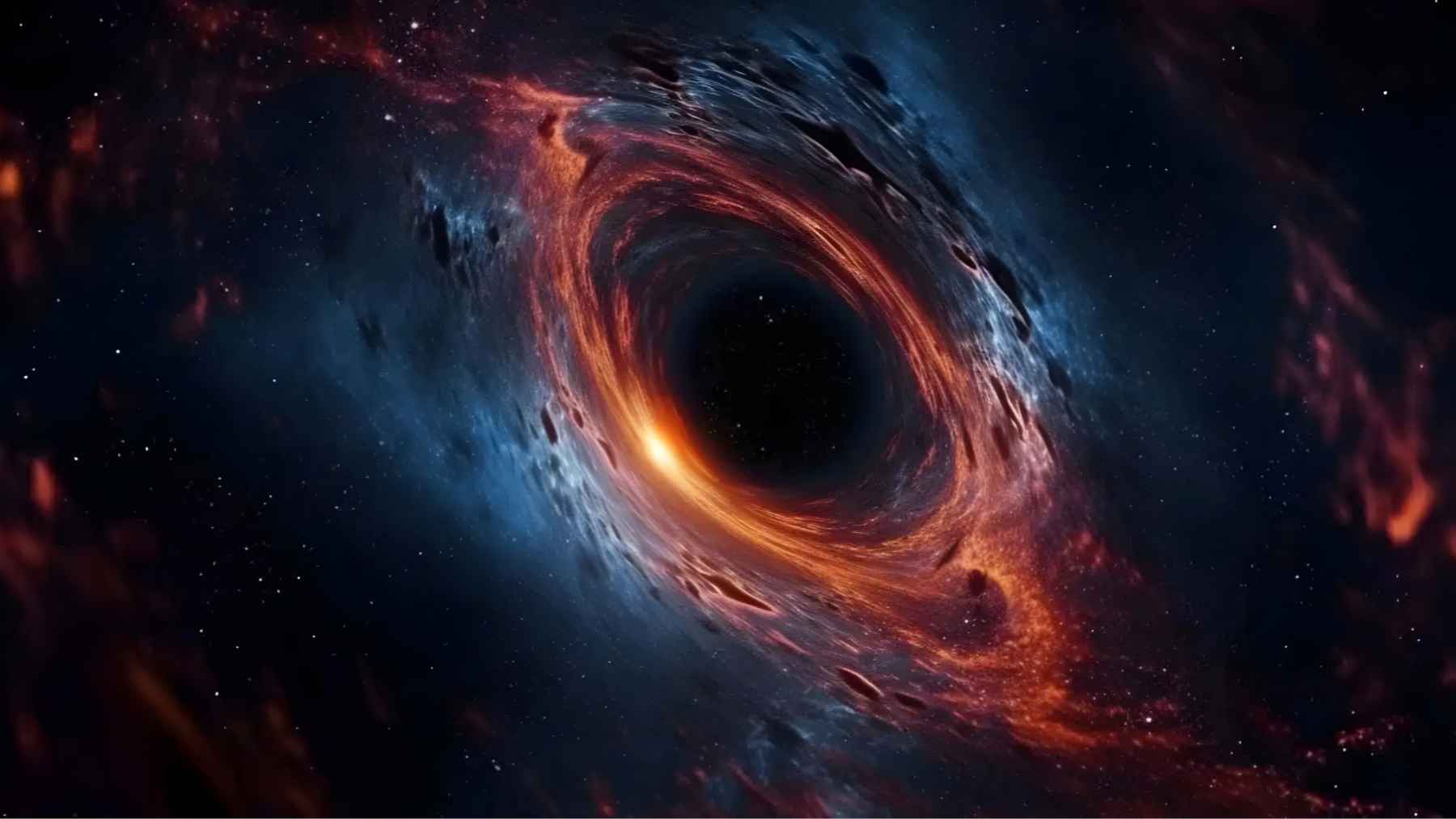
For decades, black holes were treated like a cosmic punchline. In the 1930s, astronomer Arthur Eddington openly mocked the idea that a star could collapse into something so extreme, calling it “absurd.”
Now the conversation has flipped. A new peer-reviewed study argues that black holes could be tied to dark energy, the unknown “push” that makes the universe expand faster and faster, and the team says fresh data is turning this from a thought experiment into a testable claim.
From “absurd” to unavoidable
Black holes went from math on paper to observed reality over the last century, helped along by new instruments and a lot of stubborn scientists. Stephen Hawking made them mainstream in physics, but even today, researchers still debate what is happening deep inside them.
That old skepticism matters because it shapes how careful scientists are now. When a new idea claims black holes might also explain dark energy, the burden of proof is high, and the debate is very much alive.
Dark energy in plain language
Dark energy is the name scientists give to whatever is driving the universe’s accelerated expansion. In simple terms, it’s like a background “pressure” that keeps nudging space itself outward, even though gravity should be pulling things together.
It’s not a small detail. The University of Michigan press release behind the new work notes that dark energy makes up roughly 70% of the universe, yet scientists still do not know what it is made of.
The key concept behind the new claim
The study focuses on an idea called cosmological coupling. In practical terms, it suggests a black hole’s effective mass could grow as the universe expands, even if it is not actively swallowing stars or gas.
That growth matters because it can mimic the effect of dark energy. Researchers including Kevin Croker say that if black holes carry something like “vacuum energy,” their connection to the expanding universe could help drive the acceleration we measure from far away.
What the researchers actually did
The team tested the idea against measurements from the Dark Energy Spectroscopic Instrument, a project that maps the universe in 3D by tracking millions of galaxies and how their light is spread across space.
If you want a simple picture, it is like using an enormous cosmic survey to measure how “stretched” the universe is at different times.
In the new paper, the scientists compared that expansion history to when black holes should have been “born,” mostly from the collapse of massive stars. Gregory Tarlé described the concept as a kind of “Big Bang played in reverse,” where matter collapsing into a black hole could be linked to a rise in dark energy.
What this could change, and what comes next
If this picture holds up, it would offer a concrete origin story for dark energy that does not require inventing a brand-new field of physics from scratch. It would also connect huge, abstract questions to something more grounded, the life and death of stars.
But there are big open questions. Brian Cartwright and Rogier Windhorst point out that the strongest signal in this analysis comes from black holes born later in cosmic history, and researchers still need to pin down where those black holes are today and how they moved over billions of years.
Related reading includes the team’s earlier work on black hole growth in dormant galaxies, described in this 2023 Imperial College London release and in the University of Hawaiʻi System News summary, along with the newer DESI-based press release and the paper preprint for readers who want the details.
The main study has been published in the Journal of Cosmology and Astroparticle Physics.