

Researchers at Nanjing University have just broken a major optical rule with a groundbreaking design for metasurfaces, ultra-thin materials that manipulate light in innovative ways. This new approach allows light to maintain color clarity and behave independently, even as it travels along different paths. This leap forward could pave the way for better optical devices, from full-color imaging to multi-band sensing, with applications spanning the microwave to visible light.
The study, led by Professors Yijun Feng and Ke Chen, presents a unique hybrid-phase technique that combines two geometric phases: Aharonov–Anandan (AA) and Pancharatnam–Berry (PB). By combining these phases, the researchers have created a metasurface that can independently control the dispersion of light for both right-handed and left-handed circularly polarized (RCP and LCP) light, without introducing the common distortions typically seen when working with multiple wavelengths. This method significantly advances our ability to achieve true achromatic control, making it easier to manage light at different frequencies.
The breakthrough builds on the concept of metasurfaces, flat materials that use small, engineered structures to control light in ways that traditional lenses and mirrors cannot. These metasurfaces are already essential for tasks like focusing light and shifting its direction, but until now, most designs struggled with maintaining performance across a broad range of wavelengths. According to the study published in PhotoniX, the new design has the potential to overcome these limitations by addressing the phase and group delay (the time it takes light to travel through the material) independently for both spin states.
Achieving Dual-Spin Control Through Hybrid Phases
According to the researchers, the key to this innovation is the use of two distinct geometric phases within a single metasurface layer. The AA phase is responsible for “spin unlocking,” which separates the two spin channels (RCP and LCP) allowing them to behave independently. Meanwhile, the PB phase contributes to “phase extension,” which broadens the range of achievable phase shifts without affecting the group delay. This clever combination enables light to follow two different paths, with each spin channel treated as a separate degree of freedom, something that has been nearly impossible with previous metasurface designs.
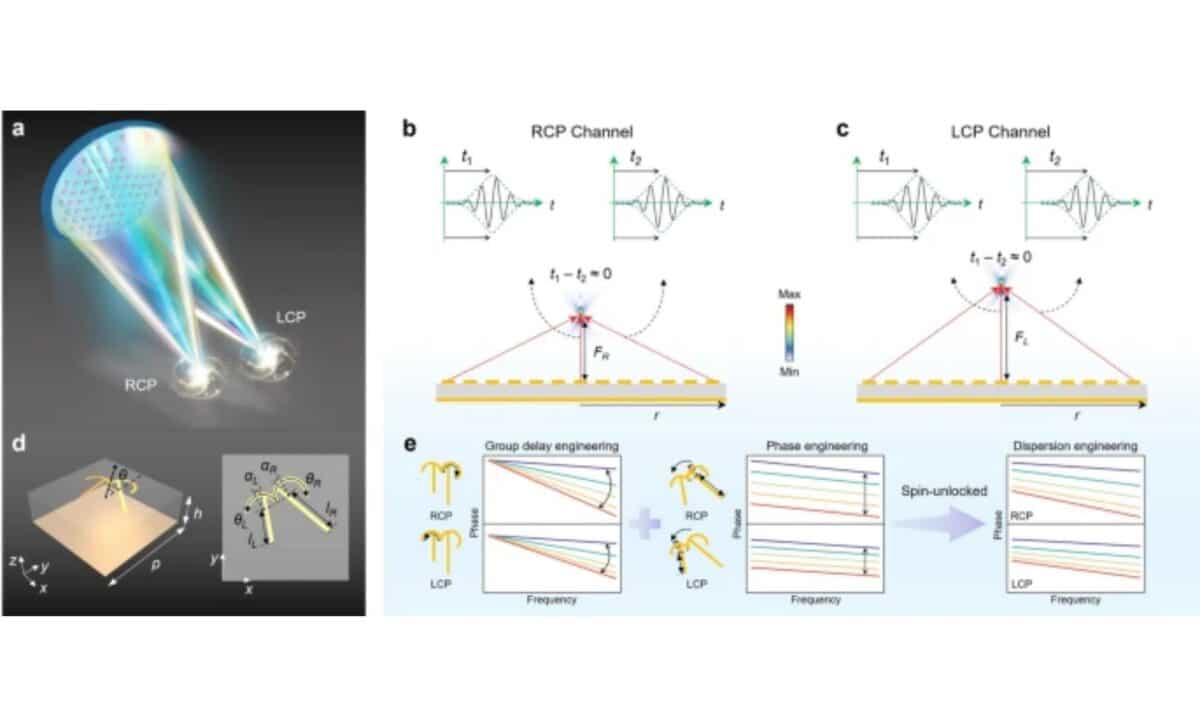 Spin-Unlocked Achromatic Meta-Lens: Independent Focusing for RCP and LCP Light with Hybrid-Phase Control ©Springer Nature
The hybrid-phase strategy relies on engineering asymmetric current distributions within each meta-atom, which is the basic building block of metasurfaces. These asymmetries cause the RCP and LCP light waves to reflect along distinct paths, allowing for precise control over their individual dispersion properties. This separation also helps minimize unwanted crosstalk between the two spin channels, a common problem in previous designs that used a shared dispersion behavior.
Experimental Validation Across Multiple Frequencies
In their experiments, the team tested the metasurface at two distinct frequency ranges: from 8 GHz to 12 GHz, and from 0.8 THz to 1.2 THz. They demonstrated two types of devices using their design: spin-unlocked achromatic beam deflectors and meta-lenses. According to the researchers, these devices successfully maintained stable performance across both frequency bands, steering beams and focusing light with minimal chromatic aberrations.
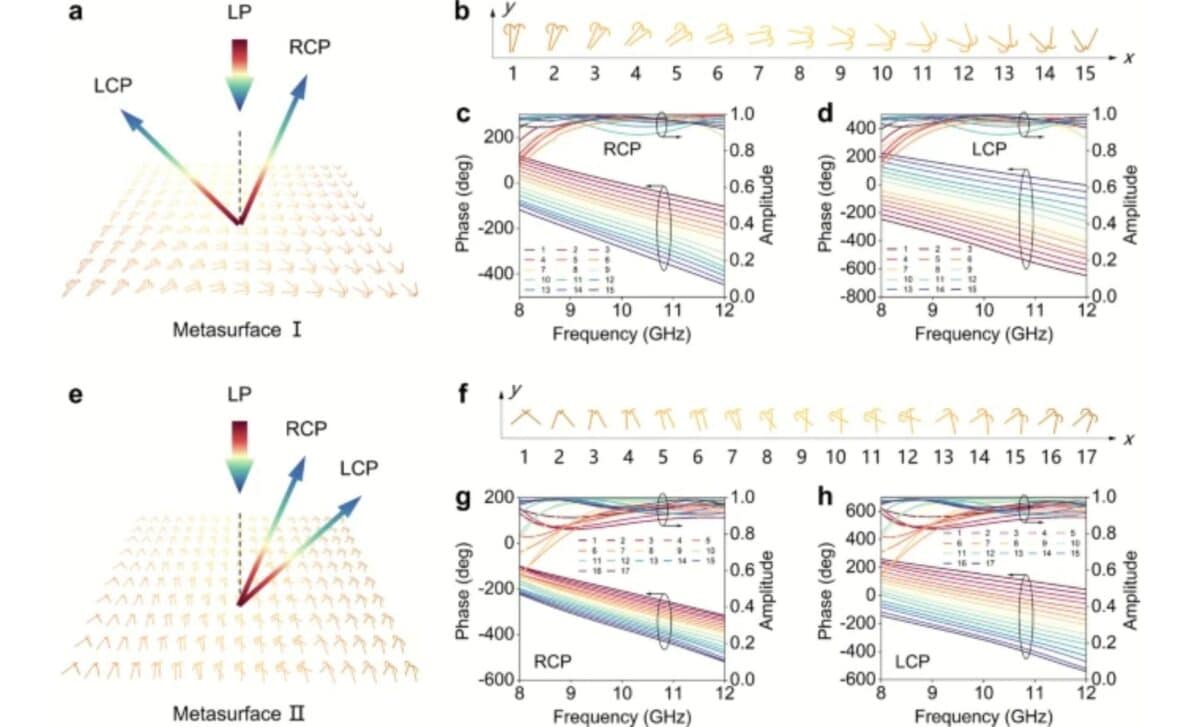 Design of Spin-Unlocked Achromatic Beam Deflectors: Meta-atom Distribution and Reflection Amplitude/Phase for RCP and LCP ©Springer Nature
The experimental results were consistent with the simulations, showing that both beam deflectors and meta-lenses operated effectively at the specified frequencies without the typical distortions that come with working across broad bands. Notably, the meta-lenses could focus RCP and LCP light onto two separate spots without causing focal shifts, an achievement that is crucial for applications that require high precision in imaging or sensing.
Expanding the Potential of Metasurfaces
This new hybrid-phase metasurface design is not just a breakthrough for the microwave and terahertz ranges. According to the team, the principles they developed can also be extended into the visible light spectrum. If successful, this could lead to new technologies in areas like multi-functional imaging systems and polarization-sensitive devices, enabling innovations in everything from medical imaging to optical communications.
The ability to independently manipulate both the phase and group delay for two spin channels could allow for more compact and efficient devices. As the researchers point out, future work could involve using machine learning techniques, such as genetic algorithms, to further optimize metasurface designs. This would speed up the process of creating devices with precise control over light, making them more suitable for real-world applications.
By treating both RCP and LCP light as independent channels, this new metasurface design opens up possibilities for next-generation optical systems that can handle complex tasks with minimal size and high efficiency. This is a step closer to realizing the dream of ultra-compact, broadband optical devices that can be used in everything from telecommunications to advanced sensors.