

In an unprecedented astronomical event, Comet C/2025 K1 (ATLAS) has been caught breaking apart as it passed perilously close to the Sun. This dramatic disintegration was captured by the Gemini North telescope in Hawaii, as outlined in a recent study published by the National Optical-Infrared Astronomy Research Laboratory (NOIRLab).
The study reveals not only the stunning images of the comet’s death spiral but also provides deeper insights into how comets behave under extreme solar conditions. This rare cosmic occurrence has intrigued astronomers, giving us a glimpse into the violent and fleeting nature of these icy visitors from the outer solar system.
The Spectacular Breakup of Comet C/2025 K1 (ATLAS)
Comets, often considered messengers from the outer reaches of our solar system, can be both fragile and resilient, depending on the forces they encounter. Comet C/2025 K1 (ATLAS) was no exception. As it made its way toward the Sun in October 2025, it was subjected to extreme solar radiation, a force strong enough to disrupt its nucleus. This is a well-known phenomenon that occurs when a comet gets too close to the Sun, leading to intense outgassing, a process where the heat causes the ices within the comet to sublimate into gas, creating jets of material. These jets, combined with the gravitational forces from the Sun, began to tear the comet apart.
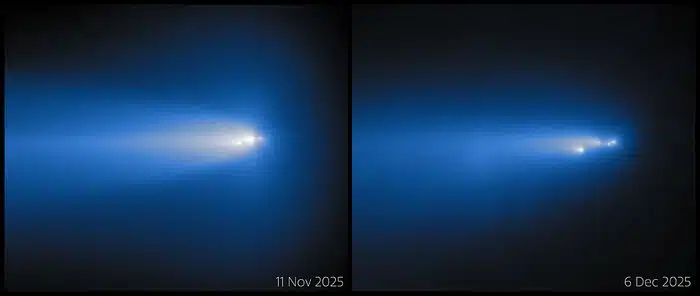 On 11 November and 6 December 2025, the Comet C/2025 K1 (ATLAS) soared in the skies above Maunakea, Hawai‘i, where Gemini North captured it in action! Gemini North is one half of the International Gemini Observatory, supported in part by the U.S. National Science Foundation and operated by NSF NOIRLab. The 11 November observation of C/2025 K1 (ATLAS) was featured as a NOIRLab Image of the Week.
The images captured by the Gemini North telescope revealed a comet in its final moments, with three distinct fragments visible, each piece a reminder of the comet’s initial structure. The breakup is a reminder of the constant, chaotic forces that shape the evolution of such objects, some of which may have been in existence for billions of years. The event has been described as “spectacular,” offering a rare opportunity for astronomers to study the disintegration of a comet in real-time.
The Role of Extreme Solar Heat in Comet Disintegration
The Sun’s influence on comets is both powerful and destructive. As comets like C/2025 K1 (ATLAS) approach the Sun, they begin to feel the intense heat and radiation, which causes their icy components to vaporize. This process, known as sublimation, generates gas jets that shoot out from the comet’s nucleus, carrying with them dust and other debris. Over time, these jets erode the comet’s core, causing it to weaken and, eventually, break apart.
This breakup is a natural part of a comet’s life cycle, though it is not always visible to Earth-based observers. Most comets either never emerge from behind the Sun or break apart before they can be observed. In the case of Comet K1, however, it made it through the worst of its passage only to disintegrate in full view of astronomers. This event provides valuable insight into the effects of solar heating on comets, offering a rare opportunity to understand how they evolve, and sometimes meet their end, as they venture through our solar system.
What Can We Learn from the Disintegration of Comet C/2025 K1 (ATLAS)?
The study of Comet C/2025 K1 (ATLAS) provides valuable lessons about the nature of comets and their relationship with the Sun. The comet’s dramatic breakup shows how vulnerable these icy bodies are to the extreme conditions near our star. By studying such events, scientists can better understand the forces that shape our solar system, from the creation of comets to their eventual destruction.
Additionally, the images captured by the Gemini North telescope offer clues about the composition of the comet and how it interacted with the Sun’s radiation. This data will likely help astronomers refine models of comet behavior, as well as our understanding of the early solar system. Comets like C/2025 K1 (ATLAS) are thought to be relics from the formation of the solar system, containing materials that are older than the planets themselves. Thus, studying their disintegration provides a unique window into the distant past.
The Future of Comet Observations: What’s Next After K1?
The fate of Comet C/2025 K1 (ATLAS) raises important questions about the future of cometary research. With the comet now reduced to fragments, astronomers are turning their attention to other near-Sun comets, such as Comet C/2026 A1 (MAPS). This comet, which is currently on a collision course with the Sun, could provide further insights into the processes that lead to the disintegration of such objects. In April 2026, Comet A1 will pass within a dangerously close 465,000 miles of the Sun, and astronomers are eager to see how it will fare under similar conditions.
If Comet A1 survives this perilous encounter, it could reach a brightness comparable to Venus, creating a spectacular visual display. This will be an exciting moment for astronomers and skywatchers alike, as we witness the fate of another comet and learn more about the dynamic forces at play in our solar system.