
By Faris Mokhtar and Ishika Mookerjee
(Bloomberg) — Singapore’s top 20 per cent households are richer than all the other families combined, a reflection of the extent of wealth inequality in the city state.
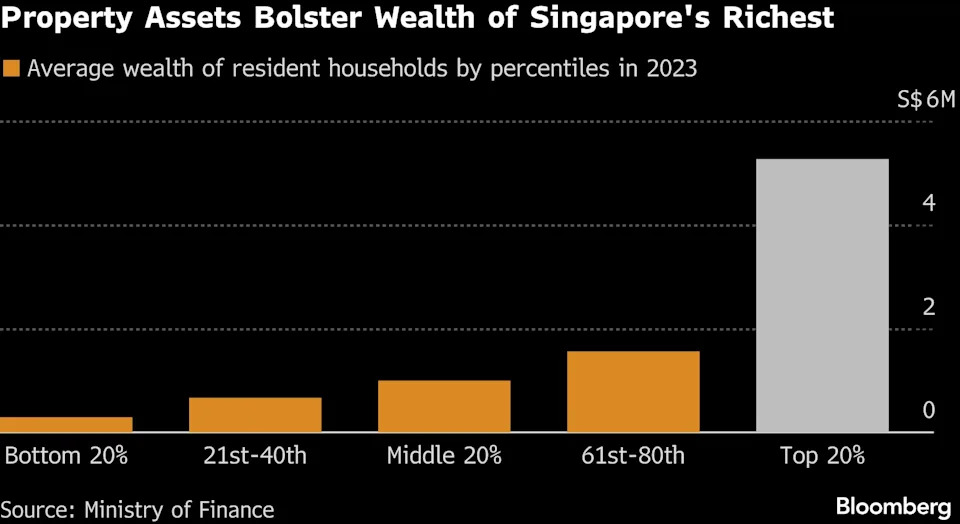
The top quintile of resident households held an average wealth of about S$5.3 million (US$4.2 million) in 2023, the latest available figures based on a study published on Monday (9 Feb) by the Ministry of Finance (MOF). Property accounted for at least half of their worth.
That compares with a combined average wealth of about S$3.5 million for all other households, with the bottom 20 per cent having a net worth of S$293,000, the data showed.
Singapore’s wealth inequality stood at 0.55 in 2025, the first time the government has released such data following concerns of inequity in one of the world’s richest cities. The finance ministry acknowledged the challenges in measuring wealth.
The wealth Gini coefficient is “broadly comparable” to other developed economies including the UK, Japan and Germany, the ministry said. The city-state had the 11th highest wealth inequality in 2024, according to UBS’s Global Wealth Report.
Globally, the gap between the richest and the poorest has widened. Since the 1990s, the wealth of billionaires and centimillionaires has risen at about 8 per ent annually, nearly twice the pace experienced by the bottom half of the population, according to a World Inequality Report.
Income inequality in Singapore fell to a record low of 0.379 in 2025, compared with 0.437 in 2015, according to the finance ministry’s data. The city recently updated the figures to factor in other sources like rental income and investments, tweaking the methodology for figures since 2015. Previously, the metric was measured based only on income from employment.
Singapore has been trying to navigate a tricky balance. It strives to keep inequality low without excessively taxing the rich, including high net worth foreigners.
Prime Minister Lawrence Wong’s government has raised taxes on high-end property and cars and warned that Singapore risks losing out to other hubs seeking to woo wealthy foreigners if it’s too heavy handed. His administration has provided housing and healthcare subsidies to ensure affordability as well as cash handouts to help residents cope with rising costs. Wong is scheduled to present his annual budget speech on 12 Feb.
“We are refreshing our approaches and renewing our social compact,” Wong said in a video posted on YouTube. “Every Singaporean has real and meaningful opportunities to progress, and we continue to move forward together, even amidst a more challenging global environment.”
More stories like this are available on bloomberg.com
©2026 Bloomberg L.P.