
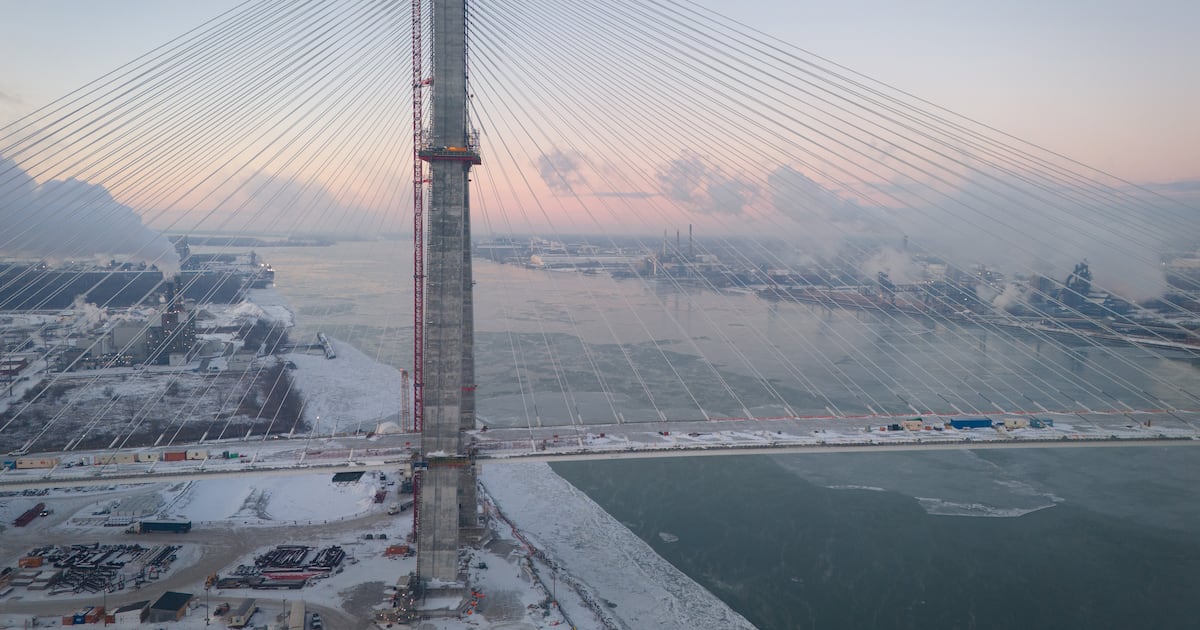
US president Donald Trump has threatened to block the opening of a new bridge between the United States and Canada if Canadian officials do not address a long and growing list of grievances, escalating diplomatic tensions between the two countries.
Amid a trade war and a deepening rift between the United States and its northern neighbour, Trump said he would “not allow” the opening of the Gordie Howe International Bridge, scheduled to open early this year for traffic between Detroit and Windsor, Ontario, “until the United States is fully compensated for everything we have given them, and also, importantly, Canada treats the United States with the Fairness and Respect that we deserve”.
The Canadian Chamber of Commerce, the nation’s largest business lobbying group, denounced the president’s threat in a statement, writing that “whether this proves real or simply threatened to keep uncertainty high – blocking or barricading bridges is a self-defeating move”.
It was not immediately clear how Trump would block the opening of the bridge. Its construction was paid for by Canada, and a public-private arrangement, under which Canada and Michigan would jointly operate the crossing, gives Michigan part ownership.
One possible avenue would be for Trump to declare an emergency. Under the law, Customs and Border Protection can temporarily close a port of entry “when necessary to respond to a specific threat to human life or national interests”.
Trump has often invoked emergency statutes for events and circumstances that are largely considered routine to make use of the expanded authority that doing so grants him.
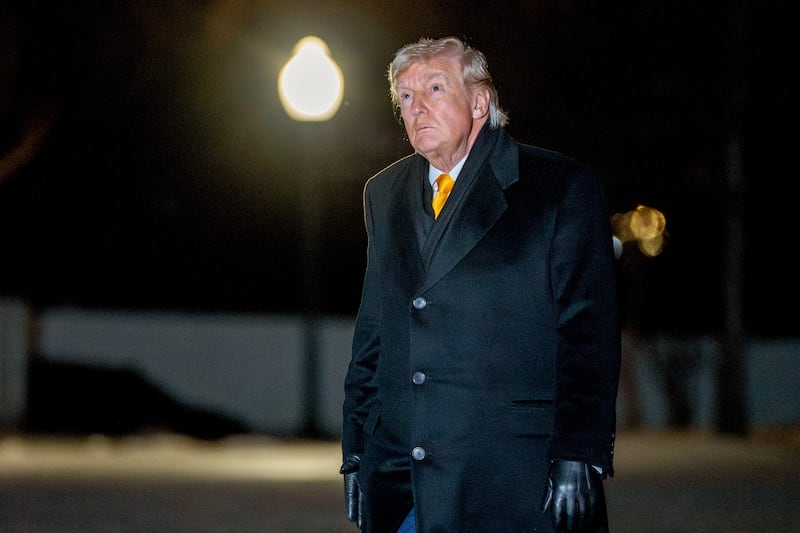 US president Donald Trump after arriving in Washington, DC, early on Monday. Photograph: Bonnie Cash/UPI/Bloomberg
The nearby Ambassador Bridge, one of the busiest border crossings on the continent, has been privately owned for decades by a Detroit trucking industry billionaire and his family, the Morouns.
The family had previously called on Trump to halt the construction of the Gordie Howe Bridge – which would, once opened, compete for the more than $300 million (€252 million) in daily cross-border trade over the Ambassador Bridge.
Trump also suggested in his social media post on Monday night that the United States might seek to acquire “at least one half” of the new bridge and to get a cut of the revenue from bridge tolls.
In his first term, Trump had promoted the project in a joint statement with Canadian officials as a symbol of the countries’ deep economic partnership and as “a vital economic link between our two countries”.
But the president’s threat to block the bridge’s opening is in keeping with a larger pressure campaign to force the Canadian government to capitulate to his demands. In addition to threatening to annex Canada as the 51st state, Trump has waged an expansive trade war against his northern neighbour, levying tariffs and threatening other economic sanctions.
It is possible that Trump may not follow through on his threat to block the bridge, or that he may take a less severe action to avoid the most serious economic repercussions.
Trump has previously delayed or walked back implementing tariffs that had the potential to disrupt American trade and cripple domestic industries.
Trump made a similarly alarming statement last month that appeared to threaten to ground all Canadian-built aircraft currently flying in the United States over a regulatory dispute, but air industry regulators quickly clarified that his statement was meant to apply only to new aircraft certifications and that air travel would not be disrupted by the president’s threat.
Trump’s attacks against Canada increased in intensity after remarks last month by the Canadian prime minister, Mark Carney, at the World Economic Forum in Davos, Switzerland, in which he urged leaders of middle-sized nations to band together to resist Trump’s America First doctrine and his efforts to dismantle the post-second-World-War international order.
Carney’s office declined to comment on Trump’s threat to block the bridge’s opening. Stacey LaRouche, a spokesperson for governor Gretchen Whitmer of Michigan, downplayed the president’s threat, saying in a statement that the bridge was “going to open one way or another, and the governor looks forward to attending the ribbon cutting”.
Drew Dilkens, the mayor of Windsor, said on Monday evening that he was stunned but not surprised by the president’s threat.
“This is crazy stuff,” said Dilkens. He added that the bridge’s delayed opening last fall had raised concerns of Trump administration involvement.
Trump’s aggressive stance against Canada since returning to office has infuriated its government, enraged its citizens and significantly harmed economic ties between the two countries.
Canadians, who have historically formed a large share of international tourists in the United States, are boycotting US travel destinations and imported US products.
In his meandering social media post, Trump complained, among other grievances, that “Ontario won’t even put US spirits, beverages, and other alcoholic products, on their shelves”.
Trump’s post on Monday also repeated an unfounded claim that if Canada aligned itself with China, “the first thing China will do is terminate ALL Ice Hockey being played in Canada, and permanently eliminate The Stanley Cup”. Trump has previously claimed that China seeks to “end ice hockey” in Canada, without elaborating on what he meant.
Major construction on the Gordie Howe International Bridge is complete, and engineers have been in the testing phase for months, according to the Windsor-Detroit Bridge Authority, a government-funded corporation that is managing the bridge’s construction and future operation. The authority did not respond to a request for comment.
This article originally appeared in The New York Times.