
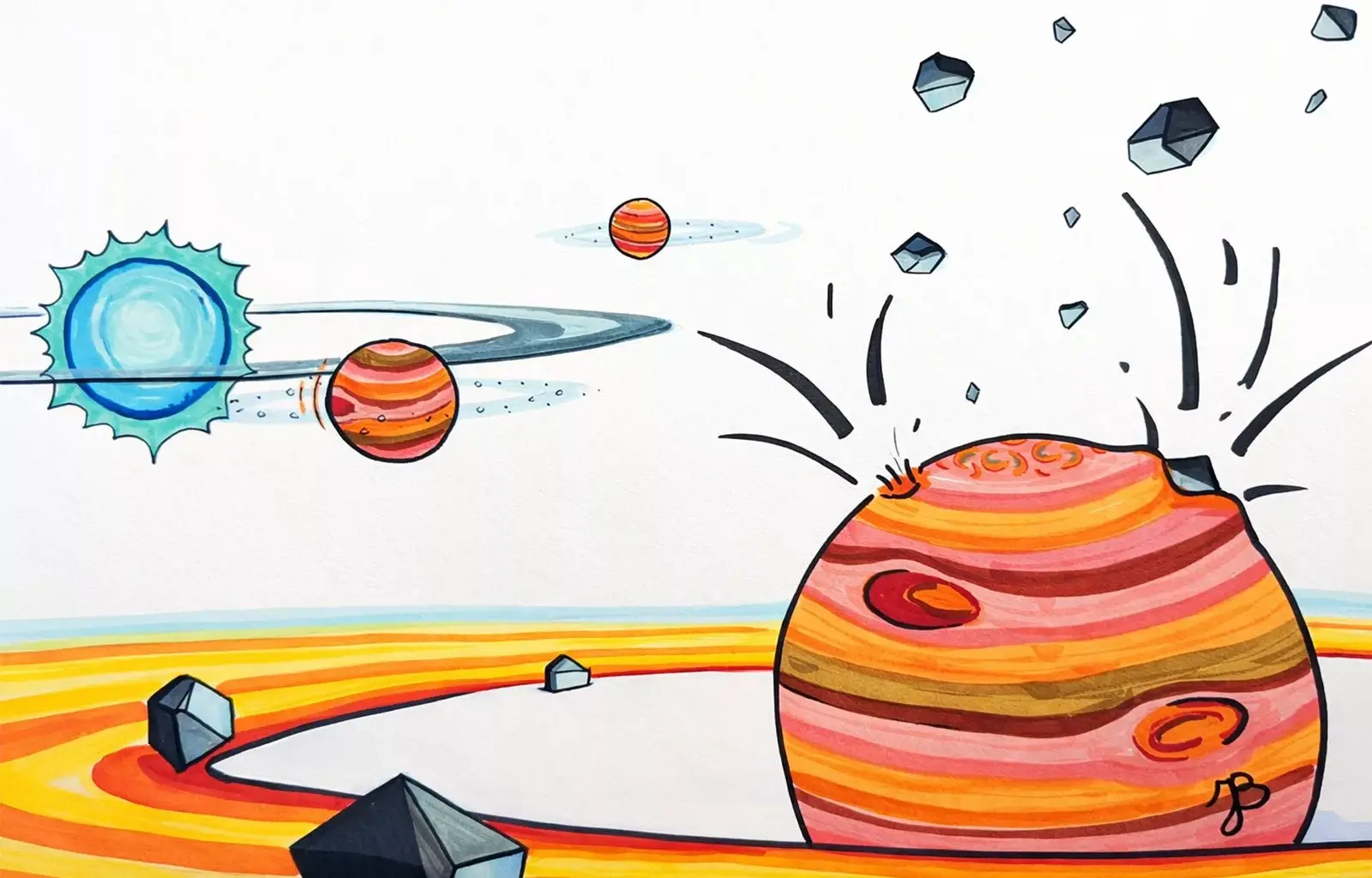
There’s a comforting idea in planetary science. That no matter how strange a distant world looks, its beginnings might still feel familiar.
For decades, astronomers have argued about how super Jupiters, giant planets several times more massive than Jupiter and orbiting far from their stars, come into existence. Are they really planets at all? Or do they form more like failed stars, collapsing directly out of a disk of gas?
Thanks to the astonishing sensitivity of the James Webb Space Telescope, we finally have a chemical clue. And it smells faintly of sulfur.
The spotlight here is on HR 8799, a young star in the constellation Pegasus, about 133 light-years from Earth. It’s famous for hosting four directly imaged giant planets, each weighing five to ten times as much as Jupiter and orbiting at distances between 15 and 70 astronomical units.
That’s far. For comparison, Neptune sits at 30 AU from our Sun. At those distances, building a planet the “normal” way, grain by grain, pebble by pebble, was thought to be painfully slow. Too slow, many believed, to explain worlds this big.
Which is why some scientists leaned toward another idea: gravitational instability, where a chunk of the disk collapses quickly under its own gravity, skipping the slow construction phase entirely. But chemistry doesn’t lie easily.
Why sulfur changes everything
Using JWST’s infrared spectrograph, researchers zoomed in on the atmosphere of the third planet, HR 8799 c. Buried in the faint signal 10,000 times dimmer than the glare of the host star, they found hydrogen sulfide (H₂S). This matters more than it sounds.
In a planet-forming disk, sulfur behaves differently from common gases like carbon monoxide or water vapor. Sulfur freezes into solid grains. It doesn’t hang around in gas form. So if a planet’s atmosphere contains sulfur today, it almost certainly swallowed solid material while forming.
That’s the signature of core accretion, the same basic process that built Jupiter and Saturn.
In other words, these monsters didn’t form like stars. They grew like planets.
The team didn’t stop at sulfur. JWST’s data revealed a whole molecular zoo: water, carbon monoxide, methane, carbon dioxide, rare carbon isotopes, and more. What stood out was the pattern.
The three innermost planets around HR 8799 are uniformly enriched in heavy elements, carbon, oxygen, and sulfur compared to their parent star. That chemical fingerprint closely mirrors what we see in Jupiter and Saturn. Bigger planets, wider orbits, and the same basic recipe.
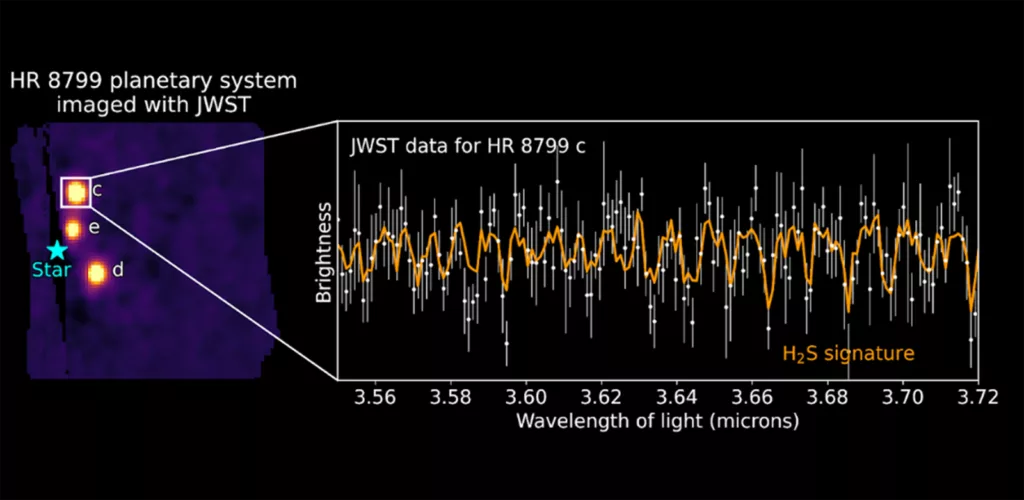 The three inner planets orbiting the star HR 8799 were imaged by JWST in 2023. A clear spectral signature of hydrogen sulfide (H2S) was detected in the atmosphere of the planet HR 8799.
Credit: Jean-Baptiste Ruffio, Jerry Xuan et al.
The findings, published in Nature Astronomy, push planetary formation models into new territory.
“This is exactly the kind of science JWST was built for,” says Jean-Baptiste Ruffio, co-lead author of the study and a research scientist at the University of California, San Diego.
Detecting these molecules wasn’t easy. JWST’s instruments weren’t originally designed for directly imaging exoplanets this faint. Ruffio had to develop new data-analysis techniques just to tease the planetary signal out of the stellar glare.
Meanwhile, detailed atmospheric models custom-built for this dataset were developed to interpret what JWST was seeing, molecule by molecule.
Jupiter was once twice as prominent with a supercharged magnetic field
The reward? The first clear detection of hydrogen sulfide in these worlds and a new way to test planet-formation theories with chemistry rather than assumptions.
Rethinking how far planet formation can go
One of the biggest takeaways is distance.
Astronomers weren’t sure how far from a star’s core accretion could still work. HR 8799’s planets push that boundary outward, suggesting that solid cores can form and efficiently, even tens of astronomical units from their star.
That’s not a small tweak. It reshapes where we expect planets to exist and how common familiar formation pathways might be across the galaxy.
As one researcher said, observations shape theory. Theory changes, and then the loop starts again.
With JWST now in full stride, that loop is spinning faster than ever. And somewhere out there, in a cold, distant disk around another star, another oversized planet may be quietly growing one grain at a time.
Journal Reference
Ruffio, J. B., Xuan, J. W., Chachan, Y., Kesseli, A., Lee, E. J., Beichman, C., Hodapp, K., Balmer, W. O., Konopacky, Q., Perrin, M. D., Mawet, D., Knutson, H. A., Bryden, G., Greene, T. P., Johnstone, D., Leisenring, J., Meyer, M., & Ygouf, M. (2026). Jupiter-like uniform metal enrichment in a system of multiple giant exoplanets. Nature Astronomy, 1-11. DOI: 10.1038/s41550-026-02783-z