
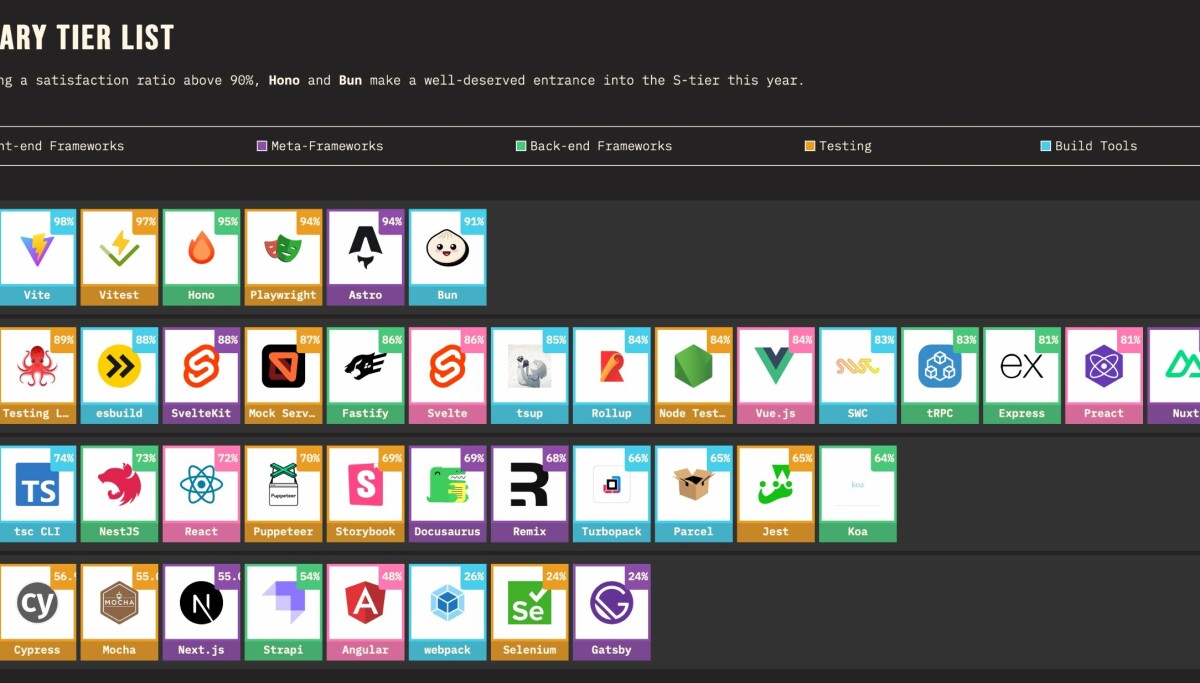
The 2025 state of JavaScript survey, sponsored by six organizations
including Google and JetBrains, shows that some of the most used tools and
libraries are also among the least popular, though some are well-loved
including Vite and relative newcomer Bun.
Around 12,000 respondents completed the survey, which was
conducted in November 2025. Note that percentages typically sum to more than
100 thanks to developers choosing more than one of the available options.
JavaScript is the most popular programming language according
to most surveys, though 40 percent of respondents code only in TypeScript, a
superset of JavaScript which adds strong typing. This proportion “keeps
increasing, and may soon represent a majority of respondents,” the survey
notes.
Despite this, lack of static typing remains the top pain
point according to the survey, though with date handling second. JavaScript
date handling is notorious for being both verbose and error-prone; but this is
being addressed by the technical committee via the Temporal project,
with the further good news that support for this has just shipped in Google Chrome
144, available from January 13 this year. Firefox already has
support, but not yet Apple’s JavaScriptCore (Safari).
Satisfaction with the language is reasonable, but there is disquiet regarding some of the most popular tools and libraries. Webpack,
a bundler used by more than 86 percent of respondents, is disliked by 37 percent,
and liked by only 14 percent. “Absolute nightmare to configure,” said
one respondent, with other complaints including complexity and slow performance.
The community prefers Vite, which has nearly equal usage (84
percent) and is viewed positively by 56 percent. Turbopack, the Rust-based
successor to Webpack sponsored by Vercel, has only 29 percent usage.
There is also notable unhappiness with React and
especially Next.js, regarded by the React team as the most complete implementation. React is used by 83 percent of respondents, with 16 percent dissatisfied,
and Next.js by 59 percent, 17 percent with negative opinions. “I’ve
written Next.js in production for going on 6 years … there’s a lot of brilliant
engineering … but the Next complexity has gotten absurd,” said one respondent.
Another common gripe is the perception that it is too tightly controlled by
Vercel, the hosting platform which sponsors the framework. “Will no longer
be using it because of how Vercel-centric the framework is becoming,” said another comment.
Vercel will not be unhappy with the survey though, since it
shows up as the second most popular hosting service after AWS, with 44 percent
usage; nor will AWS, the top hosting service at 48 percent and also used by
Vercel under the covers.
The Bun project appears several times in the survey, being
both a bundling tool and a runtime. In its latter guise it is the third most
used by respondents, with 21 percent usage, well ahead of its older rival Deno
at 11 percent. Another notable contender is Cloudflare workers, with a huge
usage growth since last year, from 1 percent to 12 percent. The top runtime remains Node.js with 90
percent usage.
The survey’s conclusion? There is a lot to unpack, more than
we have summarized here, but according to Daniel Roe, leader of the Nuxt core
team, “TypeScript has won. Not as a bundler, but as a language.” He
notes that stable Node.js versions now support TypeScript, via type stripping.
Roe adds that “the day of Vite has come,” and suggests that 2026 is
the year to opt into the Vite toolchain, including the Vitest testing
framework.