
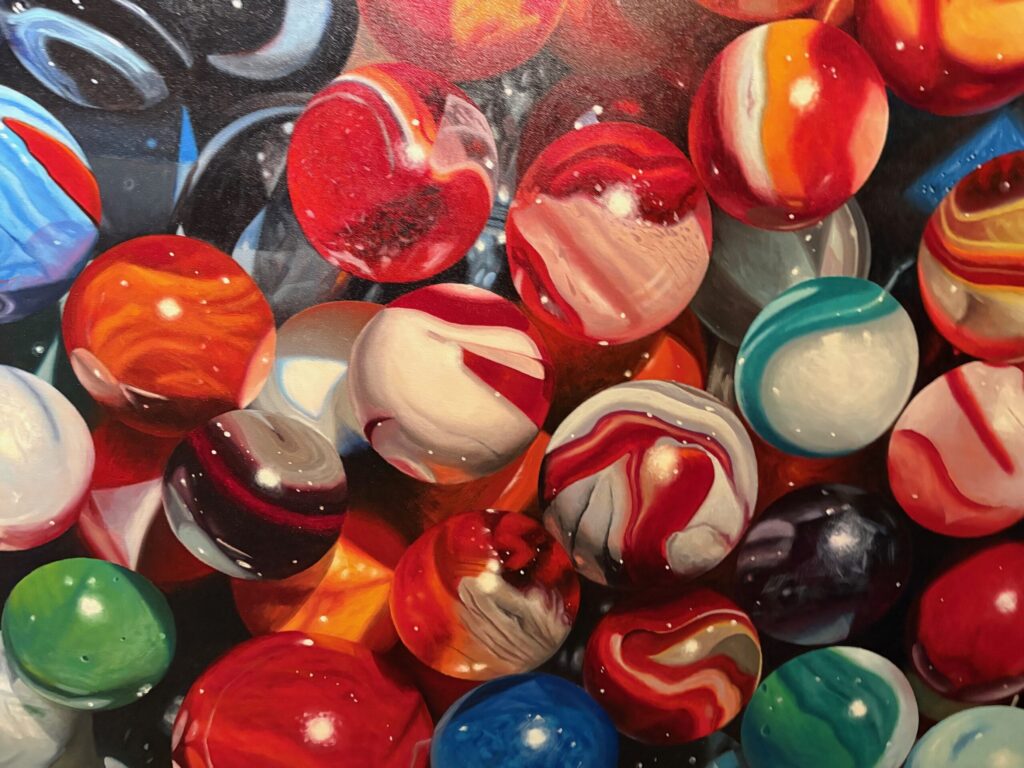
Longtime Arts Students League of Denver teacher to show paintings and 3-D works
Robert Gratiot’s Congress Park home, like most residences in the historic central Denver neighborhood, stands as a charming, one-of-a-kind brick house. Yet beyond the arched, wooden front door, the interior testifies to Gratiot’s lifetime of artistry.
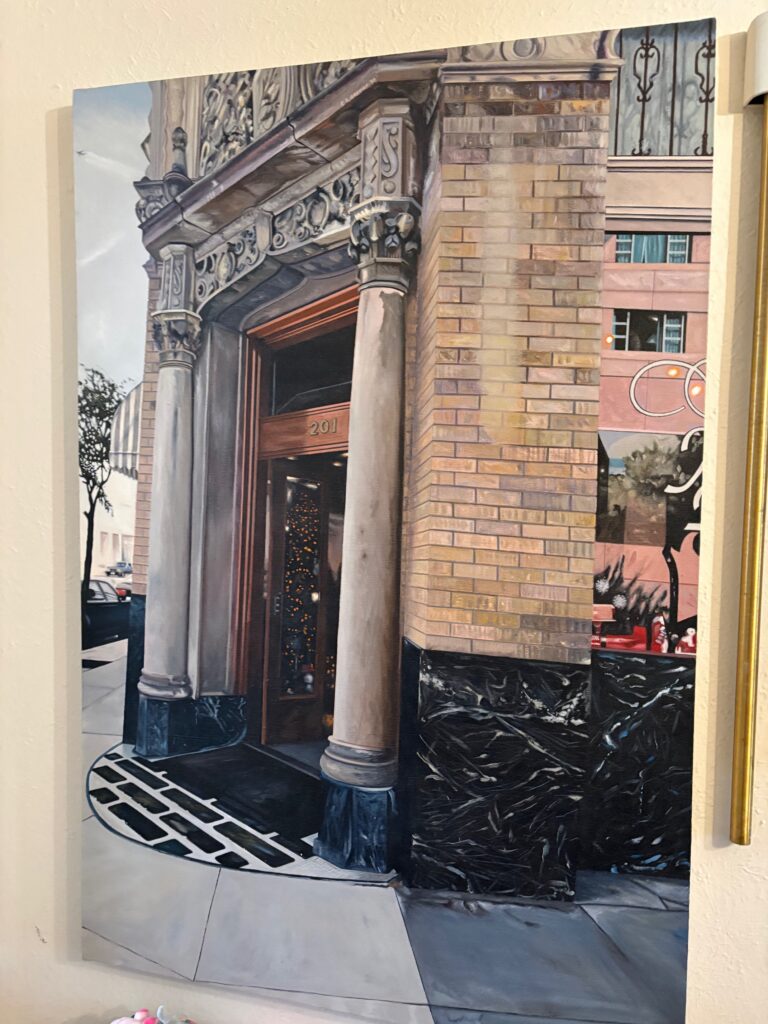 Denver painter Rob Gratiot takes on challenging subject matter rendered in mind-boggling detail. (Colleen Smith/Special to The Denver Gazette)
Upstairs and down, Gratiot’s house holds hundreds of photorealistic paintings for which the artist is known. The paintings keep company with dozens of his hand-built “Peaceable Kingdom” ceramic figurines, his series of stamped and glazed clay “Tiles of Wisdom and Truth,” stacks of cigar boxes painted with miniature landscapes or skyscapes and shelf after shelf holding his school of carved wooden fish with shiny fins cut from tin cans.
“I’ve always given myself permission to do a variety of things,” Gratiot said. “Most of my work has never been seen.”
That’s about to change in the coming year. The artist, 79, is anticipating his retrospective exhibition at the Curtis Center of Arts in Greenwood Village. And while the show is almost a year away, the run-up to the retrospective finds Gratiot introspective.
“I’ve done a lot of group shows with one or two, sometimes three or four paintings. In a way — and this goes back to my shyness — a solo show scares me quite a bit,” Gratiot said.
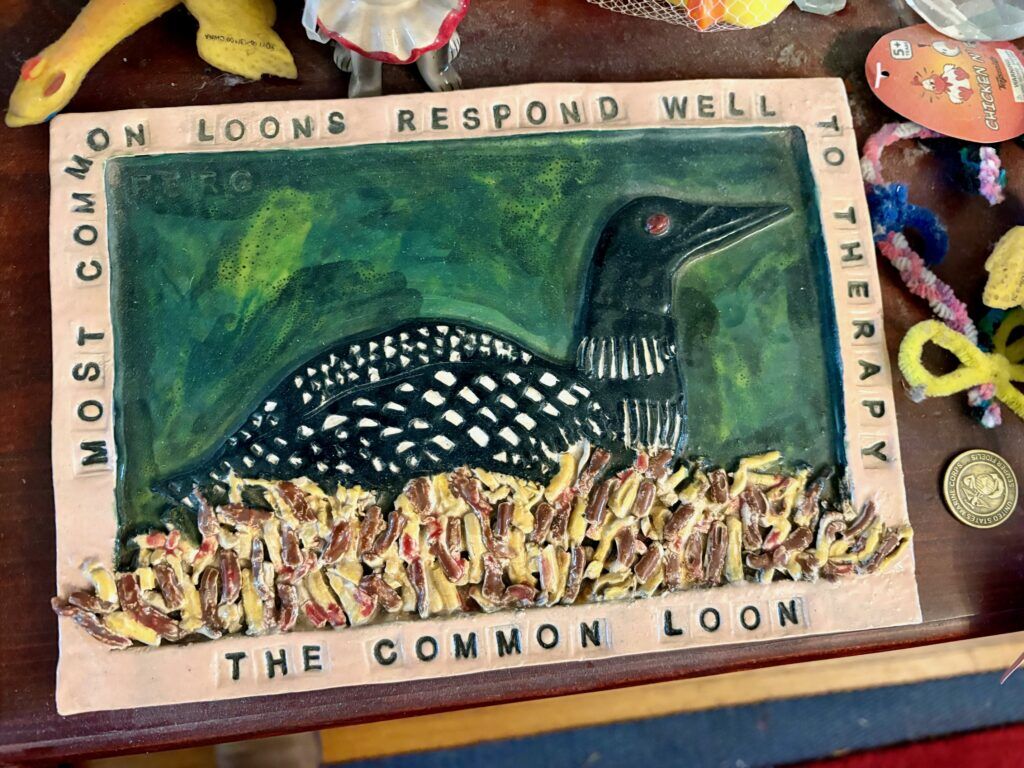 Denver painter Rob Gratiot created a series of ceramic tiles he calls “Tiles of Wisdom and Truth.” (Colleen Smith/Special to The Denver Gazette)
On the other hand, his body of work is bold. As a painter, the artist has most notably demonstrated his zeal for reflections and uncompromising detail. Gratiot has reached the summit of photorealism. He’s serious about his art, yet his subject matter often is playful: candies in reflective wrappers, colorful glass marbles or clusters of tiny toys all rendered on a grand scale and in mind-boggling detail.
HIS FORMER STUDENT, FUTURE CURATOR
Lisa Neeper serves as the cultural arts manager at The Curtis Center for the Arts, housed in a 1914 schoolhouse, the oldest municipal building in Greenwood Village. Previously, Neeper held similar community arts leadership positions in the cities of Denver and Thornton.
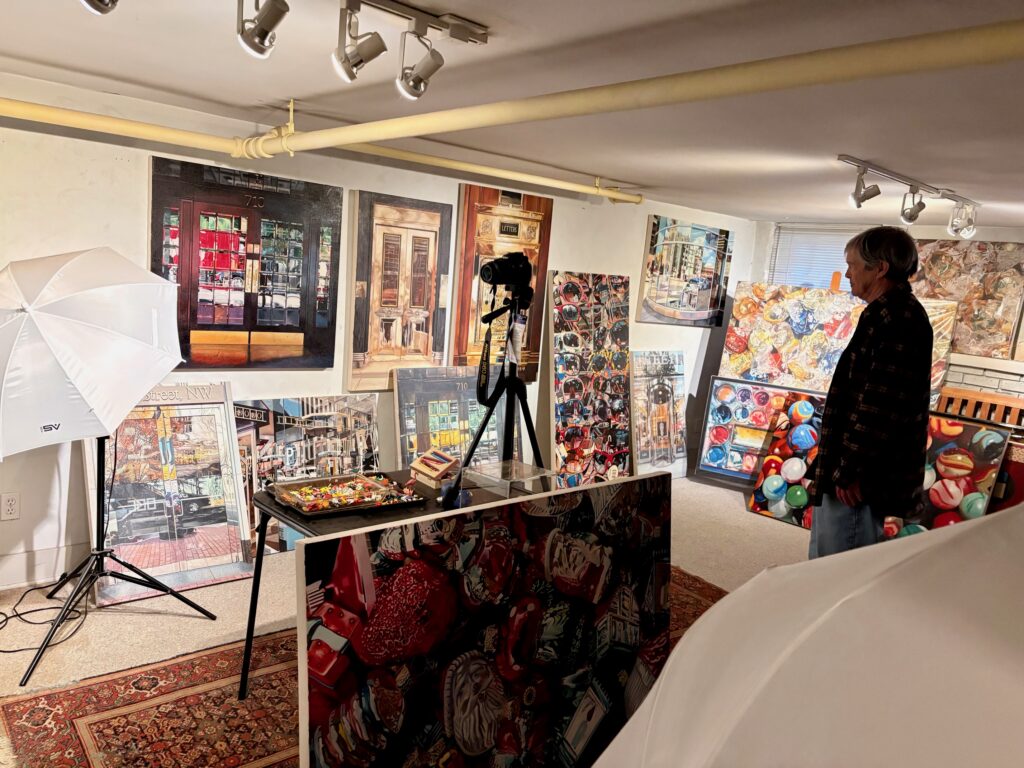 Denver painter Robert Gratiot looks over his artworks created over decades in his Congress Park home and studio. (Colleen Smith/Special to The Denver Gazette)
Neeper, who earned her art degree at Metropolitan State University, first connected with Gratiot when she took one of his painting classes at the Art Students League of Denver (ASLD) about 25 years ago.
“He’s lovely. He has such a nice personality,” Neeper said of Gratiot. “I took a traditional painting class with him, and he was very approachable and so supportive. Rob has a quirky sense of humor. I noticed that right away, and we see it in some of his paintings.”
Neeper reconnected with Gratiot in 2025 at the Curtis Center‘s All Colorado Art Show, which Gratiot has participated in for many of the past 43 years of the exhibit.
“I knew Rob’s work. He’s always been on my radar, and I’ve always been a big fan of his work,” Neeper said. “When he was showing here, I remember a lot of the super-real paintings with marbles and reflective surfaces. One of his paintings of reflections lets the viewer see into the building and the reflections on glass, car windows and mirrors. There are so many different planes that show Rob’s idea about abstract realism. He captured it.”
The Curtis Center’s challenge will be to capture Gratiot’s artistic expression over the years — his reflective architectural works, his painting clusters of John Lennon wire-rimmed glasses or the colorful lollipops known Saf-T-Pops in cellophane, swanky storefronts, neon signs.
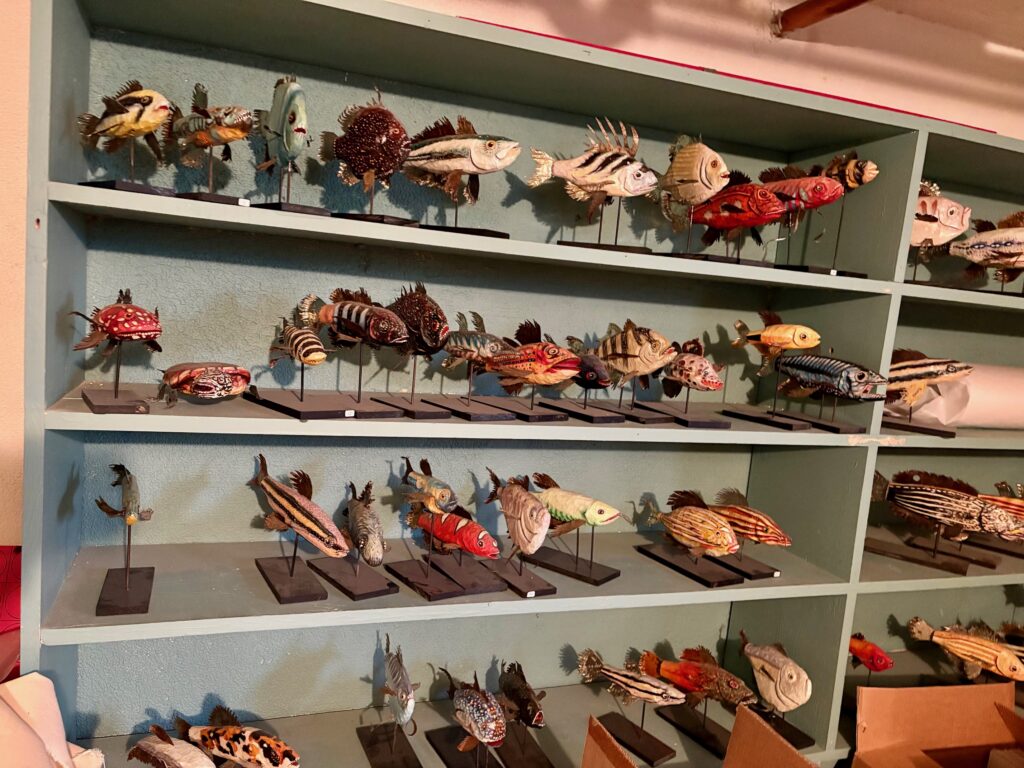 Denver artist Rob Gratiot’s school of hand-carved, oil-painted fish with fins he cut from tin cans. (Colleen Smith/Special to The Denver Gazette)
“This will be a big show. Curtis Center looks diminutive from the outside, but it’s quite large. We’ll typically show 75 small or 50 large paintings. For Rob’s retrospective, we’ll include his 3-D works,” Neeper said. “We’re excited about this solo show to support him and exhibit some of his works that have never been seen. And we sell a lot, and we only take 30 percent, so we’re very motivated to support Rob as an artist in our community.”
GRATITUDE FOR TEACHING, COMMUNITY
Though he has worked much of his life in solitude, Gratiot values community. He’s been a fixture at the ASLD since 1995. Gratiot teaches oil and acrylic painting classes.
“Teaching at the Art Students League is on my gratitude list,” the artist said. “Everybody wants to be there. It’s a beautiful community. They bond with each other, and we all bond together. Connecting with all the personalities helps me in my isolation.”
The bond, Gratiot said, serves the collective and the individual.
“I’m in a recovery program, and we talk about prayer and meditation a lot. There’s such a focus when people are making art. I think it is a meditative process,” he said. “Every day before I go teach, I ask God to help me teach with wisdom, humor and kindness. I try to get that trio with everybody I meet, and I think I’m pretty good at what I do.”
Aubrey Ryan, ASDL director of programming and community engagement, noted in an email that Gratiot teaches two monthly painting classes that meet once a week and are always at or near capacity.
“He has some students who have been taking his classes for years,” Ryan said. “Rob is friendly and welcoming, and his classroom dynamic exudes that energy. He meets his students where they’re at, both in terms of their ability and experience, and he takes time every class to individually check in with each student.”
His classes typically include 13 or 14 students.
Gratiot said: “A lot of students in younger days took art classes in college, and then real life got in the way. Some have kids who are gone, so they come back and see if they have still the spark to paint. And generally, they do. Or we can find it in them.”
AGING AS AN ARTIST
For Gratiot, the spark never entirely ceases. Yet, like any artist — or any person, for that matter — he struggles with challenges. He was diagnosed with an ocular condition that could affect his artistic vision. Yet asked whether he considers altering from photorealism to a less demanding painting style, he shakes his head no.
“I might paint something not as complex as reflections, but I’m not attracted to Impressionism. I’m still interested in Realism, though maybe a simpler realism. Something less complex,” he said.
“I walk a lot in the neighborhood, and it’s a wonderful neighborhood to walk. There’s a dumpster on Detroit Street, and the short end of the dumpster — there’s something beautiful about it, a handsomeness. It looks a bit beat up, like it’s had some lifetime experiences for an inanimate object. It’s not as complex as the reflections, but I see the idea of abstraction among the reality.”
Gratiot earned his undergraduate degree in art at the University of the Pacific in California. He then attended the Art Center College of Design in the Wilshire District of Los Angeles for three years.
Gratiot completed his Master’s in Fine Arts degree at DU in 1973.
“I was at a great art school in L.A., but L.A. was very unhealthy for me. And the school was very technically oriented toward illustration, advertising, car design,” Gratiot said.
“DU was a very different orientation. They assumed you knew how to paint. The first quarter there I was in a seminar class, and I’d never been to a seminar in my life. The head of the department said to all of us brand-new students, ‘Next week, come back and talk about the premise of your art.’ When I got home, I looked up the word ‘premise.’ It was a fulfilling assignment. DU was a great school for me. Sometimes, it’s so chancy whether something’s going to work out or not, but DU was a good fit for me, and they let me teach some classes as a graduate student.”
HIS FATHER THE PHYSICIAN AND PAINTER
Gratiot’s first art teacher was his father, a physician who painted as a hobby.
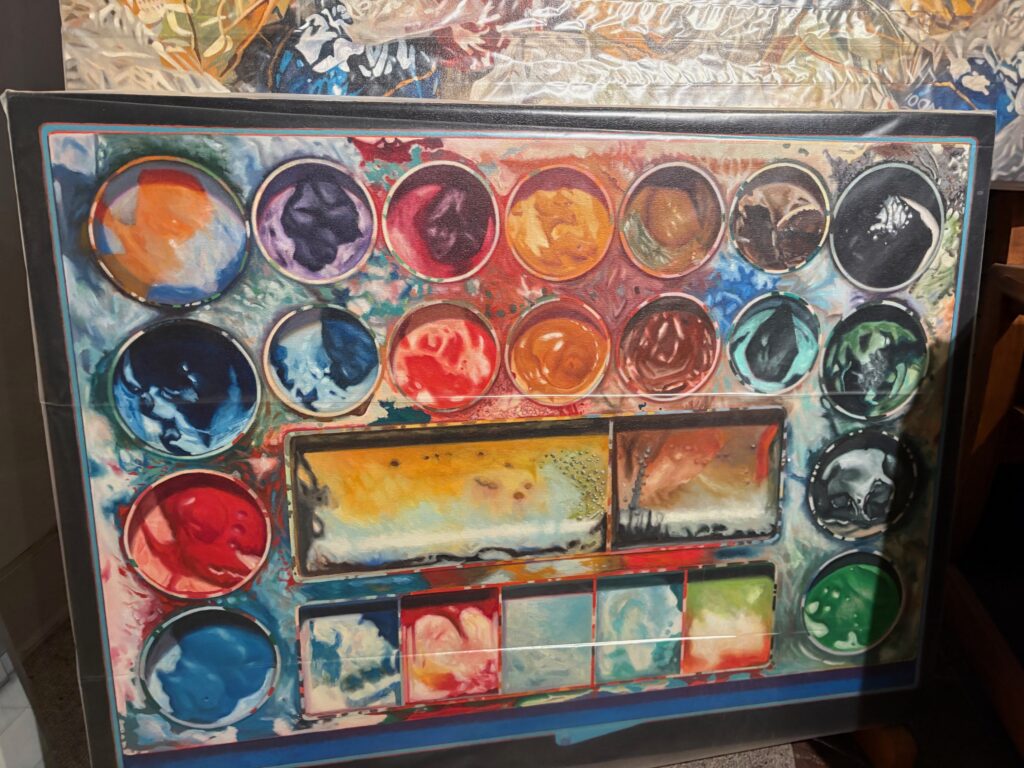 Denver painter Rob Gratiot will have a retrospective at The Curtis Center in Greenwood Village in early 2027. (Colleen Smith/Special to The Denver Gazette)
“He had a studio in our house, and he’d give me lessons. He was patient. At night, instead of reading storybooks, we’d look at art books. The first painter I loved was Renoir, and I knew that ‘Renoir’ rhymed with ‘red car,’” Gratiot said.
A lifetime of artistry has left him with a lot to show for his efforts. All the artwork. All the students. All the collectors and the exhibitions. But Gratiot admits his life isn’t always as sweet and richly satisfying as foil-wrapped Swiss chocolates.
“I’ve been plagued with depression and anxiety. I’m a little bit phobic, so I like to control my environment. These are kind of serious paintings, but they have a lightheartedness to them, as well,” he said. “My paintings are very honest.”
His paintings, too, are a profound reflection upon reflection much like the artist’s deep mind, his sense of humanity, his sense of divinity.
“One thing about all of my paintings: The images moved my soul. It’s hard to describe, but there’s a connection in my heart,” Gratiot said. “I’m insecure enough that I want people to like them, because that’s a reflection on me. It isn’t that I have an idea of pleasing anybody but myself with my art, but I want people to be pleased by my art. I want people to love my work. I hope people find joy in my art. I hope it’s uplifting.”
SAVE THE DATE/IF YOU GO
Curtis Center for the Arts: 2349 East Orchard Road, Greenwood Village, CO, 80121.
Gallery Hours: 8:30 a.m. – 4:30 p.m. Monday to Friday, 10 a.m. – 4 p.m. Saturday.
Phone: 303-797-1779
Email: Curtis@GreenwoodVillage.com |
Website: GreenwoodVillage.com/Curtis
The Robert Gratiot show opens to the public from Jan. 11 to Feb. 26, 2027. An opening reception will be held from 6 to 8 p.m. Jan. 9, 2027.