
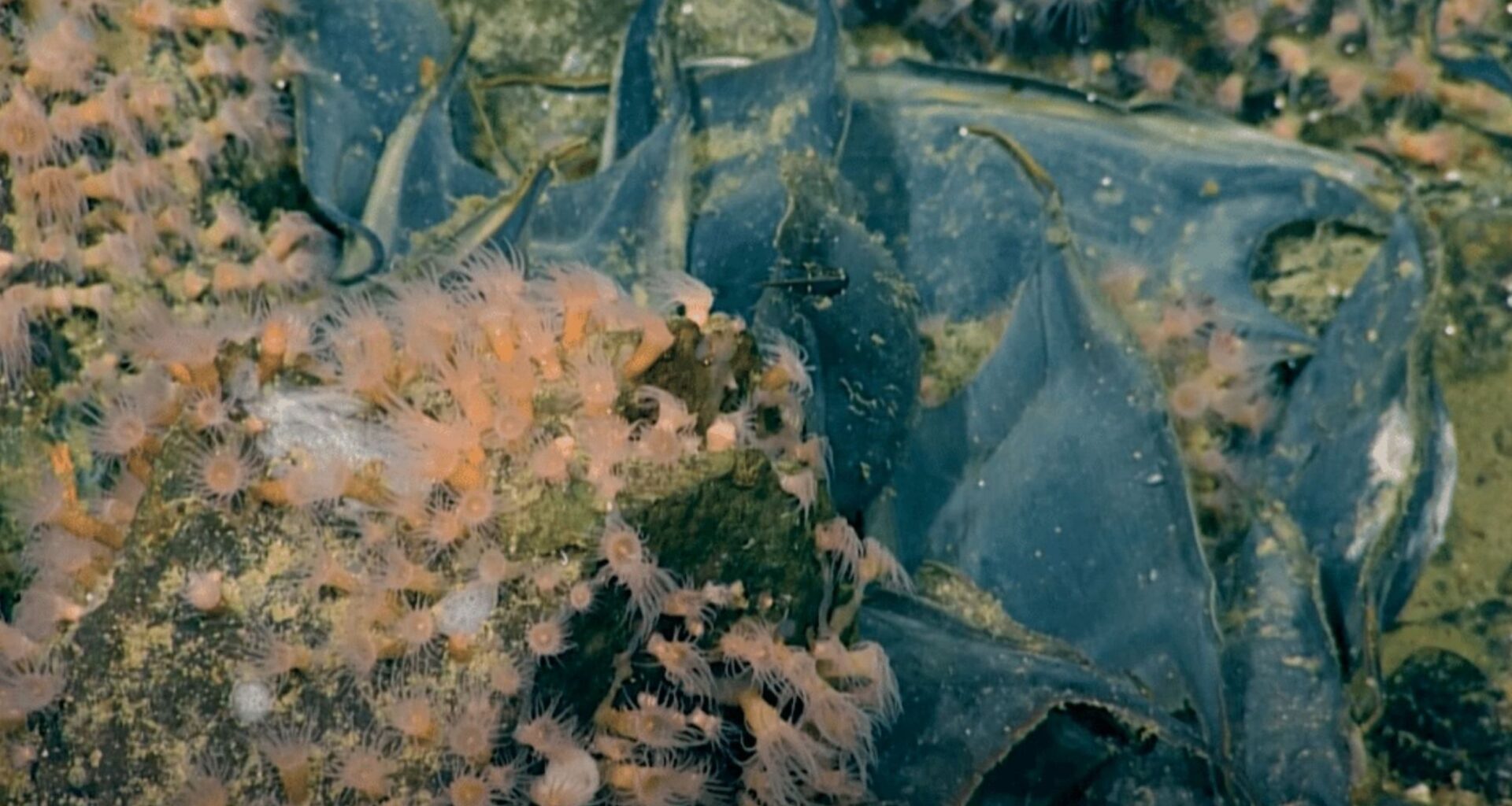
More than one million giant, leathery skate egg capsules from a deep-sea ray-like fish have been documented incubating at a single underwater volcanic site off Canada’s Pacific coast.
The concentration links volcanic heat to reproduction at a scale never observed for animals living this far below the surface, reshaping how extreme environments can sustain life.
Warm water on the summit

Warm water continues to rise through fractured rock near the summit of a submerged mountain off Vancouver Island, concentrating developing eggs in one place.
Survey work by Fisheries and Oceans Canada directly documented this egg field on the Tuzo Wilson Seamount Complex, with marine biologist Cherisse Du Preez observing Pacific white skates depositing eggs in the warmed zone.
Repeated observations showed the egg cases spread across the summit rather than clustered at one outlet, indicating sustained use of the site over time.
That tight link between a single volcanic system and such a large nursery sets a clear boundary for the discovery and points to why the biology of the species itself needs closer examination next.
Meet the Pacific white skate
Far below sunlight, the Pacific white skate lives from about 2,600 to 9,600 feet down, staying mostly out of view.
Scientists know it as Bathyraja spinosissima, a pale deep-water skate related to rays and sharks, with rough skin and slow growth.
Adult females can reach about 6.5 feet long, but their depth keeps encounters rare and basic biology hard to pin down.
That lack of sightings makes a single nursery site unusually valuable, because it offers a place to study reproduction directly.
Giant skate eggs, high stakes
Each egg case measured around 20 inches across, with rounded edges and a slight curve that fed the ravioli nickname.
The tough shell held a developing embryo, and the oversized yolk inside carried fuel for years of growth.
Producing such large eggs costs the mother a lot of energy, yet the payoff is a better-fed hatchling.
That strategy can fail if conditions stay too cold, so a warm volcano top may tip the odds.
Heat speeds young development
Warm water likely shortened gestation, the time embryos grow before hatching, making this nursery a place where time mattered for survival.
Development inside each egg case normally takes about four years, a long stretch during which embryos remain exposed to deep-sea conditions.
“The warm water likely speeds up the gestation period of the eggs, resulting in more successful juveniles,” Du Preez said.
If warmth trims even a small part of that wait, more young skates could survive before entering deeper, harsher water.
Safe place for skate eggs
Higher on the seamount, young skates started life in water that was shallower than their adult hunting grounds.
This seamount, an underwater mountain rising from the seafloor, leaked warm fluids that helped corals and sponges hold on.
At that depth, fewer large predators patrol, and the rough landscape gives egg cases and hatchlings places to hide.
The site could protect young skates until they were strong enough to drop into colder, darker waters below.
Galapagos gave an early clue
A 2018 paper reported Pacific white skate eggs sitting near hot springs on the seafloor.
Those hydrothermal vents, hot springs that release heated water, warmed the egg cases enough for embryos to keep developing.
Researchers also collected genetic material from the cases, linking the nursery to Bathyraja spinosissima and showing the behavior was real.
Finding a far bigger nursery on a Canadian volcano suggests that using volcanic heat may be more than a one-off trick.
Counting eggs without scooping
Researchers could not scoop up and count every case, so they relied on wide-area mapping and careful review.
Video runs traced egg patches across the summit, and analysts compared overlapping images to avoid double counting the same spot.
That approach also let the team flag which cases looked fresh and which already held empty shells.
Even with good footage, the final estimate still carried uncertainty because currents and terrain hid part of the field.
A volcano becomes a food web
The egg field did not sit alone, because warm, mineral-rich water drew a community that could feed on, or shelter, it.
Crabs, snails, and other scavengers can bite into damaged cases, turning lost embryos into meals that recycle energy quickly.
Living cases also attract predators, and a dense nursery can reshape local feeding patterns around a single patch.
If the volcano cools or disturbances remove the egg cases, the whole hotspot could fade as quickly as it formed.
Protecting skate egg nursuries
Deep-sea nurseries face threats that are easy to miss, because they sit far from shore and far from view.
Bottom-contact fishing gear and future seabed mining could crush corals or scrape eggs, and recovery would take years.
Because the species grows slowly and invests heavily in each case, losing a nursery year could echo for decades.
Clear maps of where skates breed give government fisheries managers a concrete target, but protection only works if it is enforced.
This volcano nursery shows that deep-sea animals can use geothermal warmth as a tool, not just tolerate it.
Future work will need to track how often skates return, how fast embryos grow in warm water, and what protection holds.
Image crédits: NEPDEP 2023.
—–
Like what you read? Subscribe to our newsletter for engaging articles, exclusive content, and the latest updates.
Check us out on EarthSnap, a free app brought to you by Eric Ralls and Earth.com.
—–