
“You can leave at any time.” The disembodied voice in the dark, tiny room in the Little Museum of Dublin crackles with injustice, anger and strength. It is the voice of Mary Merritt, Magdalene Laundry survivor.
Born Mary O’Conor in a workhouse in Dublin, raised in an orphanage in Ballinasloe, Co Galway, and then in 1947 sent back to Dublin to High Park Magdalene laundry in Drumcondra at 16 for the “crime” of robbing apples.
In High Park she was incarcerated with other girls and women, doing unpaid labour, cleaning the dirty linen of the great and the good, for 14 years. They did laundry for the department of justice and Áras an Uachtaráin. “We were slaves,” she says.
You can leave at any time. That’s the name of the extraordinary installation created by Mary Merritt and Gerry Stembridge and others. Before you enter the room, you sit at a desk in the museum’s elegant library and sign a form. A disclaimer. “I am over 18 years old. I am aware that this installation tells a story that some people feel is very disturbing. I do not suffer from claustrophobia or any other conditions that might preclude me from entering a small dark room. I am entering the installation of my own free will. I can leave at any time.”
Before entering the room you are handed a worn, brown leather belt. And then the door closes. The Red Cross of a sacred heart picture glows in the gloom. Mary’s voice comes from a blank screen. She tells you the story of her life. She tells you things that are uncomfortable to hear. You discover why you were handed the belt. You are reminded of the things Irish society ignored for decades until the women like Mary started speaking out and demanding to be heard. It’s uncomfortable. But there is one small consolation. You can leave at any time.
Mary left once. At least she tried to. Escaped the slave compound run by nuns. Escaped the punishing unpaid labour, the abuse, the confinement. She ran out of there one day, asked a stranger on the street in Drumcondra, where she might find a priest. A priest would help, she felt sure. She was shown into a side room in the Archbishop’s Palace in Drumcondra. A room full of holy pictures. A priest came. Said he would get her a cup of tea. And then he raped her. Afterwards, he told her that she was going back where she came from. He had called the police. The detectives brought the distraught slave back to her captors in High Park.
Later, she found out she was pregnant and was sent to the mother and baby home on the Navan Road. Mary saw her baby once before she was taken away. She would not see her baby again for another nearly 40 years.
Thousands of women were incarcerated in Magdalene laundries, a slave trade that thrived in holy Ireland where blind eyes were turned and everybody knew something wasn’t right but few said anything. The last of these places only closed 30 years ago. Mary was finally granted her freedom at the age of 31.
Sitting on a bench in Drumcondra, scared and with nowhere to go, she met a woman called Mrs Cronin who asked what she needed, took her in and found her a flat and a job.
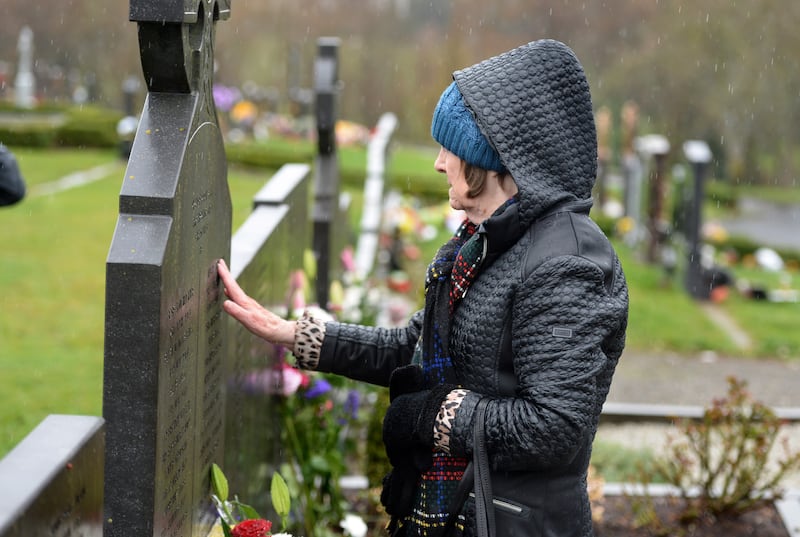 Mary Merritt in Glasnevin Cemetery during the eighth annual Flowers for Magdalenes. Photograph: Dara Mac Donaill
You sit in the tiny room and discover why Mary eventually felt she had to flee Dublin for London in the 1960s, fearful of being incarcerated again. You hear of the beautiful life she built there with her husband Bill. And of the terror that never left her.
She was 87 when the story of her life was recorded for the installation. The museum’s founder Trevor White heard about her from a BBC Panorama programme and invited her to tell her story. When the installation first ran, briefly, as part of the Dublin Theatre Festival in 2019, Trevor asked me to dinner with Mary. She was a remarkable woman, funny and fierce. It was a privilege to be in her company.
Mary died in Tunbridge Wells, England, a few weeks ago at the age of 95. Her beloved husband Bill left the news on a voice mail on the phone of The Little Museum of Dublin. As he left the message, the final touches were being made to the installation. It was hoped Mary might have travelled to Dublin once more when the installation opened last week. Instead, Trevor went to Tunbridge Wells where he gave the eulogy for a woman who had become a dear friend.
In time Mary and all the other survivors got an apology from the State. She got compensation. But what she wanted most of all was an apology from the institution that sanctioned her enslavement. “I never received an apology from the church,” she told Trevor once. “I am still angry. I want that apology before I die. And until then, I will continue to speak out.” She never got that apology and now she never will. But Mary’s voice will not be silenced.
This important and unforgettable installation hosts an audience of one, once a day. In a dark, tiny room you can bear witness to her story. You can honour the lives of all survivors of those barbaric institutions. And you can leave at any time.