

Researchers at Penn State University have unveiled a 4D printing method that produces “smart synthetic skin” capable of dynamically changing its shape, texture, and appearance in response to external stimuli. Unlike traditional synthetic materials with fixed properties, this hydrogel-based material can perform multiple functions, from adaptive camouflage to information encryption and mechanical deformation, all within a single sheet.
The research demonstrates that 3D printing can produce materials with programmable, multifunctional properties, rather than only static structures, potentially enabling applications in soft robotics, wearable devices, and biomedical systems.
The research was published in Nature Communications. Collaborators include doctoral candidates Haotian Li and Juchen Zhang, lecturer Tengxiao Liu at Penn State, and H. Jerry Qi from Georgia Institute of Technology.
Inspired by Nature, Enabled by 4D Printing
The project, led by Hongtao Sun, assistant professor of industrial and manufacturing engineering (IME) at Penn State, drew inspiration from cephalopods like octopuses, which can rapidly alter their skin’s appearance and texture. “Cephalopods use a complex system of muscles and nerves to exhibit dynamic control over the appearance and texture of their skin,” Sun said. “Inspired by these soft organisms, we developed a 4D printing system to capture that idea in a synthetic, soft material.”
Unlike traditional synthetic materials, which offer fixed properties, this hydrogel-based smart skin is programmable. Using halftone-encoded printing, a technique that converts image or texture data into binary patterns on the material’s surface , the team can dictate how each region of the hydrogel responds to stimuli like heat, solvents, or mechanical stress.
“In simple terms, we’re printing instructions into the material,” Sun explained. “Those instructions tell the skin how to react when something changes around it.”
Multifunctionality in a Single Sheet
The material’s capabilities extend beyond visual effects. By co-designing the printed patterns, the team demonstrated how a single hydrogel film could simultaneously encode images and change shape. In one demonstration, a hidden image of the Mona Lisa became visible only under specific conditions, such as immersion in ice water or exposure to heat. The patterns also allowed information to be revealed through mechanical deformation, adding another layer of functional control.
“This behavior could be used for camouflage, where a surface blends into its environment, or for information encryption, where messages are hidden and only revealed under specific conditions,” said Haoqing Yang, first author of the paper and doctoral candidate in IME. The smart skin also exhibits bio-inspired shape-morphing without needing multiple layers or materials, allowing flat sheets to curve into complex, textured 3D structures as the encoded patterns guide their transformation.
Towards Scalable, Adaptive Materials
Building on previous work in 4D printing, the team’s halftone-encoded approach enables the co-design of multiple functionalities, optical, mechanical, and morphological, in a single hydrogel sheet. Future goals include creating a scalable platform for encoding a range of responses into adaptive materials for applications across soft robotics, biomedical devices, encryption technologies, and more.
“This interdisciplinary research at the intersection of advanced manufacturing, intelligent materials and mechanics opens new opportunities with broad implications for stimulus-responsive systems, biomimetic engineering, advanced encryption technologies, biomedical devices and more,” Sun said.
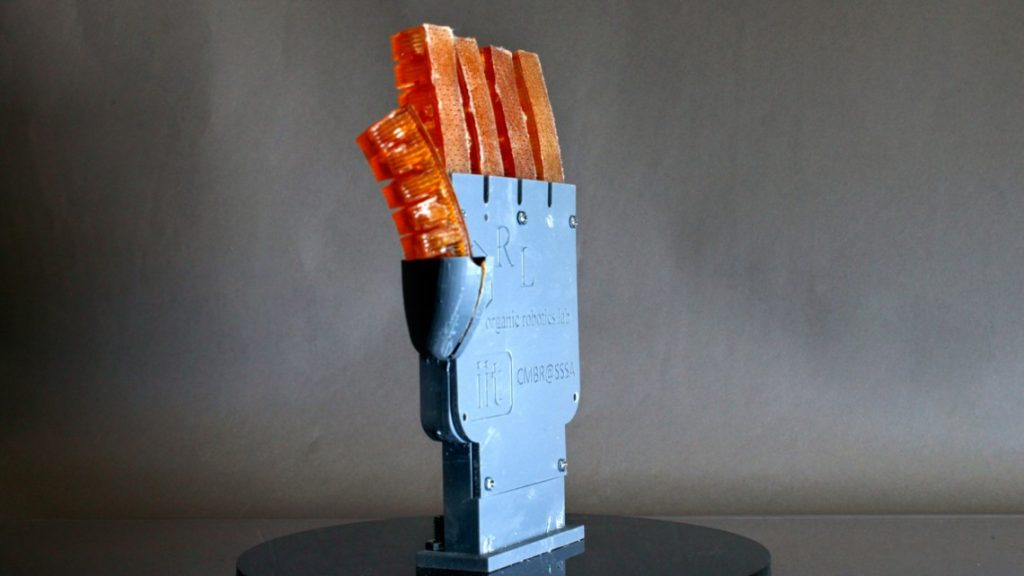 A 3D printed soft robot muscle that can regulate its temperature through sweating. Clip via Cornell University.
3D Printing Enables Programmable, Stimulus‑Responsive Materials
Smart synthetic skin relies on embedding stimulus‑responsive behavior directly into a material’s internal architecture, something traditional fabrication cannot achieve at fine spatial scales. 4D printing provides the necessary geometric control, tuning internal structure rather than chemistry, to define where and how a material expands, softens, or changes appearance under specific conditions, a constraint that static materials cannot overcome. Current 4D printing methods, however, remain limited by the types of polymers that can be printed, the speed and resolution of fabrication, and the achievable scale of responsive structures.
Recent research illustrates both the potential and boundaries of stimulus‑responsive materials. Researchers have used 3D printing to create light‑activated polymers that morph into programmed shapes, demonstrating how flat prints can become dynamic 3D objects when stimulated. Another project achieved reversible 4D printing of dual‑layer components, where printed parts autonomously change shape and return, showing how 4D printing can encode reversible mechanical behavior.
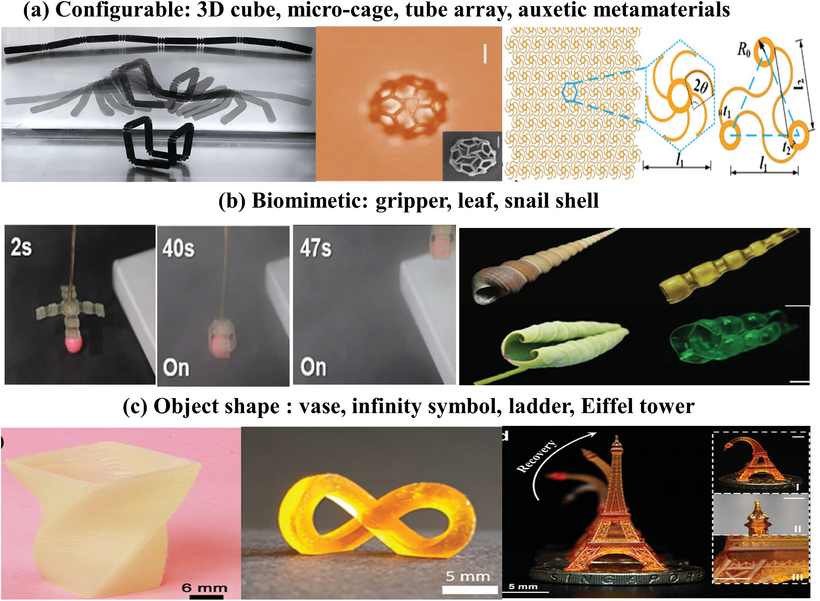 4D printed forms include auxetic lattices, biomimetic grippers, and shape-memory objects.
Image via ResearchGate.
The 3D Printing Industry Awards are back. Make your nominations now.
Do you operate a 3D printing start-up? Reach readers, potential investors, and customers with the 3D Printing Industry Start-up of Year competition.
To stay up to date with the latest 3D printing news, don’t forget to subscribe to the 3D Printing Industry newsletter or follow us on Linkedin.
Featured image shows Pennsylvania State University. Photo via Penn State.