
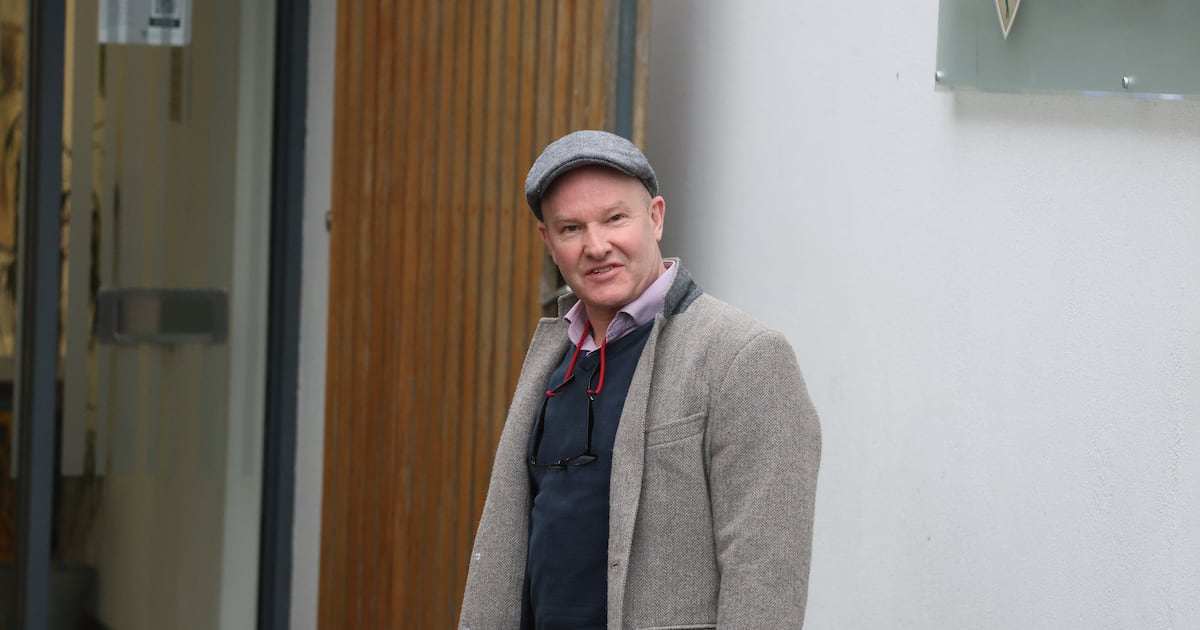
A fitness-to-practise committee regarding allegations that a Dublin GP tweeted anti-Covid policy comments during the pandemic will reconvene on Wednesday after ruling he has a case to answer.
Chairwoman Deirdre Murphy said the authorship of the tweets by Dr Marcus de Brun, who ran Rush Family practice in north Co Dublin, and his attendance at an anti-mask rally in August 2020, were not in dispute.
Murphy also quoted De Brun from the second hearing of the inquiry, on September 24th, where he said: “I think it’s quite clear I used Twitter to seriously undermine public health guidelines.”
De Brun rose to prominence online due to his outspoken criticism of the State’s handling of the pandemic.
He is facing 10 allegations, each of which contains a number of sub-allegations.
The allegations are that De Brun tweeted comments critical of the National Public Health Emergency Team (Nphet) and the State’s Covid-19 vaccination programme regarding children and young people, between May 2020 and October 2021.
It is further alleged he posted tweets critical of Nphet, describing them as “a clear and present danger to public health” and expressing disagreement with the use of vaccines against Covid-19 in children and healthy young people.
It is also alleged he posted tweets promoting the use of ivermectin and hydroxychloroquine as a treatment for Covid-19 when he ought to have known these tweets were inappropriate.
It is alleged too that his conduct breached multiple sections of the Guide to Professional Conduct and Ethics for registered medical practitioners.
De Brun also tweeted that the use of Covid-19 vaccines in children was “the greatest crime against humanity” and criticised face masks, lockdowns and the Government.
It is further alleged that De Brun attended an anti-mask rally on August 22nd, 2020, at Custom House in Dublin, at which it is alleged he did not adhere to public health guidelines and spoke out against Covid-19 safety measures.
The inquiry reconvened on Tuesday to consider an application by De Brun to exclude an expert report by Prof Colin Bradley, for the chief executive of the Medical Council or alternatively to attach limited weight to it as De Brun submitted it was not independent.
He said Bradley’s evidence was “not stable”, was “self-contained” and that he had provided a sequence of reports “responding to the changes in the prosecution’s case”. He said, consequent to the deletion of some allegations, there was a “hardening of language” in Bradley’s report.
At the hearing on September 25th, Bradley said De Brun “set a bad example” at the anti-mask rally in 2020. He concluded the allegations against the GP cumulatively amounted to professional misconduct.
De Brun also referred to the email that Bradley sent on August 28th, 2023, that accompanied his expert report and to the fact that the evidence of Prof Graham Bottley was withdrawn from the process.
The application for Bradley’s evidence to be excluded arose at the last hearing on September 26th. It came after De Brun claimed the concerns of Bradley about Bottley, who made a complaint about the GP to the Medical Council, were not referenced in the report which Bradley provided to the preliminary proceedings committee (PPC) which recommended De Brun should face a fitness-to-practise inquiry.
On Tuesday, de Brun submitted that Bradley said that Bottley’s evidence could not be relied upon and that these concerns were not placed before the PPC.
However, the committee ruled there was “no basis” to exclude the expert’s evidence.
The chairwoman added that as to the issue of what weight to attach to Bradley’s evidence, the committee would consider this after hearing the evidence and submissions made in the case.
Consequently, De Brun renewed his application to direct the attendance of the case officer to appear before the inquiry so he could put questions to him. These questions would be over why the concerns of Bradley regarding Bottley expressed in his covering email with his report on August 23rd, 2023, were not brought to the attention of the PPC.
The committee ruled it would not call the case worker as his evidence would not be admissible or relevant and they were not satisfied that he was a material witness to the issues in the inquiry.
Following this, De Brun made his unsuccessful application for no case to answer. He said there was no complainant evidence, that the case involved an untested paper complaint and there was no explanation as to how the case against him had crossed the statutory threshold of seriousness.
The inquiry heard there were four complainants, three from the UK, including Bottley, and one from Ireland, none of whom were called to give evidence.
The inquiry will reconvene on Wednesday.