

HELSINKI — China took a major step forward in its lunar and human spaceflight programs late Tuesday with successful in-flight abort and rocket recovery tests.
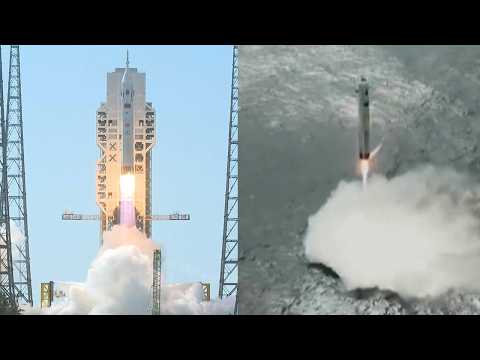
A Long March 10 low-altitude flight demonstration vehicle topped with an uncrewed Mengzhou spacecraft lifted off at 10:00 p.m. Eastern, Feb. 10 (0300 UTC, 11:00 a.m. Beijing time, Feb.11) from a newly built pad at Wenchang Space Launch Site.
The Mengzhou spacecraft received the abort command from the rocket and successfully separated and escaped from the vehicle, according to the China Manned Space Engineering Office (CMSEO), China’s human spaceflight agency and the authority overseeing China’s crewed lunar program.
The abort took place when aerodynamic forces on the spacecraft would be at their peak during ascent. Mengzhou then descended to the sea assisted by parachutes. The Long March 10 single-core test vehicle continued its flight to simulate a full first stage orbital flight profile. The rocket then made a successful reentry burn, powered descent and a propulsive splashdown close to a ship fitted with a wire recovery system for the Long March 10.
“The test successfully verified the functional performance of the rocket’s first-stage ascent and recovery phases, as well as the maximum dynamic pressure escape and recovery of the spacecraft,” CMSEO said in a statement. “It also verified the compatibility of the relevant interfaces of various engineering systems, accumulating valuable flight data and engineering experience for subsequent crewed lunar exploration missions.”
The demonstration is a crucial step in China’s plans to attempt to land astronauts on the moon by 2030. The Mengzhou in-flight abort test echoes NASA’s Orion 2019 abort test.
The demonstration launch vehicle was adapted from a Long March 10 short stage which has completed two tethered ignition tests in 2025. Mengzhou underwent a pad abort test in June 2025. These tests add to a series of crewed lunar hardware tests conducted by China over the past year, including a landing and liftoff test of the Lanyue lunar lander in August 2025.The Long March 10A is a single-stick variant for low Earth orbit (LEO) being developed by the China Aerospace Science and Technology Corporation (CASC). The full Long March 10 will be a tri-core rocket. Separate launches of the Long March 10 will send a Mengzhou and lunar lander stack into translunar injection where the spacecraft will dock ahead of a lunar landing attempt.
Mengzhou is designed to be partially reusable and eventually replace the Soyuz-derived Shenzhou for LEO while also allowing missions to the moon. Mengzhou features a service module and a crew module and can carry six or seven astronauts to LEO, while a heavier variant can carry three astronauts to the moon to dock with a lunar lander stack. The three-module Shenzhou can carry three astronauts and is limited to LEO.
The successful demonstration launch and abort tests pave the way for more significant tests for China’s crewed lunar program later this year. The country now appears clear to proceed with a planned full orbital Long March 10A launch test with the first Mengzhou spacecraft, with the mission potentially involving a visit to, or co-orbiting with, the Tiangong space station.
The successful splashdown test also means CASC may attempt to recover the first stage from a payload-adapted variant of the Long March 10 planned for the first half of this year.
Related