
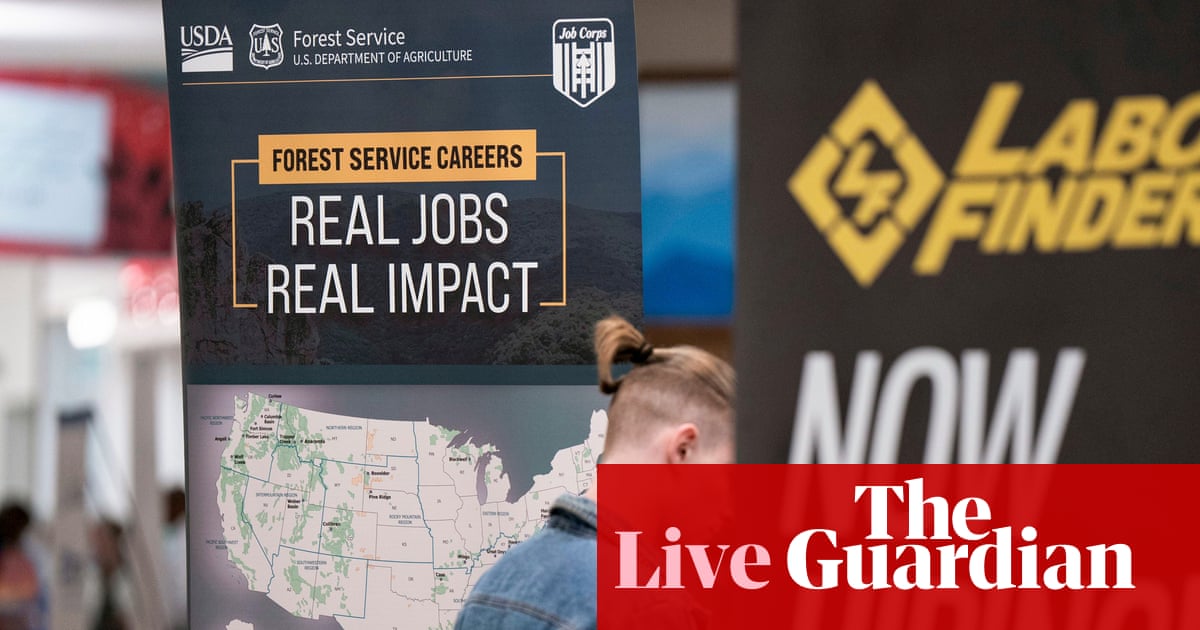
US jobs report beats forecasts with 130,000 increase in January
US employers hired 130,000 more workers in January, which was stronger than expected (and despite warnings from the White House of smaller numbers because of its deportation programme).
Non-farm payrolls figures from the Bureau of Labor Statistics showed the unemployment rate dipped to 4.3% last month from 4.4% in December.
Economists had pencilled in an increase of 70,000 jobs, on average, and forecast the rate would stay at 4.4%. There was an unusually wide range of forecasts, and the January number was near the top end.
Private sector jobs increased by 172,000 in January but this was partly offset by cuts elsewhere.
US stock futures are extending gains following the report.
However, because of revisions to past data, the economy only created 181,000 new jobs last year, revised down from 584,000.
In December, employment rose by 48,000, rather than 50,000, and in November, it went up by 41,000, rather than 56,000.
Updated at 09.12 EST
Key events
Show key events only
Please turn on JavaScript to use this feature
Fujifilm Biotechnologies has officially opened its expanded advanced biologics manufacturing site on Teesside, on the old ICI site, backed by £400m from Japan’s Fujifilm Corporation.
It is one of the UK’s largest inward investors in medicines manufacturing.
The expansion more than doubled the space. It is set to be Britain’s largest single-use biopharmaceutical manufacturing site and home to the country’s largest process development labs on one campus.
ShareChina charges AZ former China head
China has officially charged AstraZeneca’s former head of the business in the country, Leon Wang, who had been in detention since October 2024.
AstraZeneca said in its latest financial results on Tuesday that a former executive vice president and one former senior employee were indicted by prosecutors in China in November, without naming them.
The Financial Times first reported that the executive charged was Wang.
AstraZeneca is under investigation by Chinese authorities over allegations of unpaid import taxes on certain cancer drugs, breaches of data privacy laws and medical insurance fraud. This has not deterred the company from announcing $15bn of investments in the country.
ShareFDA declines to review Moderna’s new flu vaccine
A few bits of pharmaceutical news:
Moderna shares tumbled more than 10% after the US health regulator declined to review the US biotech’s application for approval of its flu vaccine, following shifts in US vaccine policy under US health secretary Robert F. Kennedy Jr., a long-time vaccine critic.
Sweeping changes to vaccine policy have led to reduced vaccine use and a surge in measles cases.
ShareWall Street stocks jump after strong US jobs report
Wall Street has jumped at the open.
The Nasdaq surged by nearly 200 points, or 0.8% to 23,296 while the S&P 500 opened 47 points higher, or 0.7%, at 6,988 and the Dow Jones leapt 207 points, or 0.4%, to 50,395.
Stephen Brown, deputy chief North America economist at Capital Economics, said:
The 172,000 surge in private payrolls in January owed a lot to a 124,000 surge in health care & social assistance, but private sector hiring elsewhere still appears to be strengthening.
Indeed, the decline in the unemployment rate to 4.3%, despite a rebound in participation, suggests that labour market conditions may be tightening even sooner than we expected.
Turning to the other detail, he said:
Meanwhile, retail payrolls were basically unchanged in January… as well as a 33,000 rise in construction payrolls and a 34,000 increase in professional and business service payrolls.
The latter, together with upward revisions for professional services payrolls sector in recent months, should soothe fears about the negative impact of AI on hiring.
At the other extreme, another 42,000 drop in government payrolls – primarily due to further federal job losses – was a drag on total payrolls.
More reaction…
Sonali Basak, chief investment strategist for iCapital, said:
This is a HOT jobs print relative to what was expected and arguably against trend. Unemployment rate drops to 4.3%. Short term rates popping higher.
*US JAN. NONFARM PAYROLLS RISE 130,000 M/M; EST. +65K pic.twitter.com/zT7OgddP3A
— Sonali Basak (@sonalibasak) February 11, 2026
Non-Farm Payrolls rose 130,000 in January.
Annual benchmarking removes 898,000 from last years already low numbers.
With these type of revisions, not to mention the monthly revisions that occur, its increasingly harder to believe what posts. pic.twitter.com/8aDOraQCmI
— David A. Morris Banner Legacy Planning Ex 17:15 (@TruNorthAdvice) February 11, 2026
The FTSE 100 index has jumped 103 points, or 1%, to 10,457 (leaving it only 40 points off a record high), while other European stock markets are a bit lacklustre.
Germany’s Dax slipped 0.1% while France’s CAC rose 0.2% and the Italian borsa is down 0.36%. Even so, Europe’s Stoxx 600 index (which includes UK shares) hit a new record high after the US jobs figures, rising 0.3%.
Susannah Streeter, chief investment strategist at the investment service Wealth Club, said:
Even though confidence is seeping out of the US economy, employers are taking a glass‑half‑full approach and have taken on more staff than expected. While there could be anomalies in this delayed data release, given the chaos of the partial government shutdown, it does indicate that the US economy is continuing to show resilience.
This has helped propel the internationally focused FTSE 100 higher in afternoon trade, as prospects for the world’s largest economy appear more upbeat. While lower‑and middle‑income households are more pessimistic about the economic prospects ahead, wealthier consumers are keeping spending more buoyant, helping with job creation.
Investors had been bracing for a disappointing number, but with new hires coming in at 130,000, sharply above consensus forecasts of 70,000 for January, it has dampened hopes slightly of a super‑easy path ahead for interest‑rate cuts.
A higher interest‑rate environment affects the value of future earnings and can weigh on high‑growth firms in particular, which is why we may see an uneven reaction on equity markets. Stocks focused on the broad health of the US economy are likely to see gains while a more downbeat reaction looks may unfold for the tech sector already facing AI jitters.
Updated at 09.20 EST
Seema Shah, chief global strategist at Principal Asset Management, said the figures painted a strong picture of the US labour market.
“One shouldn’t panic, but…” – Kevin Hassett’s caveat seems unnecessary in light of today’s jobs report. This was not a weak print; it was a very strong one, even allowing for the considerable noise likely embedded in the data.
Against a backdrop of powerful structural forces that are suppressing headline job creation—retirements, shifting immigration dynamics, and AI‑driven productivity gains—the payrolls figure points to a labour market that remains firmly intact.
Broad‑based employment gains, including a rare increase in manufacturing payrolls, alongside a decline in the unemployment rate and robust hourly earnings growth, underscore the economy’s resilience.
In that context, the case for imminent Federal Reserve rate cuts looks thin. It will not be an easy task for Kevin Warsh to persuade the federal open market committee to ease policy at his first meeting: absent a clearer and sustained deceleration in inflation, the labour market will not make that case for him.
Expectations of interest rate cuts have been scaled back since the strong job figure for January came out, despite downward revisions to past data.
There have also been changes to annual benchmarking, which have removed thousands of jobs from last year’s number.
The total employment level, excluding agricultural jobs, for March 2025 was revised downward by 862,000, or -0.5%. When adjusted for seasonal effects, the downward revision was 898,000.
Kevin Gordon, head of macro research and strategy at Schwab Center for Financial Research noted:
Updated at 09.09 EST
The dollar has been boosted by the jobs data, rising nearly 0.5% against a basket of major currencies.
Meanwhile the pound, which was up half a cent at $1.3687 before the data, is now flat at $1.3644.
Liz Ann Sonders, chief investment strategist at Schwab Center for Financial Research, tweeted this useful chart:
ShareUS jobs report beats forecasts with 130,000 increase in January
US employers hired 130,000 more workers in January, which was stronger than expected (and despite warnings from the White House of smaller numbers because of its deportation programme).
Non-farm payrolls figures from the Bureau of Labor Statistics showed the unemployment rate dipped to 4.3% last month from 4.4% in December.
Economists had pencilled in an increase of 70,000 jobs, on average, and forecast the rate would stay at 4.4%. There was an unusually wide range of forecasts, and the January number was near the top end.
Private sector jobs increased by 172,000 in January but this was partly offset by cuts elsewhere.
US stock futures are extending gains following the report.
However, because of revisions to past data, the economy only created 181,000 new jobs last year, revised down from 584,000.
In December, employment rose by 48,000, rather than 50,000, and in November, it went up by 41,000, rather than 56,000.
Updated at 09.12 EST