
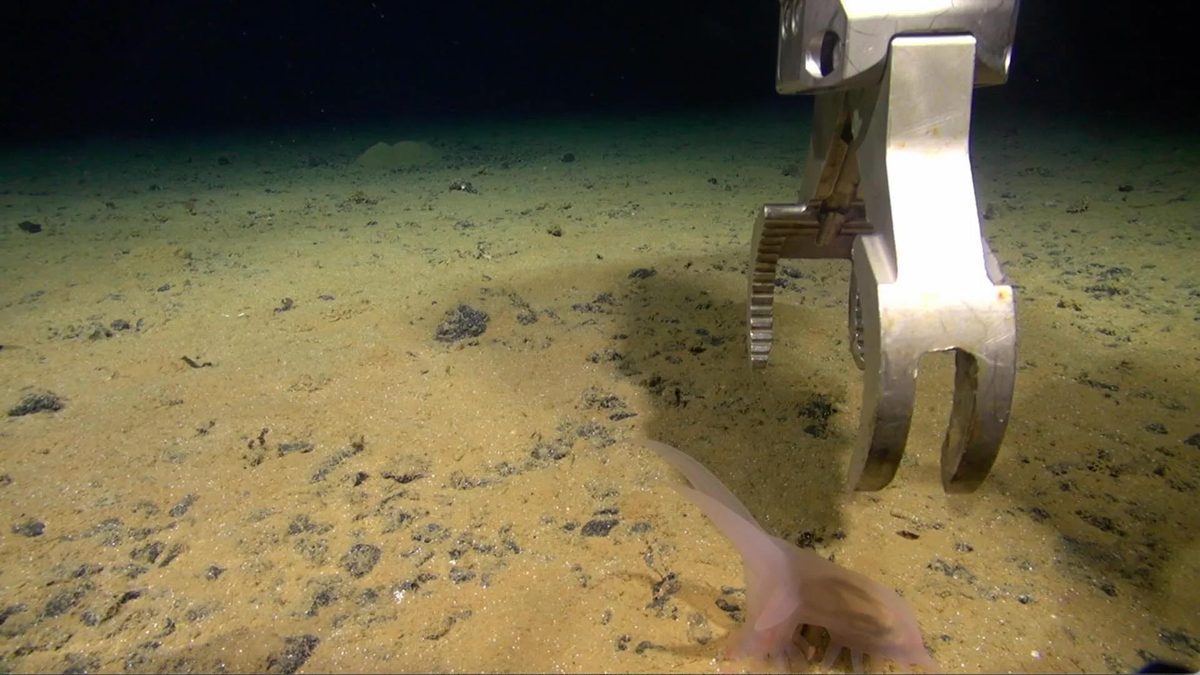
A global team of scientists have spent 160 days at sea and over five years documenting hundreds of previously unknown species on the ocean floor.
The team used a remotely operated vehicle (ROV) to collect samples in the Clarion-Clipperton Zone (CCZ), a vast region between Mexico and Hawai‘i in the Pacific Ocean.
“I have been working in the Clarion-Clipperton Zone for over 13 years,” says marine biologist Thomas Dahlgren, from the University of Gothenburg, who participated in the project. “And this is by far the largest study that has been conducted.”
The research was driven by increased interest in commercial deep-sea mining in the area. Some metals being used in the transition to green energy are found on the deep-sea floor as polymetallic nodules: small rocks that naturally form from seawater at the bottom of the ocean, which contain different metals.
Tests of nodule-mining vehicles have been carried out in the Pacific and Indian Ocean since the 1970s. However, there has been little research into the environmental impact of this mining. The study’s authors state that seven disturbance experiments measuring this have been published, all with mixed results.
Exploring the Clarion–Clipperton Zone
In 2022, a large-scale test of a commercial deep-sea mining machine was undertaken at a depth of 4,280 metres in the CCZ, recovering over 3,000 tonnes of polymetallic nodules.
For this study, the team collected samples at three points before the collector test and again two months after the collector test.
All the samples were initially sent to the Natural History Museum, London, to be sorted. After this, the samples were sent for identification at the University of Gothenburg (Sweden) and National Oceanography Centre (Southampton, UK), while others remained at the Natural History Museum.
The results, published in Nature Ecology and Evolution, reveal that the ROV collected 4,350 animals larger than 0.3 mm living in and on the seabed (referred to as macrofauna).
From these samples, 788 previously unknown species were identified – with most being marine bristle worms, crustaceans and molluscs. A new solitaire coral was also identified.
The team discovered that immediately following impact, macrofaunal densities decreased by 37 per cent within the path of the nodule collector. In comparison, densities within the control sites remained unchanged or even increased.
They also found a significant decrease (32 per cent) in species richness and diversity within the mining tracks left by the mining machine.
There is currently very limited data on whether diversity will completely recover after nodule mining, with the researchers highlighting the need for longer-term monitoring of these sites.
“It is now important to try to predict the risk of biodiversity loss as a result of mining. This requires us to investigate the biodiversity of the 30 per cent of the Clarion-Clipperton Zone that has been protected, says Adrian Glover, senior author from the Natural History Museum of London. “At present, we have virtually no idea what lives there.”
Top image: collection of a sea pig crawling across the nodule-covered seafloor in the Clarion–Clipperton Zone. Credit: ROV Isis/SMARTEX