
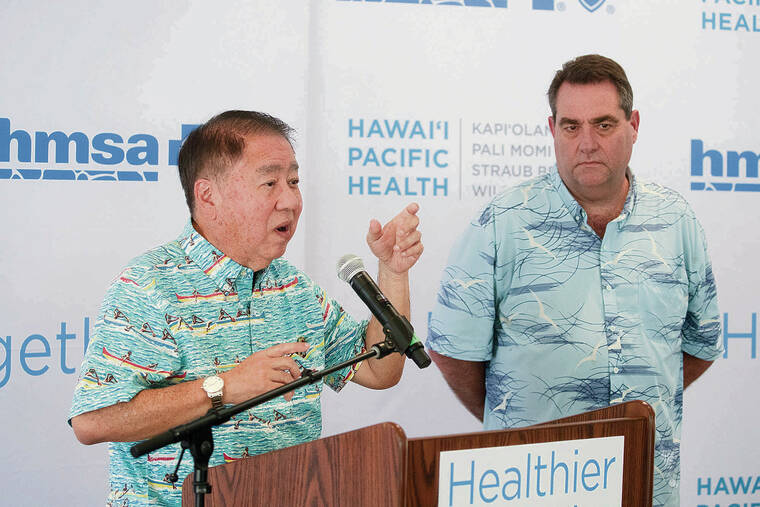
Two dominant players in Hawaii’s health care landscape continue to press forward on their plans to form a partnership.
Ray Vara, president and CEO of Hawai‘i Pacific Health, and Dr. Mark Mugiishi, president and CEO of Hawaii Medical Service
Association, expect to soon file paperwork for the deal with state and federal
agencies.
HPH and HMSA, an independent Blue Cross and Blue Shield licensee, in January formally announced plans to form a partnership under a new entity, One Health Hawaii, vertically integrating the state’s largest health insurer with one of its largest health care providers.
During a meeting with the Honolulu Star-Advertiser
editorial board on Tuesday, they said their motives were simple: to fix a broken system and improve affordability and accessibility to health care in Hawaii.
“Health care in our community has truly become unsustainable,” Vara said. “If you think about what our community members, our employers, have been dealing with over the course of many years now — are what have become norms — double-digit increases to the cost of health care.”
These range from 12% on average to as high as 30% and beyond annually, he said. At the same time, providers and health insurers are also feeling the stress from rising costs.
Don’t miss out on what’s happening!
Stay in touch with breaking news, as it happens, conveniently in your email inbox. It’s FREE!
In 2025, he said, for the first time he is aware of during his executive tenure, every single health care system in Hawaii lost money, including HPH, which lost money for the first time in nearly 20 years.
“And frankly, it’s ripe for change — a change that isn’t in slow, incremental steps,” he said. “It’s large-scale, structural change, which is exactly what we’re proposing with One Health Hawaii.”
Health insurers are struggling, too, according to Mugiishi. He noted that three Blue Cross Blue Shield plans on the mainland were acquired last year due to
financial struggles.
“Our organizations got
together to figure out a local solution,” he said, “where two local, not-for-profits can build resilience for Hawaii — in our neighborhood, at least.”
Under one entity, there will be trust, an alignment of goals, and a reduction in administrative burdens, Mugiishi said, resulting in better coordination of care. The integration is expected to save more than $2 billion over
10 years.
The Queen’s Health
Systems, another major player in Hawaii’s health care landscape, opposes
the integration.
Queen’s has launched its own campaign against the move, warning of unintended consequences for Hawaii’s families and
businesses that could deepen already unacceptable gaps in care.
“Experience from other states shows that when insurers and care providers merge, costs rise, access narrows, and the community ultimately loses,” wrote Queen’s. “And when one entity gains control over both the financing and delivery of care, critical services can be pulled away from the hospitals that depend on them to stay open. These are exactly the kind of unintended consequence other states have seen.”
Queen’s said furthermore that Hawaii’s independent hospitals and rural communities could be placed under new financial pressure, small businesses could face premium increases they cannot absorb, and families could see fewer local care options.
During a legislative briefing last month, some state lawmakers also voiced concern over whether One Health Hawaii would become a preferred network
or steer patients to HPH hospitals. Some were concerned the new entity could “cherry-pick” patients with better insurance coverage, leaving other hospitals to bear the burden of caring for more vulnerable patients at greater costs.
Queen’s officials argued the move would negatively affect vulnerable populations such as Native Hawaiians, kupuna, and those relying on Medicare and Medicaid, and that they would bear the brunt of
rising costs and restricted access.
Queen’s President and CEO Jason Chang testified before a state Legislature joint briefing that commercially insured patients help fund critical services such as trauma care, and that a 1% shift in this market share is equivalent to a $9 million loss for Queen’s. Thus, a
5% shift would result in a $45 million loss.
But HPH and HMSA insist this will not be the case, as other hospitals and insurance payers are invited to be part of their network.
HPH hospitals also serve as a safety net for vulnerable patients, Vara said, with emergency rooms that serve a high volume of patients. The Kapi‘olani Medical Center for Women &Children does not divert patients either, as the only specialized children’s hospital in the state.
The network’s model of care, however, will be a “value-based” one that ties provider payments to patient health outcomes. Rather than a “fee-for-service” model, the “value-based” plan is a per-member-per-month, fixed amount for a set time.
HPH in 2022 adopted
the “value-based” model, which it calls a “healthier community” strategy, and successfully lowered the rate of premium increases, according to Vara.
Value-based plans, however, have not been popular with Hawaii’s primary care providers or private practice physicians. Some private practice physicians have expressed concerns about the HPH-HMSA partnership, pointing to studies that show vertical integration is frequently associated with higher costs, reduced competition and risks to access, especially in small, highly concentrated markets such as
Hawaii. Studies have also shown integration shifts care from physician offices to hospital outpatient departments, they say, where prices are significantly higher.
HMSA insures more than 750,000 people statewide, while HPH operates major hospitals including Kapi‘olani Medical Center for Women &Children, Pali Momi Medical Center, Straub Medical Center and Wilcox Medical Center on Kauai.
The proposed partnership requires regulatory approval by state and federal agencies including the U.S. Department of Justice, and a possible certificate of need from the Hawaii State Health Planning and Development Agency.
Vara said the partnership is expected to take between six to 18 months or more to finalize.