
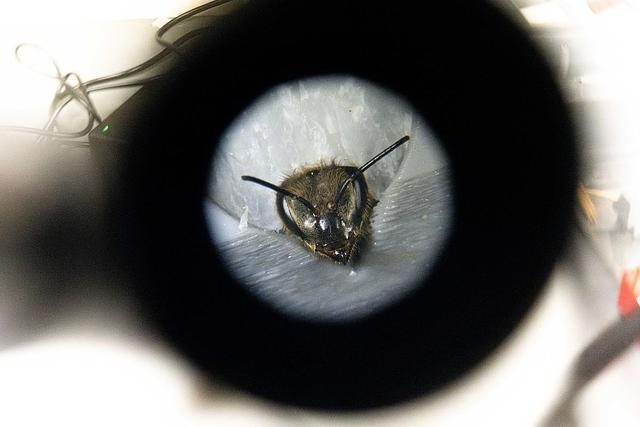
The work builds on Montague’s earlier research on bee learning. In a paper published in Nature in 1995 that has been cited more than 400 times, Montague and colleagues devised a computer model that predicts how signals from a specific individual neuron helps bees forage in unknown environments by learning which sights and smells are worth pursuing.
That work was based on the earlier contributions of the late neuroscientist Martin Hammer, whose research advanced scientific understanding of the neural mechanisms of learning and memory in insects.
Bees live relatively short lives in complex social systems and offer researchers a model to study cognition in natural and lab settings.
The insects are surprisingly sophisticated.
“A bee cannot come into the world knowing what it has to know in order to find flowers and harvest nectar and pollen,” Smith said. “In addition, a forager bee has a lifespan measured in weeks, all spent within a three- to five-mile radius of its colony. That’s a huge area for an animal with a tiny brain.”The environment is also constantly changing, with flowers blooming and declining over hours and days and weeks.
“That bee has to be a learning machine,” Smith said. “You have to be prepared to forget what you learned yesterday and learn something new today. And if they can’t do that, they’ll never be able to perform their task within the colony.”
In Montague’s computational model of learning, bees learn from a series of successive predictions that may lead to reward.
“Bees have sophisticated systems for pursuing this,” said Montague, who is also a professor in the Department of Physics within the College of Science. “They can use the systems to make cautious or risky choices.”
The models matched the way the insects behaved in observed experiments. “I applied it to the bee brain and showed that you could, in theory, guide the bee from flower to flower in a way that completely matched the statistics of foraging of the bee,” he said.
From humans to bees
During a visit with Smith and his colleagues at Arizona State University, Montague shared his latest research into new methods that he and his team at Virginia Tech had made to make real-time, sub-second measurements of monoamines, including dopamine and serotonin, in human patients undergoing deep-brain stimulation treatment for Parkinson’s disease and essential tremor.
Smith was familiar with Montague’s 1995 paper. His own research focuses on learning and memory in insects and mammals, including how animals learn about odors — research that can help inform neurological conditions.
When Smith learned about Montague’s groundbreaking work in humans, he reached out with a question.
Could Montague put his electrodes in a bee brain?
Soon after, Smith and his bees were on a plane to the research institute in Roanoke.
Montague’s earlier work had been theoretical.
“We didn’t even have a method to measure monoamines and bee brains,” Montague said. “Now we’ve taken this work in humans and we’ve transported it back down to teeny tiny electrodes that we can put in a bee brain while the bee is learning and conditioning.”
Even though their brains are small, bees have a lot to teach humans.
“We’re trying to push the bee as a model for some surprisingly sophisticated kinds of learning and memory tasks,” Smith said. “I’ve always been interested in being able to measure these neurochemicals as they’re released in real time to understand what kind of signals they give rise to that cause a neural network to go into one state or another. To remember something, or literally to forget something.”
Related brain chemicals are at play in addiction, major depression, and attention deficit disorder, among other conditions. These ancient chemicals and systems have evolved in bees over 130 million years.
“These are evolutionarily very, very old systems that we still have in our brains,” Montague said. “You can condition the bee on stimuli in the world that are relevant in a person.”
The chemical-learning connection
Honey bees are a well-established model for studying learning because they rapidly form associations between odors and food rewards. In the Roanoke lab, researchers studied the proboscis extension response in which a bee extends its feeding tube when it learns that a particular odor predicts sugar.
Seth Batten, a senior research associate in Montague’s lab, had experience measuring neurotransmitters in several organisms. “But never in a bee,” he said. “Not only was it a fun and challenging engineering feat to create systems that could take the measurements in such a small brain, but it was remarkable to see how complex these creatures were and how quickly some of them learned.”
While some bees learned after only a few odor-reward pairings, others require many repetitions or never learn in the same timeframe.
Researchers recorded sub-second estimates in four key neurotransmitters important to bees’ sensory processing and learning: dopamine, serotonin, tyramine, and octopamine. The measurements were taken from the antennal lobe, an early processing center for smell, using a machine-learning technique that tracks multiple chemicals simultaneously.
They found that bees could be grouped into learners and non-learners based on whether they developed a conditioned response to odor. Among bees that learned, some formed the association after only three odor-and-sugar trials, while others required up to eight. That variation was strongly linked to the timing and strength of antagonistic signals between octopamine and tyramine.
Bees with an earlier, stronger signal during their first exposure to an odor tended to learn faster once rewards were introduced. This relationship held even though the odor had not yet been paired with sugar.
The same push-and-pull pattern between octopamine and tyramine appeared again when bees first showed a learned response, and it still reflected how quickly they learned. Dopamine and serotonin did not show this pattern.
As learning progressed, neurotransmitter patterns continued to diverge between learners and non-learners. In bees that learned, octopamine and tyramine responses changed markedly after the learned behavior appeared, while dopamine and serotonin levels gradually declined across training. Non-learners showed little change over time.
The findings suggest that signaling between octopamine and tyramine plays a central role in setting learning sensitivity and regulating how long learning continues once an association is formed.
“In terms of biomedicine, understanding neural networks gives us some insight into how larger brains work,” Smith said.
In addition to informing basic science and human and animal health, the research has implications for the food supply because of bees’ role as pollinators. “So much of our agriculture is dependent on bees,” Smith said.
The research was supported with funding from the U.S. National Science Foundation, the U.S. Department of Energy, the National Institutes of Health, the Max Planck Society, the Humboldt Foundation, the Lundbeck Foundation, the Virginia Tech Seale Innovation Award, the Wellcome Trust, the Wellcome Centre for Human Neuroimaging, the Swartz Foundation, and The Red Gates Foundation.
Original study: https://doi.org/10.1126/sciadv.aea8433
Additional authors:
Paul Sands, research assistant professor, Fralin Biomedical Research Institute at VTC, Virginia Tech
Hong Lei, research professor, School of Life Sciences, Arizona State University
Seth R. Batten, senior research associate, Fralin Biomedical Research Institute at VTC, Virginia Tech
Alec Hartle, senior research associate, Fralin Biomedical Research Institute at VTC, Virginia Tech
Terry Lohrenz, research associate professor, Fralin Biomedical Research Institute at VTC, Virginia Tech
Leonardo Barbosa, research assistant professor, Fralin Biomedical Research Institute at VTC, Virginia Tech
Dan Bang, Fralin Biomedical Research Institute at VTC, and Center of Functionally Integrative Neuroscience, Aarhus University, Aarhus, Denmark
Peter Dayan, Max Planck Institute for Biological Cybernetics, and University of Tubingen, Tubingen, Germany
Matt Howe, assistant professor, School of Neuroscience, Virginia Tech