
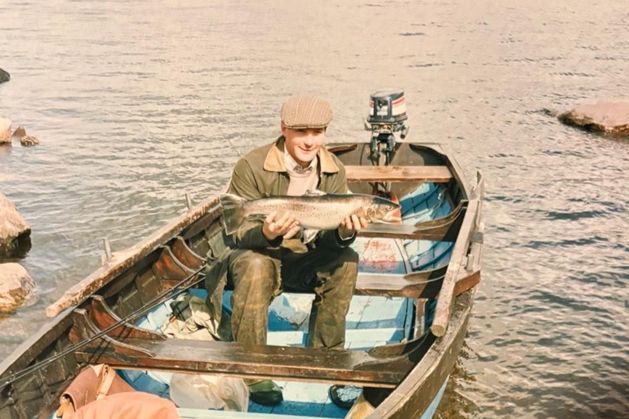
In investigating the issue, the Inland Fisheries Institute (IFI) has raised concerns over a local fish farm.
Figures from a fish counter in Waterville, a once renowned angling destination, shows sea trout stocks have decreased by 95.6 per cent since 2002.
Nearly 28,000 individuals of the species were detected in 2002, while only 1,236 were sighted in 2022.
The counter in the Currane River is operated by the Inland Fisheries Institute (IFI) and forms part of their investigation into the collapse of stocks at the Lough Currane fishery.
A range of traditional and advanced research techniques are all aggregated to build up a picture of the causal factors associated with stock’s decline.
The same data shows wild salmon stocks down 85 per cent in the same 20-year period, from an annual count of 5,579 to just 837.
Of “serious concern”, say the IFI, is the renewal of Norwegian fish farm operator Mowi’s license at Deenish Island, only 10.8km away.
Worries centre on the impact of farm generated sea lice on wild fish, with numerous research papers pointing to potentially significant damaging effects.
Dr Paddy Gargan, a retired researcher at the Inland Fisheries Institute, recently released a landmark study on the effect of sea lice on salmon stocks.
His paper showed that increased sea lice populations from nearby fish farms can have significant effects on young wild salmon (smolts) and he believes it should change current government licensing policy.
“The whole issue now will have to be taken more seriously, because we’ve shown clearly that the returns of untreated (without anti-lice treatment) salmon smolts will decrease by at least 18 per cent,” said Dr Gargan.
“All applications for renew or new salmon would have submitted that there’s no impact of sea lice on wild salmon or sea trout, but with that new paper that we’ve published that will have to be reviewed.”
The findings might be unsurprising to much of the Irish angling community, but government policy has been for years that farm-generated sea lice has little to no impact on wild fish.
Dr Gargan said the source of much of the dogma can be found from a government funded researcher’s paper from 2013.
Marine Institute researcher, Dave Jackson, wrote the following: “…while sea lice-induced mortality on outwardly migrating smolts can be significant, it is a minor and irregular component of marine mortality…”
This ambiguous sentence, that on the one hand suggests sea-lice impact can be “significant” but at the same time upholds that it is “minor and irregular”, has been a boon to aquaculture companies and their lawyers for years.
“They [aquaculture companies] would say that they’ve reviewed the literature that is available, and they’ve come down on the assessment that there’s no significant impact,” said Dr Gargan.
Kerry County Councillor Norma Moriarty said the decline of fish at Waterville was “startling” and emphasised the need to protect the county’s angling industry.
“It is really and truly wrong that we’re allowing this to happen,” she said.
“The public needs to be conscious of what goods they’re buying. That kind of consumer awareness is important, and they need to insist on ethically produced food, and food which is not damaging to the environment.”
Funded by the Local Democracy Reporting scheme