
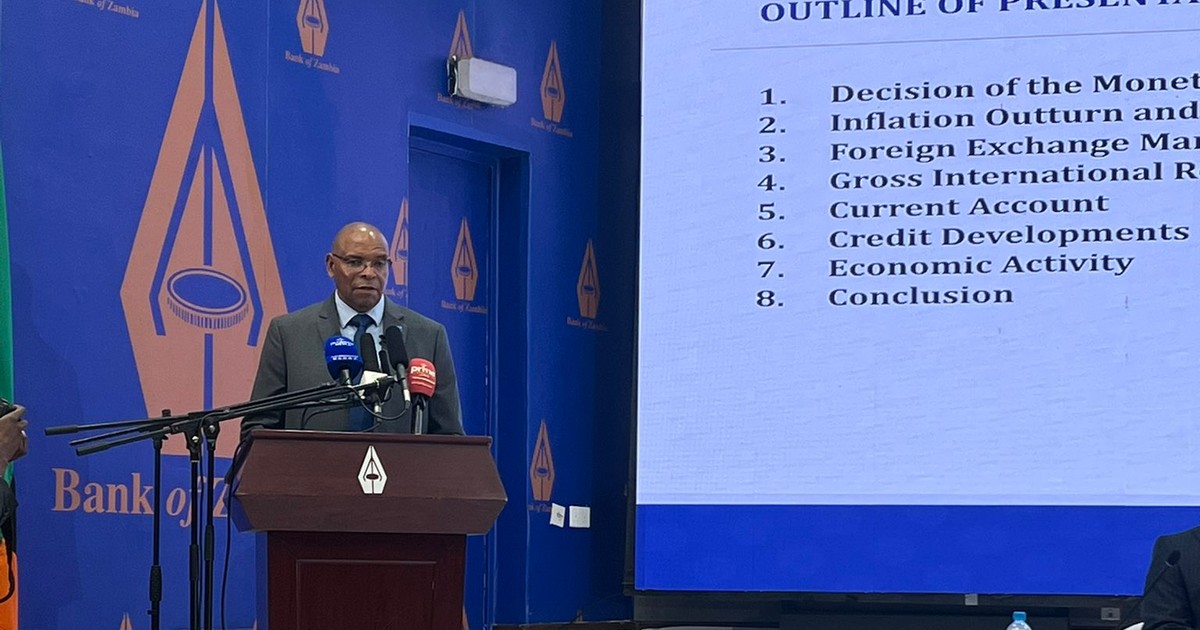
The Bank of Zambia on Wednesday reduced its Monetary Policy Rate from 14.25 per cent to 13.5 per cent, marking its second consecutive cut.
The decision followed a sharp easing in inflation to 9.4 per cent in January, supported by a bumper maize harvest and a stronger kwacha.
Officials now project that inflation could return to the 6–8 per cent target range sooner than previously expected, possibly by the second quarter of the year.
The move is significant because inflation had remained above the upper band of the central bank’s target range since May 2019.
Persistent exchange rate volatility, energy price adjustments, rising food prices and global supply chain disruptions kept price pressures elevated for years, forcing policymakers to maintain a tight monetary stance.
The recent moderation marks a potential turning point after an extended period of aggressive tightening aimed at restoring price stability and rebuilding confidence in the currency.

The most immediate impact of a rate cut is on borrowing costs.
Although policy changes do not always translate instantly into lower commercial lending rates, they typically create downward pressure on the cost of credit.
Businesses may find it easier to secure loans for expansion and working capital, while households could eventually benefit from cheaper mortgages and personal loans.
Nigerian economist Aliyu Ilias describes the move as providing “breathing space for citizens”, arguing that lower rates increase disposable income and purchasing power, which in turn supports economic growth.
He notes that interest rates across much of Africa remain structurally high, limiting industrial expansion and long-term development. In his view, Zambia’s reduction is not a token adjustment but a meaningful step in the right direction.
Still, the speed at which commercial banks adjust their lending rates will depend on their liquidity positions and risk assessments.

The implications extend beyond households and businesses. Zambia’s government is still managing the broader consequences of its 2020 default, even as it continues to make progress with international creditors.
In November 2025, the country received a significant lift when S&P Global Ratings moved it out of default status and assigned a ‘CCC+’ long-term foreign currency rating, signaling a gradual rebuilding of confidence in its economic outlook.
Against this backdrop, lower domestic interest rates ease the cost of issuing Treasury bills and bonds, giving authorities some breathing space as they try to balance fiscal consolidation with the need to support a recovering economy.
There is also the question of the currency. In many economies, rate cuts can weaken the local unit by reducing returns for foreign investors. However, Zambia’s position appears more nuanced.
The kwacha has rallied approximately 14.2 per cent against the US dollar since the beginning of the year, supported by robust foreign exchange inflows from the mining sector and foreign financial institutions, including the impact of the recent reforms, such as the issuance of Currency Directives.
The appreciation has lowered the cost of imported goods, including fuel, machinery and food products.
Non-resident investors have reportedly increased their holdings of government securities by about K4.2 billion to K65.7 billion in recent months, signaling renewed confidence
In addition, restrictions on the use of foreign currency in domestic transactions have helped strengthen demand for the kwacha.
While global commodity price movements and external financial conditions remain key risk factors, the currency’s recent stability provides policymakers with some room to ease.

Inflation dynamics remain central to the outlook. The decline to 9.4 per cent marks the first time in nearly three years that inflation has fallen below double digits.
If improved food supply, stable fuel prices and continued currency strength persist, consumers could see slower price increases and a gradual improvement in purchasing power.
However, developments in global oil markets, agricultural output and supply chain conditions will continue to shape the inflation trajectory.
The rate cut may also help revive credit growth. Domestic credit expanded by 14.4 per cent in December, down from 17.4 per cent in September, indicating some moderation in lending momentum.
A more accommodative policy environment could encourage banks to extend credit more confidently and businesses to borrow for investment.
If banks increase their lending, sectors such as agriculture, retail and construction could pick up again, helping to create more jobs.
Regionally, Zambia’s move comes at a time when African central banks are sending mixed signals.
The Bank of Uganda recently held its benchmark rate at 9.75 per cent, citing a stable inflation outlook.
Meanwhile, Nigeria’s central bank is scheduled to hold its 304th Monetary Policy Committee meeting on February 23–24, 2026, with investors closely watching for guidance.
Against this backdrop, Zambia’s easing cycle positions it among the few African economies shifting towards more supportive monetary conditions.
Overall, the decision shows cautious optimism. After years marked by inflation pressure, exchange rate instability and debt restructuring challenges, the Bank of Zambia appears confident that the worst phase of the inflation cycle may be over.
If the kwacha remains stable, inflation continues to ease and investor confidence strengthens, the country could enter a more favourable growth phase in 2026.
However, vulnerabilities remain. Zambia’s economy is still heavily dependent on copper exports, leaving it exposed to global commodity price swings.
External financing conditions, fuel costs and the pace of debt negotiations will continue to influence macroeconomic stability.
For now, the 75-basis-point cut represents more than a routine policy adjustment.
It shows a shift towards growth support while attempting to preserve hard-won stability. Whether it translates into stronger investment, more credit access and improved living standards will depend on how effectively monetary easing feeds through to the real economy in the months ahead.